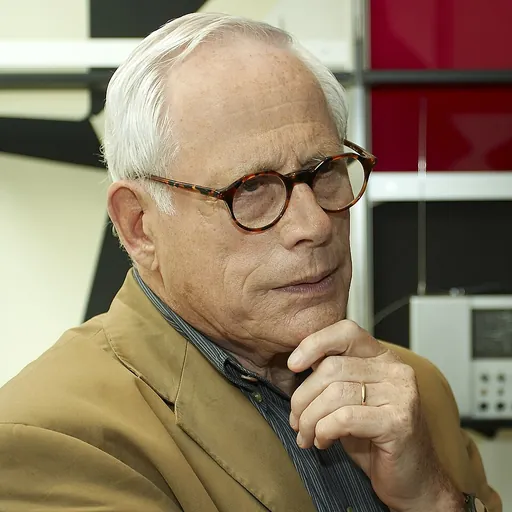
About Dieter Rams
Born 1932. Dieter Rams is a German industrial designer, architect, designer, university teacher, interior architect and joiner, known for Braun (company).
Dieter Rams (born 20 May 1932) is a German industrial designer who is most closely associated with the consumer products company Braun, the furniture company Vitsœ, and the functionalist school of industrial design. His unobtrusive approach and belief in "less, but better" design has influenced the practice of design, as well as 20th century aesthetics and culture. He is quoted as stating that "Indifference towards people and the reality in which they live is actually the one and only cardinal sin in design."
Early life and education Dieter Rams was born in Wiesbaden, Germany, in 1932. He began his studies in architecture and interior decoration at Wiesbaden School of Art (now part of the RheinMain University of Applied Sciences) in 1947. A year later, he took a break from studying to gain practical experience and finish his carpentry apprenticeship. He returned to the Wiesbaden School of Art in 1948 and graduated in architecture with honours in 1953, after which he began working for Frankfurt-based architect Otto Apel. In 1955, at the age of 23, he was recruited by Braun as an architect and interior designer. Speaking with Alessandro Mendini years later, Rams recalled this period at Braun as having been "marked by the Ulm school, through Hans Gugelot, in the sphere of product design and Otl Aicher in that of graphic design." He went on to say that "My own work and that of my group would have been unthinkable without the way paved by them."
Gugelot, Rams, and their colleagues designed many products for Braun including the radiogram and the 'D'-series (D 45, D 46) of 35mm film slide projectors. The SK 4, known as the "Snow White's coffin," is considered revolutionary because it transitioned household appliance design away from looking like traditional furniture. By producing electronic gadgets that were remarkable in their austere aesthetic and user friendliness, Rams made Braun a household name in the 1950s.
In 1968, Rams designed the cylindric T2 cigarette lighter. A member of Braun's board had asked him for a design; Rams replied, "only if we design our own technology to go inside them." Successive versions of the product went on to use then-current motorcycle-like magnetic ignition, followed by piezoelectric, and finally solar-powered mechanisms.
Vitsœ
In 1959, Rams began a collaboration with Vitsœ, at the time known as Vitsœ-Zapf, which led to the development of the 606 Universal Shelving System, which is still sold today, with only minor changes from the original. He also designed furniture for Vitsœ in the 1960s, including the 620 chair collection.
Influence His approach to design and his aesthetics influenced Apple designer Jonathan Ive and many Apple products pay tribute to Rams's work for Braun, including Apple's iOS calculator, which references the 1987 ET66 calculator, and prior to a redesign, the appearance of the playing screen in Apple's Podcast app mimicked the appearance of the Braun TG 60 reel-to-reel tape recorder. The iOS 7 world clock app closely mirrors Braun's clock and watch design, while the original iPod closely resembles the Braun T3 transistor radio. In a 2010 interview with Die Zeit, Rams mentions that Ive personally sent him an iPhone "Along with a nice letter. He thanked me for the inspiration that my work was to him".
The designer Jasper Morrison has spoken of his grandfather's Rams designed Braun "Snow White's Coffin" being an "important influence on [his] choice in becoming a designer." According to Rams, "good design":
is innovative – The possibilities for progression are not, by any means, exhausted. Technological development is always offering new opportunities for original designs. But imaginative design always develops in tandem with improving technology, and can never be an end in itself. makes a product useful – A product is bought to be used. It has to satisfy not only functional, but also psychological and aesthetic criteria. Good design emphasizes the usefulness of a product whilst disregarding anything that could detract from it. is aesthetic – The aesthetic quality of a product is integral to its usefulness because products are used every day and have an effect on people and their well-being. Only well-executed objects can be beautiful. makes a product understandable – It clarifies the product’s structure. Better still, it can make the product clearly express its function by making use of the user's intuition. At best, it is self-explanatory. is unobtrusive – Products fulfilling a purpose are like tools. They are neither decorative objects nor works of art. Their design should therefore be both neutral and restrained, to leave room for the user's self-expression. is honest – It does not make a product appear more innovative, powerful or valuable than it really is. It does not attempt to manipulate the consumer with promises that cannot be kept. is long-lasting – It avoids being fashionable and therefore never appears antiquated. Unlike fashionable design, it lasts many years – even in today's throwaway society. is thorough down to the last detail – Nothing must be arbitrary or left to chance. Care and accuracy in the design process show respect towards the consumer. is environmentally friendly – Design makes an important contribution to the preservation of the environment. It conserves resources and minimizes physical and visual pollution throughout the lifecycle of the product. is as little design as possible – Less, but better. Simple as possible but not simpler. Good design elevates the essential functions of a product.
Exhibitions and recognition
Rams has been involved in design for seven decades and has received many honorary appellations throughout his career. 1961: TP1 portable record player and radio received Supreme Award at Interplas exhibition, London 1963: F21 received ‘Supreme Award’ at Interplas exhibition, London 1965: Berliner Kunstpreise 'Bildende Kunst, Junge Generation' (with Reinhold Weiss, Richard Fischer, and Robert Oberheim) 1968: Honorary Member, Royal Designers for Industry of the British Royal Society of Arts 1969: 620 chair awarded gold medal at the International Furniture Exhibition in Vienna 1978: Awarded SIAD Medal of the Society of Industrial Artists and Designers, UK 1985: Awarded Académico de Honor Extranjero by the Academia Mexicana de Diseño, Mexico 1989: First recipient of the Industrie Forum Design Hannover, Germany, for special contribution to design 1989: Awarded Doctor honoris causa by Royal College of Art, London, UK 1992: Received Ikea prize and uses prize money for his own Dieter and Ingeborg Rams Foundation for the promotion of design 1996: Received World Design Medal from the Industrial Designers Society of America 2002: Awarded Commander's Cross of the Order of Merit of the Federal Republic of Germany 2003: Received Design Award ONDI, Havana, Cuba for his special contribution to industrial design and world culture 2007: Awarded Design Prize of the Federal Republic of Germany for his life’s work 2007: Received from the Raymond Loewy Foundation 2009: Awarded the great design prize in Australia. 2010: Kölner Klopfer prize awarded by the students of the Cologne International School of Design 2012: Red Dot Design Award and iF Product Design Award, for the BN0106 digital chronograph 2013: Awarded Lifetime Achievement Medal at London Design Festival 2014: Compasso d'Oro Career Award from the Associazione per il Disegno Industriale (ADI), Milan 2024: He became the first recipient of the iF Design Lifetime Achievement award 2024: DesignEuropa lifetime achievement award 2025: The World Design Organisation awarded the World Design Medal to 93-year-old Dieter Rams for being "one of the most influential design voices of the 20th century, having set new standards for clarity, functionality and timelessness in design."
Less and More exhibition Less and More is an exhibition of Rams's landmark designs for Braun and Vitsœ. It first traveled to Japan in 2008 and 2009, appearing at the Suntory Museum in Osaka and the Fuchu Art Museum in Tokyo. Between November 2009 and March 2010 it appeared at the Design Museum in London. It appeared at the Museum für Angewandte Kunst in Frankfurt from July to September 2010. The exhibit then appeared at the San Francisco Museum of Modern Art from August 2011 to February 2012.
Rams documentary On 22 June 2016, filmmaker Gary Hustwit announced his documentary Rams and launched a Kickstarter campaign for the project. The full-length documentary features in-depth conversations with Rams about his design philosophy, the process behind some of his most iconic designs, his inspiration and his regrets. Some of the funds raised in the Kickstarter campaign also helped to preserve Rams's design archive in cooperation with the Dieter and Ingeborg Rams Foundation.
Dieter Rams. Modular World In 2016, the Vitra Design Museum staged an exhibition titled "Dieter Rams. Modular World" focusing on Rams "obsession with grids and shelving".
Dieter Rams. A Style Room In 2022, the Museum für Angewandte Kunst in Frankfurt updated and expanded its permanent display titled "Dieter Rams. A Style Room" to mark the designer's 90th birthday. The exhibit also includes photographs by Ram's wife Ingeborg.
Dieter Rams. Looking back and ahead exhibition In 2021 an exhibition of approximately 30 works, 100 photographs, and information panels opened at the Museum Angewandte Kunst. The exhibit was subsequently on view at the Goethe Institute in New York in 2022, and the ADI Design Museum in Milan in 2023.
In popular culture Furniture and objects designed by Rams are used on the sets of the American television series Severance. Jeremy Hindle, the production designer for the series described the show's aesthetic as having "a Dieter Rams look to it.”
Personal life Rams met his wife in 1955 while she was working as a photographer for Braun.
Gallery of works
Don’t just read it —
keep it.
Full-length biographies made to live with: read them, listen on the way to work, watch them tonight.
- E-book
- Audio
- Video
Instant download · yours to keep · every purchase keeps this site free
Important facts
People in Dieter Rams's life
Named in this biography and alive at the same time







Related people
Same field, nearest in time





Contemporaries
People whose lives overlapped Dieter Rams's

Frequently asked questions
Who is Dieter Rams?
German industrial designer (born 1932)
When was Dieter Rams born?
Dieter Rams was born on 20 May 1932 in Wiesbaden.
What is Dieter Rams's occupation?
Dieter Rams is an industrial designer, architect, designer, university teacher, interior architect and joiner.
What is Dieter Rams known for?
Dieter Rams is known for Braun (company).
What nationality is Dieter Rams?
Dieter Rams is German.
Sources & further reading
Cite this page
APA: Biography.guide. (2026). Dieter Rams. https://biography.guide/dieter-rams/
MLA: "Dieter Rams." Biography.guide, https://biography.guide/dieter-rams/.
Chicago: "Dieter Rams." Biography.guide. https://biography.guide/dieter-rams/.
Data last updated: 2026-09-22 · Spot an error? Report a correction.
Portrait: Wikimedia Commons · author & licence
Page generated 2026-09-27 05:02 UTC