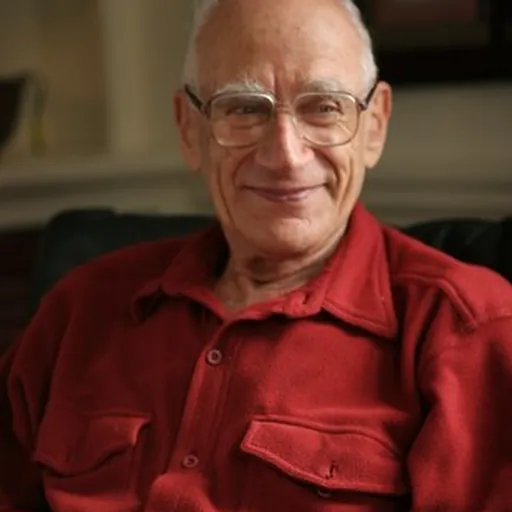
Daniel Kan
Mathematician, prolific contributor to homotopy theory
About Daniel Kan
Lived 1927 – 2013 (aged 86). Daniel Kan was a Dutch, Israeli and American mathematician and topologist, known for Dold–Kan correspondence, Kan extension and Kan fibration.
Daniel Marinus Kan (or simply Dan Kan) (August 4, 1927 – August 4, 2013) was a Dutch mathematician working in category theory and homotopy theory. He was a prolific contributor to both fields for six decades, having authored or coauthored several dozen research papers and monographs.
Career Daniel Kan was born into a Jewish family. During World War II, Kan and his family were interned at the Bergen-Belsen concentration camp. Although the family survived the internment, his parents died of dysentery shortly after the camp's liberation, leaving Kan orphaned. He received his Ph.D. at Hebrew University in 1955, under the direction of Samuel Eilenberg. His students include Aldridge K. Bousfield, William Dwyer, Stewart Priddy, Emmanuel Dror Farjoun, and Jeffrey H. Smith. He was an emeritus professor at the Massachusetts Institute of Technology where he taught from 1959, formally retiring in 1993.
Work He played a role in the beginnings of modern homotopy theory similar to that of Saunders Mac Lane in homological algebra, namely the adroit and persistent application of categorical methods. His most famous work is the abstract formulation of the discovery of adjoint functors, which dates from 1958. The Kan extension is one of the broadest descriptions of a useful general class of adjunctions.
From the mid-1950s he made distinguished contributions to the theory of simplicial sets and simplicial methods in topology in general. In recognition of this, the usual closed model category structure on the category of simplicial sets is known as Kan–Quillen model structure, while its fibrations and fibrant objects are known as Kan fibrations and Kan complexes respectively.
Some of Kan's later work concerned model categories and other homotopical categories. Especially noteworthy are his work with Aldridge Bousfield on completions and homotopy limits, and his work with William Dwyer on simplicial localizations of relative categories.
Don’t just read it —
keep it.
Full-length biographies made to live with: read them, listen on the way to work, watch them tonight.
- E-book
- Audio
- Video
Instant download · yours to keep · every purchase keeps this site free
Important facts
People in Daniel Kan's life
Named in this biography and alive at the same time



Related people
Same field, nearest in time


Contemporaries
People whose lives overlapped Daniel Kan's

Frequently asked questions
Who was Daniel Kan?
mathematician, prolific contributor to homotopy theory (1927–2013)
When was Daniel Kan born?
Daniel Kan was born on 4 August 1927 in Amsterdam.
When did Daniel Kan die?
Daniel Kan died on 4 August 2013 in Newton.
What was Daniel Kan's occupation?
Daniel Kan was a mathematician and topologist.
What was Daniel Kan known for?
Daniel Kan was known for Dold–Kan correspondence, Kan extension, Kan fibration and Kan-Thurston theorem.
What nationality was Daniel Kan?
Daniel Kan was Dutch, Israeli and American.
Sources & further reading
Cite this page
APA: Biography.guide. (2026). Daniel Kan. https://biography.guide/daniel-kan/
MLA: "Daniel Kan." Biography.guide, https://biography.guide/daniel-kan/.
Chicago: "Daniel Kan." Biography.guide. https://biography.guide/daniel-kan/.
Data last updated: 2026-09-23 · Spot an error? Report a correction.
Portrait: Wikimedia Commons · author & licence
Page generated 2026-09-27 05:07 UTC