
About Coriolano Ponza di San Martino
Lived 1842 – 1926 (aged 83). Coriolano Ponza di San Martino was an Italian politician.
Coriolano Ponza di San Martino (Turin, 9 October 1842 – Cuneo, 6 January 1926) was an Italian general and politician. He was a senator of the Kingdom and served as Minister of War in the Pelloux II, Saracco and Zanardelli governments.
Early life to 1866 Coriolano was the son of Gustavo Ponza di San Martino, senator of the Kingdom of Sardinia and of the Kingdom of Italy and Minister of the Interior in the first Cavour government.
Military theory 1866-1882 Ponza di San Martino made a careful study of the Franco-Prussian War of 1870-1871. In 1874 he published a monograph entitled "Studies on the conduct of troops and second line services" (“Studi sulla condotta delle truppe e sui servizi di seconda linea”) which marked his espousal of Prussian-German military doctrine.
General Staff 1882-1887 Painting of the battle of Custoza. Coriolano Ponza Di San Martino is the mounted officer with his sword drawn. In 1882 he was invited to join the Artillery and Engineers Committee of the General Staff. He was first a member and then chief of the General Staff Division. The General Staff Division was directly dependent on the secretary general of the Ministry of War and acted as a military operations office with the task of implementing the plans prepared by the Command of the General Staff Corps. As a collaborator of the minister Emilio Ferrero and the general secretary Luigi Pelloux, Ponza di San Martino contributed to the planning and establishment of the new Army system, responding to the need to increase Italy’s "strategic power". From this period dates his close alignment with the so-called Cult of the offensive.
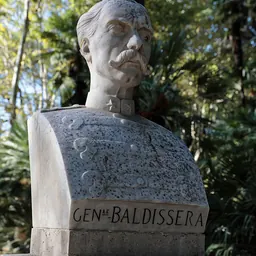
In 1885 he was first head of office C (library, history and archives) at the II Department of the General Staff and then posted in Berlin with the Italian Embassy. He was promoted to colonel in 1886. Ponza di San Martino commanded the Cacciatori d'Africa and the 7th Bersaglieri Regiment before returning to Italy at the end of 1888. His sketches were sent to Quinto Cenni and reproduced by him in his illustrations of the campaign. At the request of General Antonio Baldissera he reproduced the troop movements in the Battle of Segheneyti in a sketch which was sent to the Minister of War. Chief of Staff of the IX Army Corps in 1889, he was employed on a secret mission to Tunisia and Tripolitania in 1890 on the orders of Francesco Crispi to study the Ottoman defences and routes for a possible attack on the French border attack.
General Staff 1890-1900
In the years from 1889 to 1893 Coriolano Ponza di San Martino contributed to the Rivista Militare, writing articles on strategy, tactics and army culture. Promoted to major general commanding the Pistoia Brigade in 1894, to criticize it. Subsequently he was deputy commander of the General Staff Corps. At the General Staff he was a convinced advocate of the need to finish the fortification works on the eastern border, emphasising that although Italy was part of the Triple Alliance, a war with Austria-Hungary could not be ruled out. Indeed, upon assuming the office of Minister of War in 1900, one of the first measures he implemented was to order the resumption of fortification works on the Austro-Hungarian border.
Minister of War 1900-1902 Ponza di San Martino was invited to replace Giuseppe Mirri as Minister of War in April 1900, as part of an agreement between the parliamentary faction of Sidney Sonnino and the Prime Minister Luigi Pelloux. Not having been elected, he was created a Senator by Royal decree to allow for his appointment. As Minister Ponza di San Martino pushed forward with an “offensivist” transformation of Italian military doctrine and with a reform of the Officer Corps. Convinced of the need to strengthen Italy's position within the Triple Alliance, Ponza di San Martino saw the importance of a program of modernization of the Royal Italian Army and of collaboration with the Royal Navy, which he worked on with Navy Minister Enrico Morin.
Unlike most Italian officers, Ponza di San Martino was a supporter of recruitment on a territorial basis (in line with both the old program of the "military left" of Luigi Mezzacapo and Emilio Ferrero as well as with the Prussian military model). Among the strengths of establishing regiments locally was that it avoided separation between the resident population and soldiers and that it reduced mobilization time. and then with Giuseppe Zanardelli (in the case of the militarization of the railways) to bring forward a policy of "manu militari" repression of strikes while guaranteeing neutrality in disputes between workers and employers. At the time of his confirmation to the Ministry of War by Zanardelli, the newspaper L'Esercito italiano (organ of the offensivists and the "military left") expressed its support for him since he would guarantee the maintenance of the military budget with high levels of spending as well as the exclusion of the far left from military policy issues. Hostile to the idea of an "armed nation" advocated by the Historical Far Left, he opposed in Parliament the granting of rifles from the arsenals to local shooting clubs, one of the "flagship" measures of the democratic coalition. - starting the process which would come to fruition with the subsequent reforms of 1906 and 1908. In 1900 he secured a large five-year allocation of funds, thereby exempting the Ministry of War from having to account for individual expenditure items. This provision was in line with what had been obtained by the German generals a few years earlier and which strengthened the autonomy of the military from political constraints. In the field of colonial politics he reformed the Royal Corps of Colonial Troops ("Instructions relating to the Royal African Troops" 15 January 1902; RD no. 168 of 03/30/1902) and supported the need to guarantee the autonomy of commander of the troops in the Eritrean colony relative to the civil governor, clashing with Ferdinando Martini.
During his ministry an Italian expeditionary force was sent to China in response to the Boxer Rebellion, with Ponza di San Martino making both its strategic and tactical decisions. He enjoyed the full support first of King Umberto I and then of King Vittorio Emanuele III, so much so that the former imposed him as minister on Saracco and also made his reconfirmation a condition of his giving royal approval to the Zanardelli cabinet. Ponza di San Martino submitted his resignation as minister in protest at the concessions made to railway workers by Zanardelli and Giolitti. and his involvement in defense study commissions of the State until 1909, the year in which he left active service and dedicated himself to the management of the family properties into which he introduced innovative agricultural techniques. In 1901 he translated from German the work by R. Stutzer (Leipzig, 1895) "Guide to the study of fertilization for the use of farmers and agricultural schools". In 1913 he was a patron and founder member of the Unione Sportiva Pro Dronero together with his brother Cesare and Giovanni Giolitti who became its president. In 1914-1915 he was an interventionist with a national-conservative tendency.
During the First World War he still served as a member of important military commissions and as lieutenant general of the Territorial Militia at the Ministry of War. He was among the senators adhering to the Parliamentary Fascio for National Defence promoted by the nationalist Maffeo Pantaleoni after the battle of Caporetto to overcome the political crisis and continue the war until victory. A supporter of the break-up of Austria-Hungary, he joined the "Italian Committee for Czech-Slovak Independence" chaired by Pietro Lanza di Scalea, collaborating in the formation of the Czechoslovak Legion which fought alongside the Italian Army in the last phase of the Great War. In 1920, due to age limits, he ceased to be part of the Reserve, retaining the rank of lieutenant general and the related uniform. In the Senate he joined the liberal-democratic group, representing one of the exponents of the liberal-nationalist right of Salandra. In later years he joined the Democratic Union group born from the fusion between liberal democrats and social democrats, and then the Italian Liberal Party.
Honours
Don’t just read it —
keep it.
Full-length biographies made to live with: read them, listen on the way to work, watch them tonight.
- E-book
- Audio
- Video
Instant download · yours to keep · every purchase keeps this site free
Important facts
People in Coriolano Ponza di San Martino's life
Named in this biography and alive at the same time





Related people
Same field, nearest in time





Contemporaries
People whose lives overlapped Coriolano Ponza di San Martino's

Frequently asked questions
Who was Coriolano Ponza di San Martino?
Italian general and politician (1842–1926)
When was Coriolano Ponza di San Martino born?
Coriolano Ponza di San Martino was born on 9 October 1842 in Turin.
When did Coriolano Ponza di San Martino die?
Coriolano Ponza di San Martino died on 6 January 1926 in Cuneo.
What was Coriolano Ponza di San Martino's occupation?
Coriolano Ponza di San Martino was a politician.
What nationality was Coriolano Ponza di San Martino?
Coriolano Ponza di San Martino was Italian.
Sources & further reading
· Wikipedia: Coriolano Ponza di San Martino
· DBpedia: Coriolano Ponza di San Martino
Cite this page
APA: Biography.guide. (2026). Coriolano Ponza di San Martino. https://biography.guide/coriolano-ponza-di-san-martino/
MLA: "Coriolano Ponza di San Martino." Biography.guide, https://biography.guide/coriolano-ponza-di-san-martino/.
Chicago: "Coriolano Ponza di San Martino." Biography.guide. https://biography.guide/coriolano-ponza-di-san-martino/.
Data last updated: 2026-09-20 · Spot an error? Report a correction.
Page generated 2026-09-27 05:28 UTC