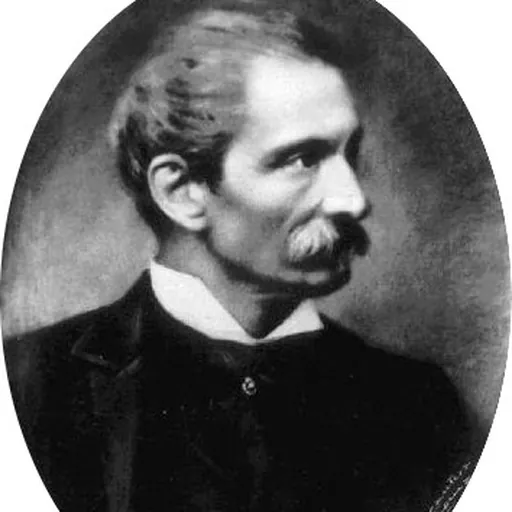
About Giuseppe Zanardelli
Lived 1826 – 1903 (aged 77). Giuseppe Zanardelli was an Italian politician and lawyer.
Giuseppe Zanardelli (29 October 1826 26 December 1903) was an Italian jurist and political figure. He served as the Prime Minister of Italy from 15 February 1901 to 3 November 1903. An eloquent orator, he was also a Grand Master freemason. Zanardelli, representing the bourgeoisie from Lombardy, personified the classical 19th-century liberalism, committed to suffrage expansion, anticlericalism, civil liberties, free trade and laissez-faire economics. Throughout his long political career, he was among the most ardent advocates of freedom of conscience and divorce.
Early life Italian Prime Minister Zanardelli standing on a cart drawn by oxen during a visit to Basilicata in September 1902. Giuseppe Zanardelli was born in Brescia (Lombardy) on 29 October 1826. He was a combatant in the volunteer corps during the First Italian War of Independence of 1848 between the Austrian Empire and the Kingdom of Sardinia, within the era of Italian unification (Risorgimento). After the lost battle of Novara he went to Pisa to study law, and he returned to Brescia to become a barrister. For a time earned a livelihood by teaching law, but was molested by the Austrian police and forbidden to teach in consequence of his refusal to contribute pro-Austrian articles to the press.
In 1859 he was forced to flee to Switzerland. He moved to Lugano, but returned in time to organize the insurrection of Brescia in the Second Italian War of Independence and welcomed Giuseppe Garibaldi in the city. Enlisted in the Cacciatori delle Alpi (Hunters of the Alps), he remained in the area until the armistice of Villafranca. With the annexation of Lombardy to Piedmont, he was elected to Parliament in Turin.
In government In 1876 he became Minister of Public Works in the first government of Agostino Depretis, and Minister of the Interior in the government of Benedetto Cairoli in 1878.
Overthrown with Cairoli in December 1878, he returned to power as Minister of Justice in 1881 with the Depretis government, and succeeded in completing the commercial code. The code was regarded as a great work by contemporary European jurists. Elected president of the chamber in 1894 and 1896, he exercised that office with ability until, in December 1897, he accepted the Ministry of Justice in the government of Antonio di Rudinì, only to resign in the following spring on account of dissensions with his colleague, Emilio, marquis Visconti-Venosta, over the measures necessary to prevent a recurrence of the Bava-Beccaris massacre of May 1898.
Prime minister Returning to the presidency of the chamber, he again abandoned his post in order to associate himself with the obstructionist campaign against the Public Safety Bill (1899–1900) restricting political activity and free speech, which was introduced by the government of general Luigi Pelloux. Giolitti became Minister of the Interior in the administration of Zanardelli, and became its real head.
Zanardelli focused his attention on the issue of the South: in September 1902 he undertook a journey through Basilicata, as one of the poorest regions in Italy, to see for himself the problems in the Mezzogiorno. Zanardelli tenure was handicapped by his declining health, but several social reforms were passed, such as a law for reducing the tax on flour, and laws regulating workmen’s compensation and the labour of women and children, while provisions were made for the treatment of poor people affected by malaria.
In 1902, a law was passed that set the minimum working age at 12, while also limiting the working day for female workers to 11 hours. That same year, a Supreme Council of Labour was set up as an advisory body "to examine labour issues and to give its opinion on proposed legislation." A law introduced on 21 June 1902 authorized the establishment of an agricultural credit institution in Lazio with the power to grant short- and long-term agricultural credit in that province. Law no. 254, which was passed on 31 May 1903, sought to improve living conditions for workers and to control housing speculation, with the establishment of a Public Housing Institute (Istituto per la Case Popolari). The law was known as the Luzzatti law, since it was introduced by the deputy Luigi Luzzatti, a member of the opposition at that time.
However, his proposed divorce bill, although voted in the chamber, had to be withdrawn on account of the strong opposition of the country. He retired from the administration on 21 October 1903 due to his declining health, and Giolitti succeeded him as Prime Minister. Grand Cordon of the Order of Osmanieh – September 1902 – during the visit to Constantinople of an Italian Regia Marina squadron. Grand Cross of the Légion d'Honneur – November 1902 – ″in testimony of the good relations between France and Italy″.
Don’t just read it —
keep it.
Full-length biographies made to live with: read them, listen on the way to work, watch them tonight.
- E-book
- Audio
- Video
Instant download · yours to keep · every purchase keeps this site free
Important facts
People in Giuseppe Zanardelli's life
Named in this biography and alive at the same time


Related people
Same field, nearest in time



Contemporaries
People whose lives overlapped Giuseppe Zanardelli's






Frequently asked questions
Who was Giuseppe Zanardelli?
Prime Minister of Italy (1826-1903)
When was Giuseppe Zanardelli born?
Giuseppe Zanardelli was born on 26 October 1826 in Brescia.
When did Giuseppe Zanardelli die?
Giuseppe Zanardelli died on 26 December 1903 in Toscolano-Maderno.
What was Giuseppe Zanardelli's occupation?
Giuseppe Zanardelli was a politician and lawyer.
What nationality was Giuseppe Zanardelli?
Giuseppe Zanardelli was Italian.
Sources & further reading
· Wikipedia: Giuseppe Zanardelli
· DBpedia: Giuseppe Zanardelli
Cite this page
APA: Biography.guide. (2026). Giuseppe Zanardelli. https://biography.guide/giuseppe-zanardelli/
MLA: "Giuseppe Zanardelli." Biography.guide, https://biography.guide/giuseppe-zanardelli/.
Chicago: "Giuseppe Zanardelli." Biography.guide. https://biography.guide/giuseppe-zanardelli/.
Data last updated: 2026-09-22 · Spot an error? Report a correction.
Portrait: Wikimedia Commons · author & licence
Page generated 2026-09-27 05:04 UTC