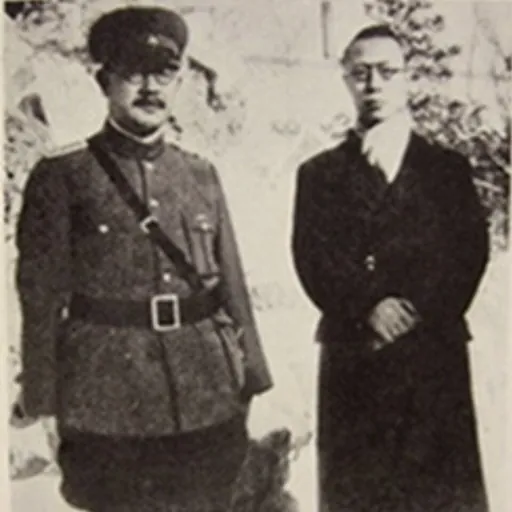
About Chū Kudō
Lived 1882 – 1965 (aged 83). Chū Kudō was a Japanese politician.
, real name , was a Japanese continental rōnin and Lieutenant General in the Manchukuo Imperial Army. He served as aide-de-camp and chief of the bodyguard of Emperor Puyi.
Background Kudō was born in Itayanagi, Kitatsugaru, Aomori as the third son of the wealthy farmer Bun'emon Obata. He had an interest in continental issues, and after graduating from Kinjō Gakuen High School left Japan. After dropping out of a vocational school in 1903, he threw himself into revolutionary movements occurring in China. In his autobiographies, he gave many fanciful accounts of his early life in China, including episodes where he claimed to have walked across the frozen Strait of Tartary in order to join bandits in northern China and to attempt to blow up a warlord operated railway.
Even though he did not have any official military standing, through his contacts with Japanese spymaster Kenji Doihara and Yoshiko Kawashima he entered the Manchukuo Imperial Army as a Lieutenant General in 1932 and served as Chamberlain and Aide-de-camp to the Emperor of Manchukuo. Feeling that a Chinese name would be more appropriate for work in China, Tetsusaburō Kudō consulted with the Manchurian emperor Puyi and received the name .
Always willing to help others from Aomori, his home in Xinjing (present day Changchun) was known as a "rōnin house". In 1942, he held secret meetings with Fumimaro Konoe and others in the upper levels of the Japanese government who hoped to bring a quick end to the Second Sino-Japanese War and an armistice with Kuomintang.
As a high level military officer and imperial official, Kudō always accompanied Puyi and offered advice. While Puyi had the title of emperor, he was only a puppet of the Japanese Kwantung Army. However, the emperor highly trusted Kudō, and in his memoirs "The First Half of My Life" (我的前半生) wrote: "He would always speak at my side. He even expressed to me secret discontent with the Kwantung Army. One time when the color of my tea seemed odd, I was about to have it tested thinking that someone had poisoned it. Kudō took the tea cup and drank it all at once. After I had become Chief Executive, he was the only Japanese to call me 'His Majesty the Emperor', and when he was displeased with the tyrannical Kwantung Army, he told me that he believed that I could restore the name of the Qing dynasty. The loyalty that he displayed would certainly not have paled even to the most model retainers, so gave him the name Chū [Loyal] and treated him like family. He wept with great emotion, and swore to always be loyal until his death."
On July 26, 2007, Kudō's house where he was raised was opened as a place of historical records. It contains, among many things, clothing of the time and pictures with the Manchukuo emperor.
Don’t just read it —
keep it.
Full-length biographies made to live with: read them, listen on the way to work, watch them tonight.
- E-book
- Audio
- Video
Instant download · yours to keep · every purchase keeps this site free
Important facts
People in Chū Kudō's life
Named in this biography and alive at the same time




Related people
Same field, nearest in time




Contemporaries
People whose lives overlapped Chū Kudō's





Frequently asked questions
Who was Chū Kudō?
Japanese adventurer, politician and Army officer
When was Chū Kudō born?
Chū Kudō was born on 10 December 1882 in Aomori Prefecture.
When did Chū Kudō die?
Chū Kudō died on 18 December 1965 in Aomori Prefecture.
What was Chū Kudō's occupation?
Chū Kudō was a politician.
What nationality was Chū Kudō?
Chū Kudō was Japanese.
Sources & further reading
Cite this page
APA: Biography.guide. (2026). Chū Kudō. https://biography.guide/chu-kudo/
MLA: "Chū Kudō." Biography.guide, https://biography.guide/chu-kudo/.
Chicago: "Chū Kudō." Biography.guide. https://biography.guide/chu-kudo/.
Data last updated: 2026-09-21 · Spot an error? Report a correction.
Portrait: Wikimedia Commons · author & licence
Page generated 2026-09-27 05:00 UTC