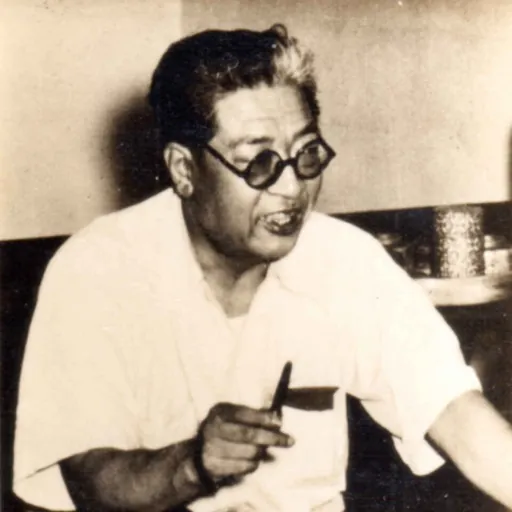
About Chosei Kawakami
Lived 1895 – 1972 (aged 77). Chosei Kawakami was a Japanese painter, printmaker, illustrator, engraver, stained-glass artist and artist.
Chosei Kawakami (10 April 1895 – 1 September 1972) was a Japanese painter and print maker. He is better known as Sumio Kawakami . His work was part of the painting event in the art competition at the 1932 Summer Olympics.
Biography Kawakami was born in Yokohama, He was quite inventive: To make his print — a woman with a traditional chignon hair-style who peers out from underneath a Western umbrella — Kawakami used a sharpened umbrella stay to carve the block. Moreover, he printed the inked block with a makeshift rubbing tool — an ashtray wrapped in a handkerchief. Kawakami was fascinated by the amusing encounters and bizarre misunderstandings that occurred when the first foreigners arrived in Japan, an interest reflected in many of his prints.
It was during this period, teaching in his free hours, that he began to devote himself in earnest to printmaking: he became a member of several sōsaku hanga associations, exhibiting regularly with them and producing ichimai-e prints as well as the more than thirty limited-edition books, mostly self-carved and self-printed. Although he exhibited with the Nihon Hanga Kyōkai from the early 1920s, he knew relatively few print artists and was never much influenced by them. Kawakami also admired the art and poetry of Yumeji Takehisa, and befriended other sōsaku hanga artists as he discovered their work through the various art societies he joined, becoming a member of the Kokuga Sōsaku Kyōkai in 1925 and of the Nihon Sōsaku Hanga Kyōkai in 1929, and a founding member of the Nihon Hanga Kyōkai in 1931. He was also involved in the publication and management of several dōjin zasshi (coterie magazines) promoting sōsaku hanga, including Shi to Hanga, Kaze, Han Geijutsu, Shiro to Kuro and Kitsutsuki.
In the early years, he developed a personal movable-type method for printing the texts by carving around 800 ideographs on individual small blocks of cherry wood (sakura: 桜 or 櫻), arranging the blocks within wood frames, and printing them with a traditional round rubbing pad (baren: 馬楝), just as he would do with his woodcut images. Among his last prints was Tokei to Ranpu (1971), commissioned by the Hotta Corporation to commemorate the 95th anniversary of its watch shop; the print was published in collaboration with the Kokugakai on paper made by Ichibei Iwano VIII. The museum building was inspired by one of Kawakami's prints. There are more than 2000 works in its collection, donated Hasegawa Katsusaburô (長谷川勝三郎 1912-2001).
For the collaborative gassaku series Shin Tokyo Hyakkei (1929–1932), Kawakami produced the woodcut Yoru no Ginza (1929), later reprinted in 1979 in the second volume of the Kawakami Sumio Zenshū published by Chūō Kōronsha in Tokyo.
In Nanban Buri (1955), a foreigner lies beside a courtesan, both smoking long kiseru pipes on a brass bed, a scene inspired by an incident in the life of the samurai Maeda Toshiie, a member of the Council of Five Elders and a warlord in the service of the daimyō Oda Nobunaga; the image has long fascinated collectors for its symbolic fusion of East and West through its two seductive figures, reinforced by the curious combination of a kimono-clad courtesan with a Western-style bed. Sometimes, as in the kappazuri-e Kirisuto to Oiran (1958), Kawakami went further still, not only depicting the meeting of East and West but evoking both the promise and the conflict of uniting two very different cultures; the meeting of Christ and a courtesan represents a combination of the sacred and the profane that Kawakami explored repeatedly in his work, its rendering of forms and sectioned colours stylistically recalling stained glass.
Among Kawakami's experiments was his use of materials other than paper for his prints: some woodcuts were printed on what several commentators have described as skin, as in Kyōchū no Chizu (1953), also known as Kyōochū no Chizu, which depicts nine exotic lands populated by figures in native dress, named after the yellow shapes visible on the map (Abobora, Raxa, Graça, Limbo, Domingo, São Tomé, Calix, Rosario and Un), and decorated with a nautical compass, a spouting whale, sailing ships, mermaids and angels. Kawakami, always fascinated by antique foreign artefacts, appears to have drawn inspiration from various maps drawn on parchment that he had either seen in person or found illustrated in one of the many books in his collection.
Don’t just read it —
keep it.
Full-length biographies made to live with: read them, listen on the way to work, watch them tonight.
- E-book
- Audio
- Video
Instant download · yours to keep · every purchase keeps this site free
Important facts
People in Chosei Kawakami's life
Named in this biography and alive at the same time
Related people
Same field, nearest in time


Contemporaries
People whose lives overlapped Chosei Kawakami's
Frequently asked questions
Who was Chosei Kawakami?
Japanese painter (1895-1972)
When was Chosei Kawakami born?
Chosei Kawakami was born on 10 April 1895 in Yokohama.
When did Chosei Kawakami die?
Chosei Kawakami died on 1 September 1972 in Utsunomiya.
What was Chosei Kawakami's occupation?
Chosei Kawakami was a painter, printmaker, illustrator, engraver, stained-glass artist and artist.
What nationality was Chosei Kawakami?
Chosei Kawakami was Japanese.
Sources & further reading
Cite this page
APA: Biography.guide. (2026). Chosei Kawakami. https://biography.guide/chosei-kawakami/
MLA: "Chosei Kawakami." Biography.guide, https://biography.guide/chosei-kawakami/.
Chicago: "Chosei Kawakami." Biography.guide. https://biography.guide/chosei-kawakami/.
Data last updated: 2026-09-23 · Spot an error? Report a correction.
Portrait: Wikimedia Commons · author & licence
Page generated 2026-09-27 05:05 UTC