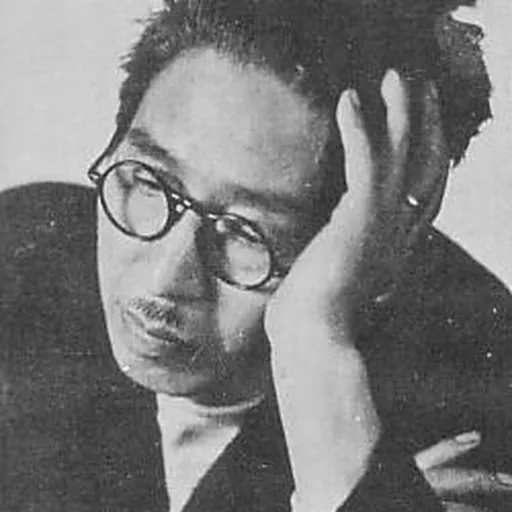
About Yumeji Takehisa
Lived 1884 – 1934 (aged 49). Yumeji Takehisa was a Japanese poet, painter, illustrator, printmaker, designer and writer.
was a Japanese poet and painter. He is known foremost for his Nihonga illustrations of bijin, beautiful women and girls, though he also produced a wide variety of works including book covers, serial newspaper illustrations, furoshiki, postcards, and patterned washi paper.
Biography Early life Takehisa was born in the town of Oku, which has since been merged into the city of Setouchi in Okayama Prefecture, Japan. His childhood home has been preserved and opened to visitors. After struggling to make ends meet doing odd jobs in Tokyo, he eventually enrolled at Waseda Jitsugyō High School, a college-preparatory school for Waseda University in September 1902.
Takehisa's career doing illustrations began in June 1905 after he won a competition by the magazine Chugakusekai, owned by Hakubunkan, one of Japan's leading publishing companies. It was at this time that he adopted the name Yumeji. After he won the competition he began contributing regularly to Hakubunkan. His struggles living in Tokyo endeared him to socialist causes, and some of his earliest work was featured in the socialist and anti-war Heimin Shinbun journal Chokugen. After the High Treason Incident, a socialist-anarchist plot to assassinate Emperor Meiji in 1910, many of the people he worked with at the Heimin Shinbun were arrested and executed. After their divorce, the two opened a store in 1914 that sold various goods featuring Takehisa's designs. Takehisa met his next lover, Hikono Kasai, shortly after the opening of the store. Takehisa left Tokyo for Kyoto in 1916, followed by Kasai the next year. They returned to Tokyo in November 1918. however, the earthquake ruined his business, and it was a setback he did not recover from for several years.
Takehisa and Oyo moved in together to a residence outside of Tokyo in 1924; however, Oyo broke off their relationship the next year. Takehisa left Japan to travel to the United States on 7 May 1931 during the decline of the Taisho Democracy and the rise of the militarist government. His intention in the United States and later Europe was to gain a larger understanding of Western art trends in order to create an art institute in Japan, a goal he never achieved. He traveled throughout Europe in 1933. In Berlin he lectured twice a week at the art school of Johannes Itten, a Swiss expressionist associated with Bauhaus.
Takehisa taught Japanese Painting in Germany from February to June 1933.
Takehisa's depictions of female characters with large eyes had a significant influence on the incipient shōjo manga genre, evident in the work of influential manga artists such as The Rose of Versailles creator Riyoko Ikeda. He also heavily influenced Koshiro Onchi, the father of the sōsaku-hanga movement.
Don’t just read it —
keep it.
Full-length biographies made to live with: read them, listen on the way to work, watch them tonight.
- E-book
- Audio
- Video
Instant download · yours to keep · every purchase keeps this site free
Important facts
People in Yumeji Takehisa's life
Named in this biography and alive at the same time
Related people
Same field, nearest in time

Contemporaries
People whose lives overlapped Yumeji Takehisa's


Frequently asked questions
Who was Yumeji Takehisa?
Japanese artist (1884-1934)
When was Yumeji Takehisa born?
Yumeji Takehisa was born on 16 September 1884 in Honjōson.
When did Yumeji Takehisa die?
Yumeji Takehisa died on 1 September 1934 in Fujimi, Nagano, Ochiai, Nagano.
What was Yumeji Takehisa's occupation?
Yumeji Takehisa was a poet, painter, illustrator, printmaker, designer and writer.
What nationality was Yumeji Takehisa?
Yumeji Takehisa was Japanese.
Sources & further reading
Cite this page
APA: Biography.guide. (2026). Yumeji Takehisa. https://biography.guide/yumeji-takehisa/
MLA: "Yumeji Takehisa." Biography.guide, https://biography.guide/yumeji-takehisa/.
Chicago: "Yumeji Takehisa." Biography.guide. https://biography.guide/yumeji-takehisa/.
Data last updated: 2026-09-22 · Spot an error? Report a correction.
Portrait: Wikimedia Commons · author & licence
Page generated 2026-09-27 05:04 UTC