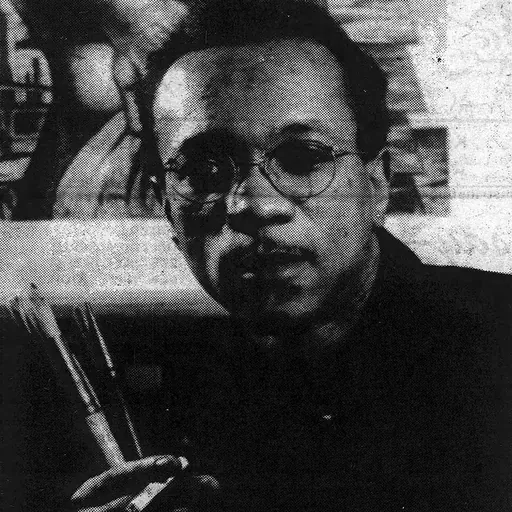
About Charles Wilbert White
Lived 1918 – 1979 (aged 61). Charles Wilbert White was an American painter, printmaker and graphic artist.
Charles Wilbert White Jr. (April 2, 1918 – October 3, 1979) was an American artist known for his chronicling of African American related subjects in paintings, drawings, lithographs, and murals. White's lifelong commitment to chronicling the triumphs and struggles of his community in representational form cemented him as one of the most well-known artists in African American art history.
Following his death in 1979, White's work has been included in the permanent collections of the Art Institute of Chicago, Los Angeles County Museum of Art, The Metropolitan Museum of Art, the Whitney Museum of American Art, the National Gallery of Art, The Newark Museum, the Nelson-Atkins Museum of Art, and the Santa Barbara Museum of Art. White's best known work is The Contribution of the Negro to American Democracy, a mural at Hampton University. In 2018, the centenary year of his birth, the first major retrospective exhibition of his work was organized by the Art Institute of Chicago and the Museum of Modern Art.
Early life and education
Charles Wilbert White was born on April 2, 1918, to Ethelene Gary, a domestic worker, and Charles White Sr., a railroad and construction worker, on the South Side of Chicago. Ethelene was born in Mississippi and came north in the Great Migration. She raised Charles, and as she had no child care, she would often leave him at the public library. There, White developed an affinity for art and reading. White's mother bought him a set of oil paints when he was seven years old, which hooked White on painting. White also played music as a child, studied modern dance, and was part of theatre groups; however, he stated that art was his true passion.
White's mother also took him to the Art Institute of Chicago, where he would read and look at paintings, developing a particular interest in the works of Winslow Homer and George Inness. Since White had little money growing up, he often painted on whatever surfaces he could find including shirts, cardboard, and window blinds. During the Great Depression, White tried to conceal his passion out of embarrassment; however, this ended when White got a job painting signs at the age of fourteen. White learned how to mix paints by sitting in every day for a week in an Art Institute-sponsored painting class that was taking place at a park near his home. His mother remarried when White's father died in 1926. She married a steel mill worker who would become an abusive alcoholic, especially toward White. This experience led him to escape into art. White had few opportunities for pursuing his natural talent at that time both because of the abuse and because there was little money for it. His mother began sending him to Mississippi twice a year to his aunts, Hasty and Harriet Baines, where he would learn about his heritage and African-American Southern folklore. He drew upon his own experiences, curiosity, and feelings about the neglected history of African Americans to help shape his work. White's social views changed. He learned about important African American figures in American history and began asking his teachers why they were not taught in school, causing him to be labeled a "rebel problematic child."
White ultimately received a full scholarship to attend the School of the Art Institute of Chicago, where he studied from 1937 to 1938. While there, White identified Mitchell Siporin, Francis Chapin, and Aaron Bohrod as his influences. He was an excellent draftsman, completing five drawing courses and earning final A grades. To pay the costs of art supplies, White became a cook, using his mother's instruction and recipes. White later became an art teacher at St. Elizabeth Catholic High School. In 1938, White was hired by the Illinois Art Project, a state affiliate of the Works Progress Administration. His work received an extended showing at the Chicago Coliseum during the Exhibition of the Art of the American Negro, which was part of the American Negro Exposition commemorating the 75th anniversary of Thirteenth Amendment ending slavery. An important figure in what became known as the Chicago Black Renaissance, White taught art classes at the Southside Community Art Center.
White moved to New Orleans in 1941 to teach at Dillard University. That same year, he married sculptor and printmaker Elizabeth Catlett, who also taught at Dillard. While at the Hampton Institute, White painted one of his most well known works, The Contribution of the Negro to American Democracy. Measuring around 12 feet by seven feet, the mural depicts a number of notable African-Americans including Denmark Vesey, Nat Turner, Peter Salem, George Washington Carver, Harriet Tubman, Frederick Douglass, and Marian Anderson.
In 1946, White and Catlett received a Rosenwald Fund Fellowship, which enabled them to train and study in Mexico City. There, White and Catlett joined the Taller de Gráfica Popular, an influential print shop collective focused on using art to advance revolutionary social causes. The couple divorced shortly after moving to Mexico. Our War, 1949. lithograph, image: 7 x 9 in. © The Charles White Archives. Printmaking enabled White to reach a wider public more directly and allowed him to bring together his social commitment and artistic practice. Although he had long been aware of art's social utility, with his lithographs and linocuts he was finally able to communicate with a large, cross-national community of black workers and socialist artists, as opposed to his paintings, which were generally tied to individual purchasers. He started providing political cartoons for the Daily Worker and, in 1953, he published, in association with Masses and Mainstream, a portfolio of six reproductions of his ink-and-charcoal drawings, entitled Charles White: Six Drawings. Priced at $3—about $35.23 in 2024—this portfolio aimed at getting art to the people, a main concern for progressive artists of the period. In this respect it was a great success, and White himself acknowledged this when he learned that a group of workers in Alabama combined their savings to buy a portfolio and shared the pictures among themselves.
In 1956, due to ongoing respiratory issues—potentially related to an earlier case of tuberculosis—White moved to Los Angeles for its drier, more mild climate. On faculty at Otis, he was a beacon for African American artists who came to study with him. Among those he taught were Alonzo Davis, David Hammons, and Kerry James Marshall. Eloy Torrez also studied under him, and considers him his greatest influence. An elementary school was named after him and is located on the former Otis College campus.
White was elected to the National Academy of Design in 1972. Later in life, White moved to Altadena, California, where he remained until his death of congestive heart failure in 1979. A park near where he lived in Altadena is named for him.
Legacy During his time at the Otis Art Institute, White was a mentor for many young Black artists, including Kerry James Marshall, Richard Wyatt Jr., David Hammons, Ulysses Jenkins, and Alonzo Davis. Marshall reflected that “Under [his] influence I always knew that I wanted to make work that was about something: history, culture, politics, social issues. (...) It was just a matter of mastering the skills to actually do it.” He also inspired a generation of socially conscious African American artists like Benny Andrews, Faith Ringgold, and Dana Chandler and regularly attended exhibitions in Black art spaces like the Brockman Gallery, Gallery 32 and the Heritage Gallery. The park hosted the Charles White Memorial Arts Festival from 1980 through to the early 1990s, and, in 2021, Altadena Arts hosted the first-ever Altadena Arts Festival, a reiteration of the Charles White Memorial Art Festival focused on celebrating artists of color, women artists, and artists with disabilities.
White's works and writings are featured in the collections of Atlanta University, the Barnett-Aden Gallery, Howard University, the Library of Congress, the Metropolitan Museum of Art, the Minneapolis Institute of Art, the Oakland Museum, the Smithsonian American Art Museum, the Nelson-Atkins Museum of Art, Syracuse University and the Virginia Museum of Fine Arts. The CEJJES Institute of Pomona, New York, owns a number of White's works and has established a dedicated Charles W. White Gallery. In 2015, Drs. Susan G. and Edmund Gordon of Pomona, New York donated their collection of works by Charles White to the Blanton Museum of Art at the University of Texas, Austin.
Reception In 1982, a retrospective exhibition of White's work was held at the Studio Museum in Harlem.
White "was a humanist, drawn to the physical body and more literal representations of the lives of African-Americans," according to Lauren Warnecke for the Chicago Tribune. The Washington Post art critic, Philip Kennicott finds White's work central to American art. "Grace, passion, coolness, toughness, [and] beauty" mark White's work, according to Holland Cotter in The New York Times; White had "the hand of an angel" and "the eye of a sage."
Don’t just read it —
keep it.
Full-length biographies made to live with: read them, listen on the way to work, watch them tonight.
- E-book
- Audio
- Video
Instant download · yours to keep · every purchase keeps this site free
Important facts
Family & relationships
People in Charles Wilbert White's life
Named in this biography and alive at the same time






Related people
Same field, nearest in time


Contemporaries
People whose lives overlapped Charles Wilbert White's


Frequently asked questions
Who was Charles Wilbert White?
American artist (1918-1979)
When was Charles Wilbert White born?
Charles Wilbert White was born on 2 April 1918 in Chicago.
When did Charles Wilbert White die?
Charles Wilbert White died on 3 October 1979 in Altadena.
What was Charles Wilbert White's occupation?
Charles Wilbert White was a painter, printmaker and graphic artist.
What nationality was Charles Wilbert White?
Charles Wilbert White was American.
Sources & further reading
· Wikipedia: Charles Wilbert White
Cite this page
APA: Biography.guide. (2026). Charles Wilbert White. https://biography.guide/charles-wilbert-white/
MLA: "Charles Wilbert White." Biography.guide, https://biography.guide/charles-wilbert-white/.
Chicago: "Charles Wilbert White." Biography.guide. https://biography.guide/charles-wilbert-white/.
Data last updated: 2026-09-23 · Spot an error? Report a correction.
Portrait: Wikimedia Commons · author & licence
Page generated 2026-09-27 05:07 UTC