David Hammons
American painter and performance artist (born 1943)
About David Hammons
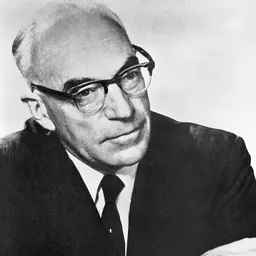
Born 1943. David Hammons is an American performance artist, sculptor, installation artist, draftsperson, painter and video artist.
David Hammons (born July 24, 1943) is an American artist, best known for his works in and around New York City and Los Angeles during the 1970s and 1980s.
Early life
David Hammons was born in 1943 in Springfield, Illinois, the youngest of ten children being raised by a single mother. This dynamic caused great financial strain on his family during his childhood; he later stated that he is uncertain how they managed to 'get by' during this time. Although not inclined academically, Hammons showed an early talent for drawing and art; however the ease at which these practices came to him caused him to develop disdain for it. There he was influenced by artists such as Charles White, Bruce Nauman, John Baldessari, Noah Purifoy, and Chris Burden, all of whom would soon be internationally known. During his time in LA, he met Senga Nengudi, a performance and conceptual artist with whom he later shared a studio. Other members of Studio Z included Maren Hassinger, Ronn Davis, Duval Lewis, RoHo, Franklin Parker, Barbara McCullough, Houston Conwill, and Joe Ray (artist). In 1974 Hammons settled in New York City, where he slowly became better known nationally. He still lives and works in New York.
Personal life In 1966, Hammons married Rebecca Williams, with whom he had two children. The couple divorced in 1972.
Hammons has been reluctant to discuss his early and personal life, as he wishes to avoid his work being framed in a certain way.
Hammons has been philanthropic with other black artists, namely by buying their work and helping them gain recognition. Hammons' work is made of not only allusions, but also metaphors. These metaphors develop into symbols that hold significant meaning in the art world as well as in the public eye. David Hammons continues to offers a crucial interpretation of the African-American art history in the life of a colored person through these symbols. It has been stated by Anthony Huberman that "Hammons work plays with art the way a jazz musician plays with sound - he gets inside it, bends it, twists it around and keeps it from getting too still or getting too comfortable."
David Hammons was considered quite distinguished from his fellow young African American artists of his time; he was seen as "postblack - avant la lettre, his work alluded to altruism the rest of us are just waking up to".
On James Turrell's works concerning perception of light, Hammons said "I wish I could make art like that, but we're too oppressed for me to be dabbling out there.... I would love to do that because that could also be very black. You know, as a black artist, dealing just with light. They would say, "how in the hell could he deal with that, coming from where he did?" I want to get to that, I'm trying to get to that, but I'm not free enough yet. I still feel I have to get my message out."
Body prints At the start of his career during the 1960s Hammons primary medium was body prints. This unique art was made by greasing Hammons' own body; then, he would press it on the paper and add graphite or another medium to accentuate the body print. Hammons acknowledges that he borrowed this technique from the French Artist, Yves Klein. Much of Hammons' Body Prints reflect one of his main influences for his artwork - that being race. Much of his work reflects his commitment to the civil rights and Black Power movements. As a black man experiencing these movements first-hand his artwork is rooted deeply in his personal experiences. These themes have been demonstrated in a range of his body prints. This is specifically seen in his "Spade" works he created during the 1970s - the word being used ironically to reflect Hammons lack of understanding as to why it is used as a derogatory term for African-Americans. Similarly, his 1970 painting, Black First, America Second, is 2 images of himself being wrapped into the American flag. It is his black self and his American self. He feels as if these two identities that he has are split and fundamentally at odds. They are constantly fighting each other and cannot be joined. Similarly, there is his 'Injustice Case' where he depicts himself bound to a chair and gagged. This image references the treatment of Bobby Seale during the Trial of the Chicago 7 and Hammons' attempts to comment on the inequity suffered by African-Americans at the time. This piece in particular reflects Hammons ability to capture the personal experience of being a Black man in America, especially at the time of the Civil Rights Movement, and has been described by Michael Govan as "an icon for American Art."
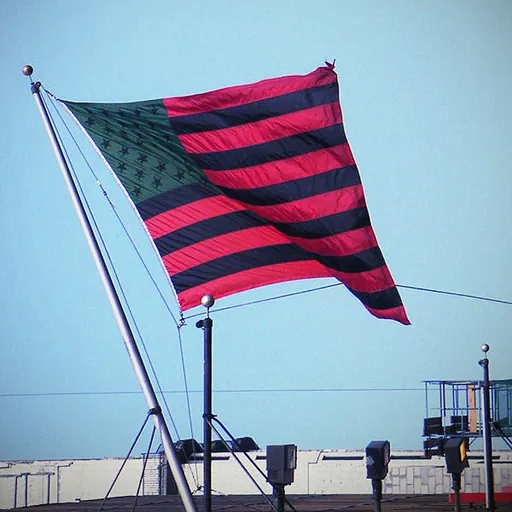
Sculpture Untitled (African-American Flag) (1990) at The Studio Museum in Harlem in New York.
Later in his career, Hammons has explored the sculptural medium in creating pieces. In his 1970's Spade series included works such as Bird (1973) where the jazz musician Charlie Parker is evoked by a spade emerging from the mouthpiece of a saxophone. The name of the piece reflecting Parker's nickname of "Yardbird" or "Bird". Similarly, there is Spade with Chains (1973), where the artist employs the provocative, derogatory term, coupled with the literal gardening instrument, in order to make a visual pun between the blade of a shovel and an African mask, and a contemporary statement about the issues of bondage and resistance. In his seminal piece, African-American Flag (1990) Hammons tackles the topic head-on. The piece depicts the American Flag in the Garvey Colours of Black, Red and Green (Pan-African Colours), these colours also being used in the UNIA Flag. The importance of this piece is demonstrated in its status as part of the permanent collection of the Museum of Modern Art in New York. A copy of the flag is hoisted at the entrance of the Studio Museum in Harlem. The title of this work refers to lyrics of "The Star-Spangled Banner". Whilst African-American Flag "is a nod to the centrality of the Black experience in America, then Oh Say Can You See – faded, tattered and riddled with holes – is emblematic of the backlash against that belief." Many critics see these objects as evocative of the desperation of the poor, Black urban class, but Hammons reportedly saw a sort of sacrosanct or ritualistic power in these materials, which is why he utilized them so extensively. For example, using hair gathered from barbershops and pasting it on top of large stones. These discarded objects have become some of David's Hammons most well known sculptures that represent the life of an African-America living in the United States. His Untitled piece, made over construction rebar coated with dreadlocked hair, was sold to the Whitney Museum for a hundred thousand dollars in 1992. It may be simple, but it is so effective and aligns with how much of Hammons' work is done. . However, where this theme is most prominently demonstrated is in his 1986 piece Higher Goals. Hammons places an ordinary basketball hoop, net, and backboard on a three-story high pole - commenting on the almost impossible aspirations of sports stardom as a way out of the ghetto. Hammons is noted to say, "It takes five to play on a team, but there are thousands who want to play—not everyone will make it, but even if they don't at least they tried." Higher Goals was on view at the Cadman Plaza Park in New York from 1986 to 1987. He continues his 'Bird' pieces with his 1990 work of the same name. This time he addresses how African-American's have been given wide opportunities in certain industries, such as music and sport, however limited opportunities in others, for example, the Arts. This piece places a basketball, which is adorned with feathers and chicken wire, in the frame of a white-painted Victorian birdcage. The cage symbolizing the metaphorical cage that the African-American community still finds themselves in.
In 2007 Hammons collaborated with his wife, Chie Hasegawa, on a piece that enjoyed public acclaim. In the posh uptown gallery specially selected by Hammons (who does not accept to be associated with any one gallery), they installed full-length fur coats on antique dress forms—two minks, a fox, a sable, a wolf and a chinchilla. They then burned, stained and painted the backs of the coats. This turned the coats into a 'sartorial trap' conjuring thoughts of politics, consumerism, animism, animal rights and more. Similarly, his 1990–95 work Smoke Screen is made of a swath of golden fabric, giving the piece, at first glance, an upper-class or regal look. However, on closer inspection the fabric is covered in burn holes and cigarette butts adorn the piece and the floor surrounding it.
In 2021, Hammons collaborated with the Hudson River Park Trust and the Whitney Museum to create Days End. This piece is a "ghost monument" to the late artist, Gordon Matta-Clark. Specifically, the art serve as a tribute to Matta-Clark's 'Pier 52' by creating a structural frame of the warehouse that made up the artist work.
Performance Hammons has expanded his repertoire into the performance medium. This medium allowed Hammons to discuss notions of public and private spaces, as well as what constitutes a valuable commodity. This was most notably seen in his 1983 piece Bliz-aard Ball Sale. Hammons situates himself alongside street vendors in downtown Manhattan in order to sell snowballs which are priced according to size. This act serves both as a parody on commodity exchange and a commentary on the capitalistic nature of art fostered by art galleries. Furthermore, it puts a satirical premium on "whiteness", ridiculing the superficial luxury of racial classification as well as critiquing the hard social realities of street vending experienced by those who have been discriminated against in terms of race or class. This performance was captured by the Black photographer and friend, Dawoud Bey.
Other media and exhibitions His first New York show took place in 1975 at Just Above Midtown (JAM), where his artworks were present alongside other artists of colour, including his friend and mentor Charles White.
Hammons has revisited the association of basketball and young black men in a series of drawings mad by repeatedly bouncing a dirty basketball on huge sheers of clean white paper set on the floor. Traveling was almost 10-feet tall and the name reference both the basketball term of 'Traveling' and being transported.
He has also exhibited the theme of race in other mediums. How Ya Like Me Now depicted the political candidate Jesse Jackson as a white male, with blonde hair and blue eyes as to reflect the racial bias of American Politics. This work, which was painted on a wall, was vandalized by two men with sledgehammers. Hammons continues to display the damaged work, and even includes sledgehammers to add to the character of the piece.
At a 2011 show at L & M Arts, he presented a number of drawings and painting obscured or cover by tarpaulins or plastic sheets - in one case being covered by a wooden armoire. He has made drawings of Kool-Aid powder before covering them with a curtain; the curtain only being lifted under certain conditions. an early solo exhibition at the New Museum, Hammons dealt with the diametrically opposed relationship between spirituality and technology by juxtaposing an African tribal mask with a modern-day invention—a child's toy television set.
In 2016, Hammons performed a gallery show in collaboration with the Mnuchin Gallery called "David Hammons: Five Decades".
In 2014 Hammons purchased a former warehouse in Yonkers, New York with the intention of creating his own art gallery there.
In 2019 Hauser & Wirth mounted a large retrospective of his work in Los Angeles which included a homeless encampment onsite.
Hammons's work was included in the 2025 exhibition Photography and the Black Arts Movement, 1955–1985 at the National Gallery of Art.
Influences One of Hammons greatest influences has been the world of music. In the aforementioned Bird he pays homage to the Jazz musician Charlie Parker. Similarly, when Hammons heard that Miles Davis had died he brought a boombox to New York's Museum of Modern Art when he was installing his works for his 1991 show 'Dislocations'. He dedicated an exhibition at the Hauser & Wirth Gallery in Los Angeles to Ornette Coleman, describing him as "the Duchamp of music, the one who changed everything". Three Spades (1971), Glenstone, Potomac, Maryland Body Print (1974-1975), Museum of Contemporary Art, Los Angeles Body Print (1975), Museum of Modern Art, New York Flight Fantasy (1978), Walker Art Center, Minneapolis Untitled (dung) (1983-1985), San Francisco Museum of Modern Art Free Nelson Mandela (1987), Piedmont Park, City of Atlanta Mayor's Office of Cultural Affairs How Ya Like Me Now? (1988), Glenstone, Potomac, Maryland Untitled (Night Train) (1988), Museum of Modern Art, New York Untitled (1989), Hirshhorn Museum and Sculpture Garden, Smithsonian Institution, Washington, D.C. Untitled (African-American Flag) (1990), The Broad, Los Angeles; Museum of Modern Art, New York (2 editions, 1 shared with Studio Museum in Harlem); National Museum of African American History and Culture, Smithsonian Institution, Washington, D.C.; and The New School, New York Esquire (or John Henry) (1990), Rubell Museum, Miami/Washington, D.C. Chasing the Blue Train (1989-1991), Stedelijk Museum voor Actuele Kunst, Ghent, Belgium Money Tree (1992), Museum of Modern Art, New York; Nasher Museum of Art, Durham, North Carolina; and Seattle Art Museum Untitled (1992), Whitney Museum, New York Freudian Slip (1995), Glenstone, Potomac, Maryland Praying to Safety (1997), Museum of Contemporary Art, Chicago Stone with Hair (1998), Fondation Cartier pour l'Art Contemporain, Paris Phat Free (1995-1999), Art Institute of Chicago; Harvard Art Museums, Cambridge, Massachusetts; Metropolitan Museum of Art, New York; Stedelijk Museum voor Actuele Kunst, Ghent, Belgium; Tate, London; Walker Art Center, Minneapolis; and Whitney Museum, New York High Level of Cat (1999), Seattle Art Museum Basketball Drawing (2001), Buffalo AKG Art Museum, Buffalo, New York Traveling (2001-2002), Baltimore Museum of Art The Holy Bible: Old Testament (2002), Museion, Bolzano, Italy; Museum of Modern Art, New York; Nasher Museum of Art, Durham, North Carolina; National Gallery of Canada Library, Ottawa; Rubell Museum, Miami/Washington, D.C.; The Frances Young Tang Teaching Museum and Art Gallery, Saratoga Springs, New York; and Walker Art Center, Minneapolis Oh say can you see (2017), Pinault Collection, Paris Day's End (2014-2021), Gansevoort Peninsula (former Pier 52), Meatpacking District, New York (maintained by Whitney Museum)
Don’t just read it —
keep it.
Full-length biographies made to live with: read them, listen on the way to work, watch them tonight.
- E-book
- Audio
- Video
Instant download · yours to keep · every purchase keeps this site free
Important facts
People in David Hammons's life
Named in this biography and alive at the same time






Related people
Same field, nearest in time






Contemporaries
People whose lives overlapped David Hammons's


Frequently asked questions
Who is David Hammons?
American painter and performance artist (born 1943)
When was David Hammons born?
David Hammons was born on 24 July 1943 in Springfield.
What is David Hammons's occupation?
David Hammons is a performance artist, sculptor, installation artist, draftsperson, painter and video artist.
What nationality is David Hammons?
David Hammons is American.
Sources & further reading
Cite this page
APA: Biography.guide. (2026). David Hammons. https://biography.guide/david-hammons/
MLA: "David Hammons." Biography.guide, https://biography.guide/david-hammons/.
Chicago: "David Hammons." Biography.guide. https://biography.guide/david-hammons/.
Data last updated: 2026-09-21 · Spot an error? Report a correction.
Portrait: Wikimedia Commons · author & licence
Page generated 2026-09-27 04:59 UTC