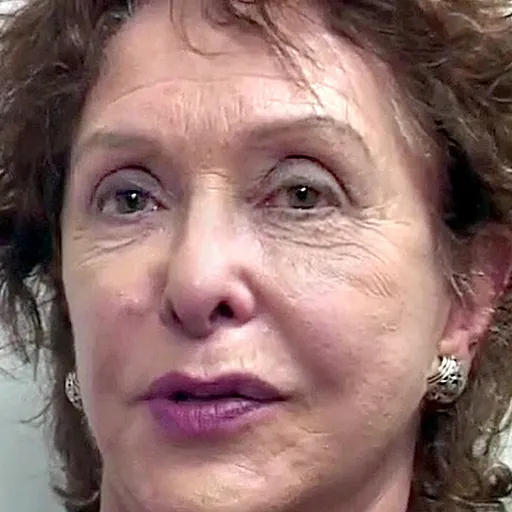
Carolee Schneemann
American visual experimental artist
About Carolee Schneemann
Lived 1939 – 2019 (aged 79). Carolee Schneemann was an American performance artist, choreographer, painter, university teacher, graphic artist and photographer.
Carolee Schneemann (October 12, 1939 – March 6, 2019) was an American visual experimental artist, known for her multi-media works on the body, narrative, sexuality and gender. She received a B.A. in poetry and philosophy from Bard College and a Master of Fine Arts from the University of Illinois. Originally a painter in the Abstract Expressionist tradition, Schneemann was uninterested in the masculine heroism of New York painters of the time and turned to performance-based work, primarily characterized by research into visual traditions, taboos, and the body of the individual in relation to social bodies. Although renowned for her work in performance and other media, Schneemann began her career as a painter, saying: "I'm a painter. I'm still a painter and I will die a painter. Everything that I have developed has to do with extending visual principles off the canvas." Her works have been shown at the Los Angeles Museum of Contemporary Art, the Museum of Modern Art in New York, the London National Film Theatre, and many other venues.
Schneemann taught at several universities, including the California Institute of the Arts, the School of the Art Institute of Chicago, Hunter College, Rutgers University, and SUNY New Paltz. She also published widely, producing works such as Cézanne, She Was a Great Painter (1976) and More than Meat Joy: Performance Works and Selected Writings (1979). Her works have been associated with a variety of art classifications, including Fluxus, Neo-Dada, performance art, the Beat Generation, and happenings.
Early life and education Carolee Schneemann was born Carol Lee Schneiman and raised in Fox Chase, Pennsylvania. As a child, her friends described her in retrospect as "a mad pantheist", due to her relationship with, and respect for, nature. As a young adult, Schneemann often visited the Philadelphia Museum of Art, where she cited her earliest connections between art and sexuality to her drawings from ages four and five, which she drew on her father's prescription tablets. Schneemann attributed her father's support to the fact that he was a rural physician who had to often deal with the body in various states of health. While on leave from Bard and on a separate scholarship to Columbia University, she met musician James Tenney, who was attending The Juilliard School.
Schneemann's image is included in the iconic 1972 collage Some Living American Women Artists by Mary Beth Edelson.
Early work Schneemann began her art career as a painter in the late 1950s. These works integrated the influence of artists such as Post-Impressionist painter Paul Cézanne and the issues in painting brought up by the abstract expressionists. Schneemann focused on expressiveness rather than accessibility or stylishness. She is considered a "first-generation feminist artist", a group that also includes Mary Beth Edelson, Rachel Rosenthal, and Judy Chicago. They were part of the feminist art movement in Europe and the United States in the early 1970s that developed feminist writing and art. Schneemann became involved with the art movement of happenings when she organized A Journey through a Disrupted Landscape, inviting people to "crawl, climb, negotiate rocks, climb, walk, go through mud". Soon thereafter she met Allan Kaprow, the primary figure of happenings, in addition to artists Red Grooms and Jim Dine. She was also highly interested in the abstract expressionists of the time, such as Willem de Kooning. But despite her numerous connections in the art world, New York galleries and museums were not interested in Schneemann's painting-constructions. Oldenburg suggested that there would have been more interest in Europe.
Production on Schneemann's work Eye Body began in 1963. Schneemann created a "loft environment" filled with broken mirrors, motorized umbrellas, and rhythmic color units. To become part of the art herself, she covered herself in various materials, including grease, chalk, and plastic. She created 36 "transformative-actions"—photographs of herself in her constructed environment by Icelandic artist Erró. Among these images is a frontal nude featuring two garden snakes crawling on Schneemann's torso. This image drew particular attention both for its "archaic eroticism" and her visible clitoris. Upon its presentation to the public in 1963, art critics found the piece lewd and pornographic. Artist Valie Export cites Eye Body for the way in which Schneemann portrays "how random fragments of her memory and personal elements of her environment are superimposed on her perception."
Film The 1964 piece, Meat Joy, revolved around eight partially nude figures dancing and playing with various objects and substances including wet paint, sausage, raw fish, scraps of paper, and raw chickens. It was first performed at the Festival de la Libre Expression in Paris and later filmed and photographed as performed by her Kinetic Theater group at Judson Memorial Church. Though her work of the 1960s was more performance-based, she continued to build assemblages such as the Joseph Cornell-influenced Native Beauties (1962–64), Music Box Music (1964), and Pharaoh's Daughter (1966). Her Letter to Lou Andreas Salome (1965) expressed Schneemann's philosophical interests by combining scrawlings of Nietzsche and Tolstoy with a Rauschenberg-like form.
In 1964, Schneemann began production of her 30-minute film Fuses, finishing it in 1967. Fuses portrayed her and her then-boyfriend James Tenney (who also created the sound collages for Schneemann's Viet Flakes, 1965, and Snows, 1970) having sex as recorded by a 16 mm Bolex camera, Fuses was motivated by Schneemann's desire to know whether a woman's depiction of her own sexual acts was different from pornography and classical art as well as a reaction to Stan Brakhage's Loving (1957), Cat's Cradle (1959) and Window Water Baby Moving (1959). Despite her friendship with Brakhage, she later called the experience of being in Cat's Cradle "frightening," remarking that "whenever I collaborated, went into a male friend's film, I always thought I would be able to hold my presence, maintain an authenticity. It was soon gone, lost in their celluloid dominance—a terrifying experience—experiences of true dissolution." Two years after its completion, it won a Cannes Film Festival Special Jury Selection prize. Fuses became the first film in Schneemann's Autobiographical Trilogy. Schneemann began work on her next film, Plumb Line, in 1968. It opens with a still shot of a man's face with a plumb line in front of it before the entire image begins to burn.
In 1975, Schneemann performed Interior Scroll in East Hampton, New York, and at the Telluride Film Festival. This was a notable Fluxus-influenced piece featuring her use of text and body. In her performance, Schneemann entered wrapped in a sheet, under which she wore an apron. She disrobed and then got on a table where she outlined her body with mud. Several times, she would take "action poses", similar to those in figure drawing classes. Concurrently, she read from her book Cézanne, She Was a Great Painter. Then she dropped the book and slowly extracted from her vagina a scroll from which she read. Schneeman's speech described a parody version of an encounter where she received criticism on her films for their "persistence of feelings" and "personal clutter". Art Historian David Hopkins suggests that this performance was a comment on "internalized criticism" and possibly "feminist interest" in female writing.
Schneemann's feminist scroll speech, according to performance theorist Jeanie Forte, made it seem as if Schneemann's "vagina itself is reporting [...] sexism". In 1978, Schneemann finished the last film, Kitch's Last Meal, in what was later called her "Autobiographical Trilogy". In this and another of Schneemann's works that used the same images, Dark Pond, Schneemann sought to "personalize" the attacks' victims by digitally enhancing and enlarging the figures in the images, isolating them from their surroundings.
Schneemann continued to produce art later in life, including the 2007 installation Devour, which featured videos of recent wars contrasted with everyday images of United States daily life on dual screens.
2010s−2020s In 2020, Schneemann's work was included in a major group show at the Pérez Art Museum Miami, Florida. My Body, My Rules investigated the artistic practices of 23 female-identified artists in the 21st century, including Louise Bourgeois, Ida Applebroog, Cindy Sherman, Lorna Simpson, Ana Mendieta, Wanguechi Mutu, Mickalene Thomas, and Francesca Woodman.
Personal life While living in London briefly in 1973, Schneemann met light artist Anthony McCall. When she moved back to New York, he followed her there.
Carolee Schneemann was born in 1939 in the Fox Chase neighborhood of Philadelphia to a rural physician and a homemaker. The first woman in her family to attend college, she studied at Bard College but was briefly suspended for "moral turpitude" after painting a nude self-portrait; she subsequently transferred to Columbia University and later earned an MFA from the University of Illinois. In 1955, she met experimental composer James Tenney, with whom she maintained a long-term relationship and marriage that lasted until 1968. Their domestic and sexual life became the subject of her pioneering autobiographical film Fuses (1967), which also featured her beloved cat, Kitch. Schneemann later lived with artist Anthony McCall in New York City during the 1970s and had a subsequent relationship with Bruce McPherson. Throughout her life, she was deeply devoted to her cats—including Kitch, Vesper, and La Niña—viewing them as essential muses and "co-creators" who informed her understanding of space and intimacy. From 1964 until her death in 2019, she resided and worked in an 18th-century stone farmhouse in New Paltz, New York, a property she considered a primary collaborator in her artistic practice.
Themes One of Schneemann's work's primary focuses was the separation between eroticism and the politics of gender. Schneemann used Kitch as an "objective" observer to her and James Tenney's sexual activities, saying that she was unaffected by human mores.
Schneemann listed as an aesthetic influence on herself and James Tenney the poet Charles Olson, especially the collage Maximus at Gloucester but also in general, "in relationship to his concern for deep imagery, sustained metaphor, and also that he had been researching Tenney’s ancestors", despite his occasional sexist comments.
Painting
Schneemann considered her photographic and body pieces based in painting despite appearing otherwise on the surface. She called herself a "painter who has left the canvas to activate actual space and lived time." Art history professor Kristine Stiles asserts that Schneemann's entire oeuvre is devoted to exploring the concepts of figure-ground, relationality (both through use of her body), and similitude (through the use of cats and trees). Stiles says that the issues of sex and politics in Schneemann's work merely dictate how the art is shaped, rather than the formal concepts found behind it. For example, Schneemann relates the colors and movement featured in Fuses to brush strokes in painting. Works such as Eye Body were meant to explore the processes of painting and assemblage, rather than address feminist topics, though they still possess a strong female presence.
In Schneemann's earlier work, she is seen as addressing issues of patriarchal hierarchies in the 1950s American gallery space. She addressed these issues through various performance pieces that sought to create agency for the female body as both sensual and sexual, while simultaneously breaking gallery space taboos against nude performance.
Unlike much other feminist art, Schneemann's revolves around sexual expression and liberation, rather than referring to victimization or repression of women. According to artist and lecturer Johannes Birringer, Schneemann's work resists the "political correctness" of some branches of feminism as well as ideologies that some feminists claim are misogynist, such as psychoanalysis. He also asserts that Schneemann's work is difficult to classify and analyze because it combines constructivist and painterly concepts with her physical body and energy. She also wrote, "In some sense I made a gift of my body to other women; giving our bodies back to ourselves."
Influence Much of Schneemann's work was performance-based, so photographs, video documentation, sketches, and artist's notes are often used to examine her work. The first prominent exhibition of her work was the modest 1996 retrospective Up To and Including Her Limits, named for her 1973 work of the same title. In 2013, Dale Eisinger of Complex ranked Interior Scroll the 15th-best work of performance art in history, writing, "Schneemann is argued to have realigned the gender balance of conceptual and minimal art with her 1975 piece".
Schneeman was an inspiration for the character Maude Lebowski (portrayed by Julianne Moore) in the 1998 film The Big Lebowski.
Death Carolee Schneemann died at age 79 on March 6, 2019, after suffering from breast cancer for two decades.
Awards
1993 John Simon Guggenheim Memorial Foundation Fellowship 2003: Eyebeam Residency 2011: United States Artists Rockefeller Fellow for Visual Arts 2011: The Women's Caucus for Art Lifetime Achievement Award 2012: One of that year's Courage Awards for the Arts from Yoko Ono 2017: Venice Biennale's Golden Lion Award For Lifetime Achievement 2018: Maria Anto & Elsa von Freytag-Lorignhoven Art Prize, Warsaw (Nagroda im. Marii Anto i Elsy von Freytag-Loringhoven), created by artist Zuzanny Janin and awarded by Fundacja Miejsce Sztuki / Place of Art Foundation on 15.12.2018 at Zachęta National Gallery Warsaw.
Some works 1962–63: Four ~Fur Cutting Boards 1963: Eye Body: 36 Transformative Actions 1964: Meat Joy 1965: Viet Flakes Autobiographical Trilogy 1964-67: Fuses 1968-71: Plumb Line 1973-78: Kitch's Last Meal 1972: Blood Work Diary 1973-76: Up to and Including Her Limits 1975: Interior Scroll 1981: Fresh Blood: A Dream Morphology 1981-88: Infinity Kisses 1983-2006: Souvenir of Lebanon 1986: Hand/Heart for Ana Mendieta 1986-88: Venus Vectors 1987-88: Vesper's Pool 1990: Cycladic Imprints 1991: Ask the Goddess 1994: Mortal Coils 1995: Vulva's Morphia 2001: More Wrong Things 2001: Terminal Velocity 2007: Devour 2013: Flange 6rpm
Selected bibliography Cézanne, She Was A Great Painter (1976) More Than Meat Joy: Performance Works and Selected Writings (1979, 1997) Early and Recent Work (1983) Imaging Her Erotics: Essays, Interviews, Projects (2001) Carolee Schneemann: Uncollected Texts (2018)
In popular culture She is the main subject of the feature-length experimental nonfiction film Breaking the Frame by Canadian director Marielle Nitoslawska (2012).
Don’t just read it —
keep it.
Full-length biographies made to live with: read them, listen on the way to work, watch them tonight.
- E-book
- Audio
- Video
Instant download · yours to keep · every purchase keeps this site free
Important facts
People in Carolee Schneemann's life
Named in this biography and alive at the same time






Related people
Same field, nearest in time


Contemporaries
People whose lives overlapped Carolee Schneemann's


Frequently asked questions
Who was Carolee Schneemann?
American visual experimental artist (1939–2019)
When was Carolee Schneemann born?
Carolee Schneemann was born on 12 October 1939 in Fox Chase.
When did Carolee Schneemann die?
Carolee Schneemann died on 6 March 2019 in New Paltz.
What was Carolee Schneemann's occupation?
Carolee Schneemann was a performance artist, choreographer, painter, university teacher, graphic artist and photographer.
What nationality was Carolee Schneemann?
Carolee Schneemann was American.
Sources & further reading
· Wikipedia: Carolee Schneemann
Cite this page
APA: Biography.guide. (2026). Carolee Schneemann. https://biography.guide/carolee-schneemann/
MLA: "Carolee Schneemann." Biography.guide, https://biography.guide/carolee-schneemann/.
Chicago: "Carolee Schneemann." Biography.guide. https://biography.guide/carolee-schneemann/.
Data last updated: 2026-09-22 · Spot an error? Report a correction.
Portrait: Wikimedia Commons · author & licence
Page generated 2026-09-27 05:02 UTC