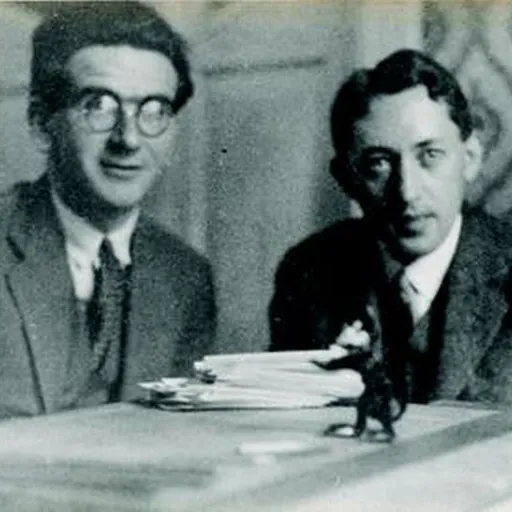
About Charles Loewner
Lived 1893 – 1968 (aged 74). Charles Loewner was an American mathematician and university teacher.
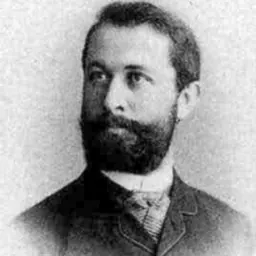
Charles Loewner (29 May 1893 – 8 January 1968) was an American mathematician. His name was Karel Löwner in Czech and Karl Löwner in German.
Early life and career Karl Loewner was born into a Jewish family in Lány, about 30 km from Prague, where his father Sigmund Löwner was a store owner.
Loewner received his Ph.D. from the University of Prague in 1917 under supervision of Georg Pick. One of his central mathematical contributions is the proof of the Bieberbach conjecture in the first highly nontrivial case of the third coefficient. The technique he introduced, the Loewner differential equation, has had far-reaching implications in geometric function theory; it was used in the final solution of the Bieberbach conjecture by Louis de Branges in 1985.
Loewner taught mathematics at the University of Berlin and University of Prague before leaving for the United States. "Richard von Mises wrote from Istanbul, in a 1939 letter of recommendation for Löwner: 'During his activity at the University of Berlin, [Lõwner] was, among all the instructors in Mathematics, the one who had the strongest influence upon the students, stimulated them to independent research, and helped them in his unselfish way. Much of the work involved in the published theses of his pupils is not only due to his influence, but can in a true sense be considered as his work'."
The boundary case of equality is attained if and only if the metric is flat and homothetic to the so-called equilateral torus, the torus whose group of deck transformations is precisely the hexagonal lattice spanned by the cube roots of unity in .
Loewner matrix theorem The Loewner matrix (in linear algebra) is a square matrix or, more specifically, a linear operator (of real functions) associated with two input parameters consisting of (1) a real continuously differentiable function on a subinterval of the real numbers and (2) an -dimensional vector with elements chosen from the subinterval; the two input parameters are assigned an output parameter consisting of an matrix.
Let be a real-valued function that is continuously differentiable on the open interval .
For any define the divided difference of at as . Given , the Loewner matrix associated with for is defined as the matrix whose -entry is .
In his fundamental 1934 paper, Loewner proved that for each positive integer , is -monotone on if and only if is positive semidefinite for any choice of . Charles Loewner: Theory of Continuous Groups (1971) was published by The MIT Press, and re-issued in 2008.
In Loewner's terminology, if and a group action is performed on , then is called a quantity (page 10). The distinction is made between an abstract group and a realization of in terms of linear transformations that yield a group representation. These linear transformations are Jacobians denoted (page 41). The term invariant density is used for the Haar measure, which Loewner attributes to Adolph Hurwitz (page 46). Loewner proves that compact groups have equal left and right invariant densities (page 48).
Works
1950: "Some classes of functions defined by difference or differential inequalities", Bulletin of the American Mathematical Society 56(4): 308–19 1971: (with Murray H. Protter and Harley Flanders) Charles Loewner: Theory of Continuous Groups, MIT Press , re-issued in 2008 by Dover Books with revised title Theory of Continuous Groups 1974: (with Louis Nirenberg) "Partial differential equations invariant under conformal or projective transformations", in Contributions to Analysis (a collection of papers dedicated to Lipman Bers), pp. 245–272. Academic Press
Don’t just read it —
keep it.
Full-length biographies made to live with: read them, listen on the way to work, watch them tonight.
- E-book
- Audio
- Video
Instant download · yours to keep · every purchase keeps this site free
Important facts
People in Charles Loewner's life
Named in this biography and alive at the same time
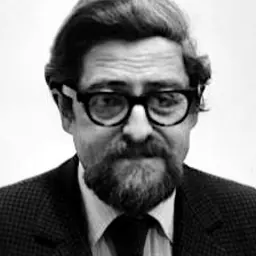
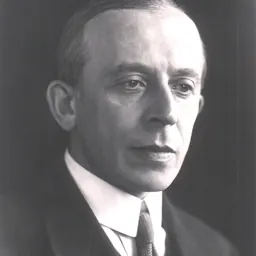


Related people
Same field, nearest in time

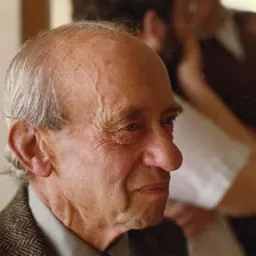
Contemporaries
People whose lives overlapped Charles Loewner's





Frequently asked questions
Who was Charles Loewner?
Czech-American mathematician
When was Charles Loewner born?
Charles Loewner was born on 29 May 1893 in Lány.
When did Charles Loewner die?
Charles Loewner died on 8 January 1968 in Stanford.
What was Charles Loewner's occupation?
Charles Loewner was a mathematician and university teacher.
What nationality was Charles Loewner?
Charles Loewner was American.
Sources & further reading
Cite this page
APA: Biography.guide. (2026). Charles Loewner. https://biography.guide/charles-loewner/
MLA: "Charles Loewner." Biography.guide, https://biography.guide/charles-loewner/.
Chicago: "Charles Loewner." Biography.guide. https://biography.guide/charles-loewner/.
Data last updated: 2026-09-20 · Spot an error? Report a correction.
Portrait: Wikimedia Commons · author & licence
Page generated 2026-09-27 04:58 UTC