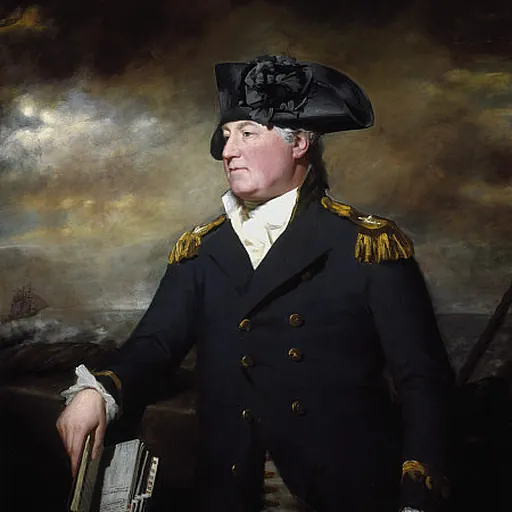
About Charles Inglis
Lived 1730 – 1791 (aged 60). Charles Inglis was a naval officer.
Charles Inglis (c. 1731 – 10 October 1791) was an officer of the Royal Navy who saw service during the War of the Austrian Succession, the Seven Years' War, and the American War of Independence, rising to the rank of rear-admiral.
Inglis was born into a gentry family and embarked on a career in the navy, serving at first under Captain George Brydges Rodney. He saw action with Rodney at the Second Battle of Cape Finisterre, and was left without a ship after the end of the War of the Austrian Succession. Family friends and connections may have helped him receive new postings, and he was promoted to lieutenant during the Seven Years' War. After serving on several different ships, he was given his own commands, in which he took part in operations off the French coast, including one led by his old commander Rodney. Peace once again brought temporary inactivity for Inglis, though he briefly commissioned a ship during the Falklands Crisis.
Back in service again with the outbreak of the American War of Independence, Inglis served in the Caribbean, where he captured a large Spanish privateer. He was in Sir Samuel Hood's fleet at the Battle of Saint Kitts in 1781, and, in 1782, fought at the Battle of the Saintes, where his old commander, now Admiral Sir George Rodney, defeated a French fleet. Inglis was given command of a small squadron of his own and cruised with some success during the last years of the war, capturing a French frigate. He retired ashore after the end of the war, was promoted to rear-admiral in 1790, and died the following year.
Family and early life Inglis was born c. 1731, the fourth son of Sir John Inglis and his wife Anne, the daughter of Adam Cockburn. He embarked on a naval career, at first joining the 40-gun under Captain George Brydges Rodney, in 1745, and the next year went with Rodney to the 60-gun . Rodney carried out several successful cruises, capturing four ships from a French convoy in June 1747, and fighting under Rear-Admiral Edward Hawke at his clash with Desherbiers de l'Etenduère's fleet at the Second Battle of Cape Finisterre on 25 October 1747. Inglis saw action on both of these occasions. Inglis was initially assigned to support Hawke's September 1757 Rochefort expedition, which ultimately failed to take the town. His next appointment was to the newly completed bomb vessel in June 1759, which was assigned to support the attack on Le Havre the following month, conducted by Inglis's old commander, George Brydges Rodney. The expedition succeeded in its aim of destroying a large number of flat-bottomed boats which had been assembled in the port, thus frustrating a planned invasion attempt. She hoisted the broad pennant of Commodore Sir Peircy Brett in January 1762, and sailed for Mediterranean that month to reinforce Admiral Sir Charles Saunders's squadron in anticipation of the entry of Spain to the war. The appointment was short-lived; the Spanish backed down after failing to gain French support for their claims and the threat of war passed. The navy demobilised many of its ships, and Inglis returned to half-pay. On 12 December she was sailing in the Bay of Honduras, when at daybreak a large ship was sighted ahead. Inglis gave chase, a pursuit which lasted all day until Salisbury came in range at 6.30pm. The fleeing ship hoisted Spanish colours and an action began, which last until 8.30pm when the Spanish ship had her mainmast shot away. Having sustained heavy casualties and suffered considerable damage, she struck her colours. He was with Admiral Robert Digby's squadron later that year, before being sent to the Leeward Islands to join Sir Samuel Hood at Barbados. St Albans had six men wounded during this engagement.
On 15 February 1783 the frigate Concorde was sighted by the 74-gun , under Captain Robert Linzee. Magnificent was close enough to identify the mysterious ship as a frigate by 18:00, and by 20:00 as darkness fell Concorde opened fire on her pursuer with her stern guns.
Later life Inglis sailed St Albans back to Britain in July 1783 and paid her off on the conclusion of the war. His biographer, P. K. Crimmin, assessed him as being 'a capable and competent officer without being inspired or presented with fortunate opportunities.'
c. Winfield includes 'in Action off Monte Christi 20 June 1780'. Cornwallis again encountered a French fleet, on 20 June 1780, but off Bermuda. Again Salisbury was not one of the ships involved.
Don’t just read it —
keep it.
Full-length biographies made to live with: read them, listen on the way to work, watch them tonight.
- E-book
- Audio
- Video
Instant download · yours to keep · every purchase keeps this site free
Important facts
People in Charles Inglis's life
Named in this biography and alive at the same time





Related people
Same field, nearest in time


Contemporaries
People whose lives overlapped Charles Inglis's





Frequently asked questions
Who was Charles Inglis?
Royal Navy admiral; (1731-1791)
When was Charles Inglis born?
Charles Inglis was born on 12 December 1730 in Edinburgh.
When did Charles Inglis die?
Charles Inglis died on 10 October 1791 in Edinburgh.
What was Charles Inglis's occupation?
Charles Inglis was a naval officer.
Sources & further reading
· DBpedia: Charles Inglis (Royal Navy officer, died 1791)
Cite this page
APA: Biography.guide. (2026). Charles Inglis. https://biography.guide/charles-inglis-naval-officer/
MLA: "Charles Inglis." Biography.guide, https://biography.guide/charles-inglis-naval-officer/.
Chicago: "Charles Inglis." Biography.guide. https://biography.guide/charles-inglis-naval-officer/.
Data last updated: 2026-09-21 · Spot an error? Report a correction.
Portrait: Wikimedia Commons · author & licence
Page generated 2026-09-27 05:00 UTC