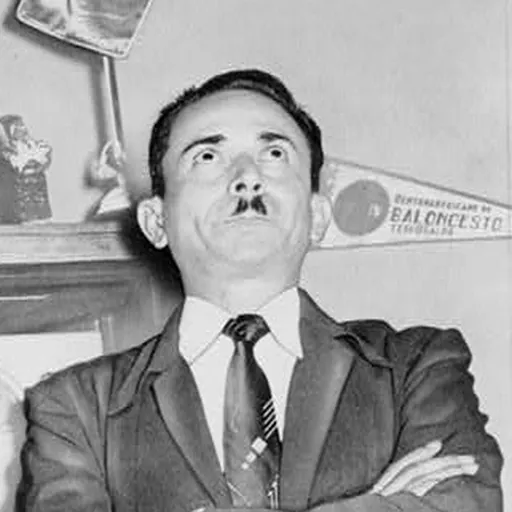
Carlos Castillo Armas
Guatemalan President
About Carlos Castillo Armas
Lived 1914 – 1957 (aged 42). Carlos Castillo Armas was a Guatemalan politician, military personnel and military officer.
Decree 900 reversal
Castillo Armas's government also attempted to reverse the agrarian reform project initiated by Árbenz, and large areas of land were seized from the agrarian laborers who had received them under Árbenz and given to large landowners. In only a few isolated instances were peasants able to retain their lands. Castillo Armas's reversal of Árbenz's agrarian reforms led the US embassy to comment that it was a "long step backwards" from the previous policy. Thousands of peasants who attempted to remain on the lands they had received from Árbenz were arrested by the Guatemalan police. Some peasants were arrested under the pretext that they were communists, though very few of them were. Few of these arrested peasants were ever convicted, but landlords used the arrests to evict peasants from their land. The government under Castillo Armas issued two ordinances related to agricultural policy. In theory, these decrees promised to protect the grants of land made by the Árbenz government under Decree900. The decrees also allowed landowners to petition for the return of land seized "illegally". However, the repressive atmosphere at the time in which the decrees were passed meant that very few peasants could take advantage of them. In total, of the 529,939 manzanas of land expropriated under Decree900, 368,481 were taken from peasants and returned to landowners. Ultimately, Castillo Armas did not go as far towards restoring the power and privileges of his upper-class and business constituency as they would have liked. A "liberation tax" that he imposed was not popular among the wealthy.
Economic issues
Castillo Armas's dependence on the officer corps and the mercenaries who had put him in power led to widespread corruption, and the USgovernment was soon subsidizing the Guatemalan government with many millions of dollars. Guatemala quickly came to depend completely on financial support from the Eisenhower administration. Castillo Armas proved unable to attract sufficient business investment, and in September 1954 asked the US for $260million in aid. Castillo Armas also directed his government to provide support to the CIA operation "PBHistory", an unsuccessful effort to use documents captured after the 1954 coup to sway international opinion in its favor. Despite examining many hundreds of thousands of documents, this operation failed to find any evidence that the Soviet Union was controlling communists within Guatemala. Castillo also found himself too dependent on a coalition of economic interests, including the cotton and sugar industries in Guatemala and real estate, timber, and oil interests in the US, to be able to seriously pursue reforms that he had promised, such as free trade with the US.
By April 1955 the government's foreign exchange reserves had declined from US$42million at the end of 1954 to just $3.4million. The regime was thus facing difficulties borrowing money, leading to capital flight. The government also received criticism for the presence of black markets and other signs of approaching bankruptcy. By the end of 1954 the number of unemployed people in the country had risen to 20,000, four times higher than it had been during the latter years of the Árbenz government. In April 1955 the Eisenhower administration approved an aid package of $53million and began to underwrite the debt of the Guatemalan government. Although officials in the USgovernment complained about Castillo Armas's incompetence and corruption, he also received praise in that country for acting against communists, and his human rights violations generally went unremarked. In 1955, during a corn famine, Castillo Armas gave corn import licenses to some of his old fighters in return for a $25,000 bribe. The imported corn, upon inspection by the United Nations, turned out to be unfit for consumption. When a student newspaper exposed the story, Castillo Armas launched a police crackdown against those criticizing him. Castillo Armas returned some of the privileges that the United Fruit Company had had under Ubico, but the company did not benefit substantially from them; it went into a gradual decline following disastrous experiments with breeding and pesticides, falling demand, and an anti-trust action.
Assassination and legacy On 26 July 1957, Castillo Armas was shot dead by a leftist in the presidential palace in Guatemala City. The assassin, Romeo Vásquez Sánchez, was a member of the presidential guard; he approached Castillo Armas as he was walking with his wife and shot him twice. Castillo Armas died instantly; Vásquez was reported to have fled to a different room and committed suicide. There is no conclusive information about whether Vásquez was acting alone or was part of a larger conspiracy. Elections were held following Castillo Armas's death in which the government-aligned Miguel Ortiz Passarelli won a majority . However, supporters of Miguel Ydígoras Fuentes, who had also been a candidate in the election, rioted, after which the army seized power and annulled the result, and another election was held. Ydígoras Fuentes won this election by a comfortable margin, and soon afterward declared a "state of siege" and seized complete control over the government.
Historian Nick Cullather wrote that by overthrowing Árbenz, the CIA ended up undermining its own initial goal of a stable Guatemalan government. Historian Stephen Streeter stated that while the US achieved certain strategic goals by installing the "malleable" Castillo Armas as president, it did so at the cost of Guatemala's democratic institutions. He further states that, although Castillo Armas probably would have committed the human rights violations that he did even without a US presence, the US State Department had certainly aided and abetted the process. The rolling back of the progressive policies of the previous civilian governments resulted in a series of leftist insurgencies in the countryside beginning in 1960. This triggered the Guatemalan Civil War between the US-backed military government of Guatemala and leftist insurgents, who often boasted a sizable following among the citizenry. The conflict, which lasted between 1960 and 1996, resulted in the deaths of 200,000 civilians. Though crimes against civilians were committed by both sides, 93 percent of such atrocities were committed by the US-backed military. These violations included a genocidal scorched-earth campaign against the indigenous Maya population during the 1980s. Historians have attributed the violence of the civil war to the 1954 coup, and the "anti-communist paranoia" that it generated.
Notes and references Explanatory footnotes
Don’t just read it —
keep it.
Full-length biographies made to live with: read them, listen on the way to work, watch them tonight.
- E-book
- Audio
- Video
Instant download · yours to keep · every purchase keeps this site free
Important facts
Family & relationships
People in Carlos Castillo Armas's life
Named in this biography and alive at the same time

Related people
Same field, nearest in time






Contemporaries
People whose lives overlapped Carlos Castillo Armas's
Frequently asked questions
Who was Carlos Castillo Armas?
Guatemalan President (1914-1957)
When was Carlos Castillo Armas born?
Carlos Castillo Armas was born on 4 November 1914 in Quetzaltenango.
When did Carlos Castillo Armas die?
Carlos Castillo Armas died on 26 July 1957 in Guatemala City, National Palace.
What was Carlos Castillo Armas's occupation?
Carlos Castillo Armas was a politician, military personnel and military officer.
What nationality was Carlos Castillo Armas?
Carlos Castillo Armas was Guatemalan.
Sources & further reading
· Wikipedia: Carlos Castillo Armas
· DBpedia: Carlos Castillo Armas
Cite this page
APA: Biography.guide. (2026). Carlos Castillo Armas. https://biography.guide/carlos-castillo-armas/
MLA: "Carlos Castillo Armas." Biography.guide, https://biography.guide/carlos-castillo-armas/.
Chicago: "Carlos Castillo Armas." Biography.guide. https://biography.guide/carlos-castillo-armas/.
Data last updated: 2026-09-20 · Spot an error? Report a correction.
Page generated 2026-09-27 05:10 UTC