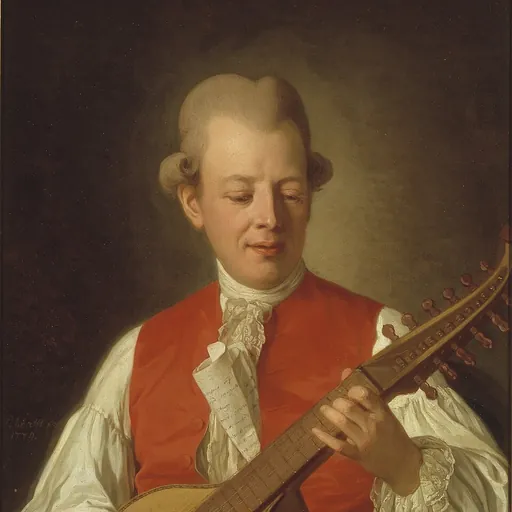
About Carl Michael Bellman
Lived 1740 – 1795 (aged 55). Carl Michael Bellman was a Swedish poet, composer, writer and office worker.
Carl Michael Bellman (; 4 February 1740 – 11 February 1795) His legacy further includes a museum in Stockholm and a society that fosters interest in him and his work.
Biography
Early life Bellman's birthplace, the Stora Daurerska house in Södermalm, Stockholm. Carl Svante Hallbeck, 1861 Carl Michael Bellman was born on 4 February 1740 in the Stora Daurerska house, which was one of the finest in the Södermalm district of Stockholm. The house was the property of his maternal grandmother, Catharina von Santen, who had brought up his father, orphaned as a small child. Carl Michael's parents were Johan Arndt Bellman, a civil servant, and Catharina Hermonia, daughter of the priest of the local Maria parish. Her family was wholly Swedish, whereas Johan's family had German origins: they had come from Bremen in about 1660. His first songs were "parody songs", a common form of entertainment at the time. In 1776, the king gave him a sinecure job as secretary to the national lottery; this supported him for the rest of his life.
On 19 December 1777, at the age of 37, he married the 22-year-old Lovisa Grönlund in Klara Church. They had four children, Gustav, Elis, Karl, and Adolf; Elis died young. Throughout his life, but especially during the 1770s, Bellman also wrote religious poetry, seeing no conflict with his bacchanalian works; he published collections of his religious poems in 1781 and 1787. Fredman's songs also include Old Testament figures such as Noah and Judith.
Paul Britten Austin says instead simply that:
Legacy
Performance and recordings
Bellman's informal Bacchi Orden (Order of Bacchus) was replaced in the 1770s by the more structured Bacchanalian society Par Bricole, which still exists in the 21st century. It enabled Bellman to publish his book Bacchi Tempel in 1783. When the tradition of solo performance of his songs died out, Par Bricole continued to perform his songs as choral pieces.
Bellman's poetry continued to be read and sung throughout the 19th century, contrary to the widespread belief among researchers that he was largely forgotten during this period. His songs were sung especially by the urban bourgeoisie and in fraternities, but also in aristocratic circles and ordinary people in the countryside. The Epistles and Songs were published in chapbooks, sung at festivals and performed in a variety of concerts and entertainments. Figures such as Fredman, Ulla Winblad and Movitz, as well as Bellman himself were painted on tavern walls and memorabilia such as plates, beer tankards and hipflasks. Curiously, Bellman was celebrated at least as enthusiastically in polite and abstemious circles, though with bowdlerized versions of the songs.
Major interpreters of Bellman's songs include Sven-Bertil Taube, who helped to start the 1960s Bellman renaissance; Fred Åkerström, who brought a fresh earthiness to Bellman interpretation; and the Dutch-born Cornelis Vreeswijk, who fitted Bellman to the style of American blues. Other recordings have been made by Evert Taube, and as rock music by Joakim Thåström, Candlemass or Marduk. They are also performed as choral music and as drinking songs. Martin Bagge has recreated Bellman's dramatic style complete with period costume. In 2020, Uppsala stadsteater and Västmanlands Teater created Bellman 2.0, a costumed theatre concert, directed by Nikolaj Cederholm with Fredman's Epistles and Fredman's Songs arranged by Kåre Bjerkø for guitar, electric guitar, double bass, cello, tuba, clarinet, drumkit and percussion, keyboards, accordion, and five voices.
Translations
The Crawl-in Tavern (Krogen Kryp-In) of Epistle 23. Järntorget 85 in Stockholm's Old Town
Bellman has been translated into at least 20 languages, including German by Hannes Wader. German Communist leader Karl Liebknecht liked Bellman's songs and translated some into German. English interpretations have been recorded by performers including William Clauson and Martin Best. Freddie Langrind made some Norwegian translations in 2008.
Memorials
Bellman was the subject of an 1844 ballet choreographed by August Bournonville. Bellman features as a character, along with Ulla Winblad and King Gustav III, in the first episode of the Swedish television series "Nisse Hults historiska snedsteg" (Nisse Hult's historical slips) by SVT Drama. Bellman appears with his cittern and various objects from Fredman's Epistles and Fredman's Songs on a 100 Swedish kronor postage stamp issued in 2014 and designed by Beata Boucht; he was shown on earlier Swedish stamps in 1940 and 1990, commemorating the 200th and 250th anniversaries of his birth, and again in 2006. Bellmansgatan in Stockholm's Södermalm district is named for Bellman; Stieg Larsson places the apartment of his Millennium trilogy hero Mikael Blomkvist in Bellmansgatan, which Dan Burstein and Arne de Keijzer suggest is meant to provide Bellman associations.
Bellman museum
Stora Henriksvik, also called the Bellman museum (Bellmanmuseet) for its small permanent Bellman exhibition, celebrates his life and work with paintings, replica objects and a beachside café in a 17th-century Stockholm house. The place, beside the beach at Långholm, was in Bellman's time called Lilla Sjötullen (The Small Lake-Customs House) where farmers from Lake Mälaren had to pay a toll on the goods they were taking to market in Stockholm's Gamla stan. The place is mentioned in Epistle No. 48, Solen glimmar blank och trind.
Bellman society
The Bellman Society (Bellmansällskapet), founded in Stockholm on the anniversary of Bellman's birth in 1919, fosters interest in Bellman and supports research into the man and his work. To these ends it organises concerts, lectures, and excursions. It produces the series of Bellmanstudier, starting in 1924, so far running to 24 volumes, as well as facsimile prints of Bellman documents, essay collections, and Yngve Berg's Bellman porcelain. It has published recordings including Alla Fredmans Epistlar (All Fredman's Epistles) and Alla Fredmans Sånger (All Fredman's Songs). The Society's newsletter is called Hwad behagas?. Sister societies in other countries include the Danish Selskabet Bellman i Danmark, and the German Deutsche Bellman-Gesellschaft.
Works
Bellman published the following works:
Månan (The Moon), Nyström och Stolpe, 1760 Bacchi Tempel (Temple of Bacchus), 1783 Fredmans Epistlar (Fredman's Epistles), 1790 Fredmans Sånger (Fredman's Songs), 1791 Samlade verk (Collected Works)
Don’t just read it —
keep it.
Full-length biographies made to live with: read them, listen on the way to work, watch them tonight.
- E-book
- Audio
- Video
Instant download · yours to keep · every purchase keeps this site free
Important facts
Related people
Same field, nearest in time


Contemporaries
People whose lives overlapped Carl Michael Bellman's





Frequently asked questions
Who was Carl Michael Bellman?
Swedish poet, songwriter and composer (1740–1795)
When was Carl Michael Bellman born?
Carl Michael Bellman was born on 4 February 1740 in Maria Magdalena parish.
When did Carl Michael Bellman die?
Carl Michael Bellman died on 11 February 1795 in Klara Church Parish.
What was Carl Michael Bellman's occupation?
Carl Michael Bellman was a poet, composer, writer and office worker.
What nationality was Carl Michael Bellman?
Carl Michael Bellman was Swedish.
Sources & further reading
· Wikipedia: Carl Michael Bellman
· DBpedia: Carl Michael Bellman
Cite this page
APA: Biography.guide. (2026). Carl Michael Bellman. https://biography.guide/carl-michael-bellman/
MLA: "Carl Michael Bellman." Biography.guide, https://biography.guide/carl-michael-bellman/.
Chicago: "Carl Michael Bellman." Biography.guide. https://biography.guide/carl-michael-bellman/.
Data last updated: 2026-09-22 · Spot an error? Report a correction.
Portrait: Wikimedia Commons · author & licence
Page generated 2026-09-27 05:03 UTC