
Carl Giesecke
Organ builder
About Carl Giesecke
Lived 1812 – 1888 (aged 76). Carl Giesecke was an organ builder.
Carl Giesecke (2 September 1812 – 28 September 1888) was a German organ builder who became known as a supplier of reed pipes.
Life and work Born in Göttingen, Giesecke was the son of the clothier Otto Heinrich Giesecke and Marie Caroline Aue. His grandfather and great-grandfather were surgeons in Schoningen.
Giesecke learned organ building from 1840 to 1844 from Johann Friedrich Schulze, on whose style he oriented himself structurally and tonally. On 1 April 1844, he acquired citizenship in Göttingen, set up his own business there and was soon one of the most important organ builders in southern Lower Saxony. He initially supplied Schulze with reed stops and other organ parts. By 1860, the workshop had attained a leading position as a subcontractor and from 1870 onwards supplied reeds and organ parts exclusively. Until 1869, he created over 20 new buildings.
On 28 July 1844 he married Wilhelmine Rosine Charlotte Schulz from Hameln, with whom he had six children. His son Hermann (11 May 1847 in Göttingen - 12 February 1928 ibid) was also an organ builder and partner of his father shortly after 1880. According to a contractual agreement, the company traded as "Carl Giesecke & Sohn" from 1884. Hermann took over the construction of the reeds from then on, while his father only made mechanical parts. In view of the growing demand for reeds, the building of complete organs was abandoned.
Since Hermann had no male descendants, the company was leased in 1909 to Adolf Hammer, the co-owner of the company. Hermann's two daughters Helene Giesecke and Gertrud Steggewentz became partners and the company was named "Gieseckes Erben und W. Furtwängler". The number of employees grew to over 75 after the Second World War. In 2006, the company was transformed into a limited liability company. Continuing the company tradition, about 25 employees supplied organ builders worldwide with reed and labial pipes. In 2012, the company filed for insolvency, as a result of which the workshop was dissolved and business operations ceased.
List of works (selection) The size of the instruments is indicated in the fifth column by the number of manuals and the number of sounding stops in the sixth column. A capital "P" stands for an independent pedal, a small "p" for an attached pedal. Italicisation indicates that the organ in question is no longer preserved or that only the casing is preserved.
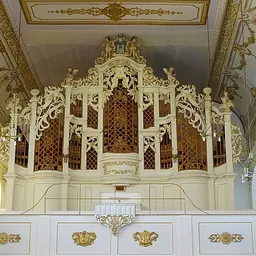
Year Location Church Picture Manual Stops Notes 1848 Weende (Göttingen) St. Petri I/P 8 Some stops are preserved 1850 Moringen Stadtkirche II/P 23 New construction with integration of some stops by Christian Vater. (1743); 1976 restoration by Martin Haspelmath; casing and several stops by Giesecke preservedum 1850 Oldenrode Ev.-luth. Kirche I/P 6 New construction; casing preserved 1851 Ev.-luth. Kirche I/P 7 Only lower casing in the parapet preserved 1853 St. Johannis center 160x160px I/P 7 New construction; Casing and Sub-baß 16′ preserved 1855 St. Laurentius center 160x160px I/P 6 New building; some stops preserved 1855 AltenauSt. Nikolai II/P 15 New building; rebuilt in 1965 by Schmidt & Thiemann with a (today II/P/16) 1856 Silkerode St. Nicolai II/P 14 New building; after 1900 reconstruction by Georg Kiessling & Söhne and restoration by Schönefeld (Orgelbau) in 2002 ca. 1859 Stöckheim St. Martin II/P 16 Neubau 1860 Scheden St.-Markus-Kirche 160x160px II/P 22 Reconstruction of the organ from Johann Dietrich Kuhlmann (1829) 1862 Bockelnhagen Ev.-luth. Kirche II/P 11 1863 Rosdorf Ev.-luth. Kirche 160x160px II/P 28 1911 Rebuilt by P. Furtwängler & Hammer, restored in 1997 by . 1864–1865 Göttingen St. Marien II/P 18 In 1926, P. Furtwängler & Hammer took over the majority of the stops in the new building.
Don’t just read it —
keep it.
Full-length biographies made to live with: read them, listen on the way to work, watch them tonight.
- E-book
- Audio
- Video
Instant download · yours to keep · every purchase keeps this site free
Important facts
People in Carl Giesecke's life
Named in this biography and alive at the same time


Related people
Same field, nearest in time



Contemporaries
People whose lives overlapped Carl Giesecke's


Frequently asked questions
Who was Carl Giesecke?
organ builder (1812-1888)
When was Carl Giesecke born?
Carl Giesecke was born on 2 September 1812 in Göttingen.
When did Carl Giesecke die?
Carl Giesecke died on 28 September 1888 in Göttingen.
What was Carl Giesecke's occupation?
Carl Giesecke was an organ builder.
Sources & further reading
Cite this page
APA: Biography.guide. (2026). Carl Giesecke. https://biography.guide/carl-giesecke/
MLA: "Carl Giesecke." Biography.guide, https://biography.guide/carl-giesecke/.
Chicago: "Carl Giesecke." Biography.guide. https://biography.guide/carl-giesecke/.
Data last updated: 2026-09-20 · Spot an error? Report a correction.
Page generated 2026-09-27 05:01 UTC