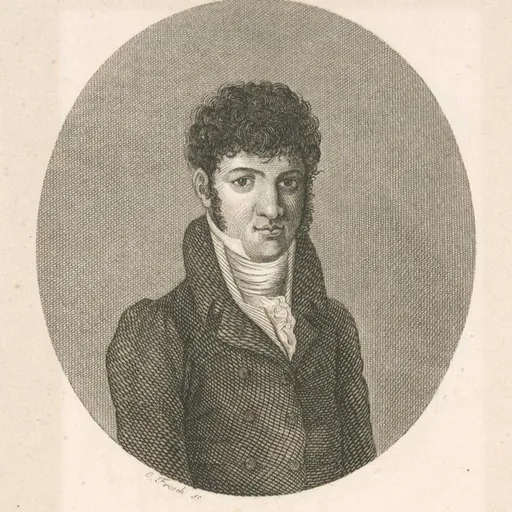
About Carl Andreas Goepfert
Lived 1768 – 1818 (aged 50). Carl Andreas Goepfert was a German composer, guitarist, clarinetist and music arranger.
Carl Andreas Göpfert (or Goepfert) (1768–1818) was a German virtuoso clarinettist, and composer. Göpfert composed in several genres, including symphonies, concerti, wind ensembles, sonatas, and songs.
Carl Andreas Göpfert, in his lifetime salaried Chamber Musician to the Duke of Saxe-Meiningen, excellent virtuoso on the clarinet and admirable composer, was born on 16 January 1768 in Rimpar near Würzburg, the son of a surgical officer. Initially taught singing, piano and organ by the local schoolmaster, his preference for the clarinet led him in 1780 to the celebrated Würzburg clarinet virtuoso Philipp Meissner, who may also have taught him the rudiments of composition. Göpfert's rapidly acquired phenomenal skill on the clarinet led to his being engaged as first clarinettist of the Meiningen court orchestra at the age of 20. As his gentle character prevented him from insisting, he had less and less opportunity to become known further afield as a virtuoso, which would certainly have brought him as much acclaim as did his very popular compositions. He received a golden medal for dedicating a Fantasia militare for wind band to King Wilhelm III. In 1788 Göpfert moved to Vienna.
While in Vienna, he studied music theory and composition with Mozart for about a year and a half. In 1793 he became first clarinet with the orchestra in the Meiningen Court Orchestra and later took charge of court military music as well. He obtained a leave of absence in 1798 to establish himself as a soloist in Vienna; however this was cancelled and he was forced to return to Meiningen where the post of Kapellmeister failed to materialize. Göpfert tried at least twice to acquire a better post. The first involved his sending a large number of works to France; these were dedicated to the French army and Napoleon as First Consul (post mid-1800–1804). This set of pieces describes him as first clarinet in the Kapelle and director of the music for the Graf's Hunting Corps. In 1817 he applied for a post at Oettingen-Wallerstein and it is his letter to them which contains the remarks about studying with Mozart and arranging his works for Harmoniemusik. Göpfert writes: "As I have been studying with the greatest fervor for some twenty years, and also for a year and a half had instruction from Mozart in the advanced study of music theory. I have always preferred those instruments in the wind ensembles, and therefore my esteemed teacher, Mozart, gave to me all of the scores of his operas, instructing me to arrange them for wind band."
Honoured as a lovable, upright person, Göpfert died in Meiningen on 11 April 1818. Göpfert's compositional output, valued and much played during his lifetime, now mostly slumbers in archives.
Selected works 15 Dances for 2 oboes, 2 clarinets, 2 bassoons, 2 horns, trumpet. Concerto in B-flat major for Clarinet, Op. 1 Quartet for clarinet, violin, viola, and cello, Op. 2 Sonata for two guitars and flute, Op. 11 Sonata for bassoon (or viola) and guitar, Op. 13 Concerto in E-flat for clarinet, Op. 14 Sonata for flute and guitar, Op. 15 3 Quartets for clarinet, violin, viola, and cello, Op. 16 Twelve small pieces for two guitars, Op. 17 Variations for guitar and flute, Op. 18 2 Duos concertants for clarinet and bassoon, Op. 19 Concerto in B-flat for clarinet, Op. 20 Concerto in F for horn and orchestra, Op. 21 3 Duos concertantes, Op. 22 24 duos for two horns, Op. 23 Six Songs with piano or guitar accompaniment, Op. 25 Douze pieces d'harmonic pour two clarinets, two horns, and two bassoons, Op. 26 Concerto in B-flat for clarinet, Op. 27 Variations pour la Flute, Accomp with two Violins, Viola, cello, 2 oboes, 2 horns & 2 Bassoons, Op. 28 6 Easy duos for two clarinets, Op. 30 24 Easy duos for two horns, Op. 31 Premier Potpourri for clarinet and orchestra, Op. 32 Fantaisie militaire pour l'orchestre, Op. 33 Concerto in E-flat for clarinet, Op. 35 Easy Sonata for piano and horn (or viola), Op. 35 (Shares the same Opus number as his clarinet concerto). Published after his death in Leipzig 1823 3 Quartets for clarinet violin, viola and cello, Op. 36 3 Progressive duos for two violins, Op. 37 Deuxième Pot-pourri pour la Clarinet, Accomp with two Violins, Viola, cello, two oboes, two horns, two bassoons, Op. 38
Don’t just read it —
keep it.
Full-length biographies made to live with: read them, listen on the way to work, watch them tonight.
- E-book
- Audio
- Video
Instant download · yours to keep · every purchase keeps this site free
Important facts
People in Carl Andreas Goepfert's life
Named in this biography and alive at the same time
Related people
Same field, nearest in time




Contemporaries
People whose lives overlapped Carl Andreas Goepfert's




Frequently asked questions
Who was Carl Andreas Goepfert?
German composer and musician
When was Carl Andreas Goepfert born?
Carl Andreas Goepfert was born on 16 January 1768 in Rimpar.
When did Carl Andreas Goepfert die?
Carl Andreas Goepfert died on 11 April 1818 in Meiningen.
What was Carl Andreas Goepfert's occupation?
Carl Andreas Goepfert was a composer, guitarist, clarinetist and music arranger.
What nationality was Carl Andreas Goepfert?
Carl Andreas Goepfert was German.
Sources & further reading
· Wikipedia: Carl Andreas Goepfert
· DBpedia: Carl Andreas Göpfert
Cite this page
APA: Biography.guide. (2026). Carl Andreas Goepfert. https://biography.guide/carl-andreas-goepfert/
MLA: "Carl Andreas Goepfert." Biography.guide, https://biography.guide/carl-andreas-goepfert/.
Chicago: "Carl Andreas Goepfert." Biography.guide. https://biography.guide/carl-andreas-goepfert/.
Data last updated: 2026-09-24 · Spot an error? Report a correction.
Portrait: Wikimedia Commons · author & licence
Page generated 2026-09-27 05:09 UTC