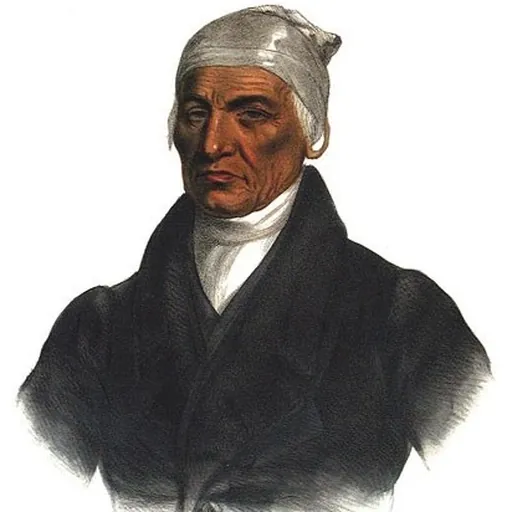
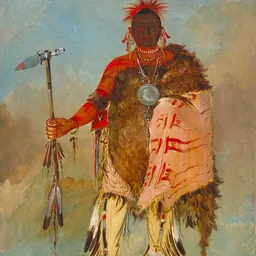
Black Hoof
Chief of the Shawnee Indians
About Black Hoof
Lived 1740 – 1831 (aged 90–91). Black Hoof was a traditional leader or chief.
Catecahassa (spelled Ca-ta-he-cas-sa) or Black Hoof (c. 1740 – 1831) was the head civil chief of the Shawnee Indians in the Ohio Country during the late 18th and 19th centuries. A member of the Mekoche division of the Shawnees, Black Hoof became known as a fierce warrior during the early wars between the Shawnee and encroaching American settlers. His long time serving as chief, until his death in 1831, he was involved in major events from the French and Indian war to the War of 1812 where he played a pivotal role to the Shawnee response to U.S. expansion.
Black Hoof was believed to be born around the early or mid-18th century with his exact birth year being unknown. As a child he may have been a member of a wandering band of some 400 Shawnees led by Peter Chartier between 1745 and 1748, who founded the community in Kentucky called Eskippakithiki and later moved to Sylacauga, Alabama, eventually settling in Old Shawneetown, Illinois.
Black Hoofs rise to power came through his courage and leadership displayed on the battlefield. By his men he was known as a fearless warrior and great leader. The Shawnees have been described as "one of the most warlike tribes" that have fought in multiple conflicts.
Black Hoof's newfound respect from both sides had put him in position to be placed as a diplomat. In an 1802 conference, Black Hoof gave a speech to promote diplomacy and demonstrated his commitment to peace. Observerse noted that Black Hoof was known for his oratorical skills, and it is recorded that he served as the Shawnees spokesman in dealings with the U.S. for many years after.
Like Little Turtle of the Miamis, Black Hoof decided that Native Americans needed to adapt culturally to the ways of the Euro-Americans in order to prevent decimation through warfare. During his later years, Black Hoof became an ally of the United States and was responsible for keeping the majority of the Shawnee nation from joining Tecumseh's War, which became part of the War of 1812.
Black Hoof resisted the policy of Indian removal that the United States implemented soon after the War of 1812. He never signed a removal treaty, and continued to lead his tribe until his death in Saint Johns, Ohio in 1831. After his death, the Shawnee were eventually compelled to emigrate to the West.
Don’t just read it —
keep it.
Full-length biographies made to live with: read them, listen on the way to work, watch them tonight.
- E-book
- Audio
- Video
Instant download · yours to keep · every purchase keeps this site free
Important facts
People in Black Hoof's life
Named in this biography and alive at the same time

Related people
Same field, nearest in time


Contemporaries
People whose lives overlapped Black Hoof's






Frequently asked questions
Who was Black Hoof?
Chief of the Shawnee Indians
When was Black Hoof born?
Black Hoof was born in 1740.
When did Black Hoof die?
Black Hoof died in 1831.
What was Black Hoof's occupation?
Black Hoof was a traditional leader or chief.
Sources & further reading
Cite this page
APA: Biography.guide. (2026). Black Hoof. https://biography.guide/black-hoof/
MLA: "Black Hoof." Biography.guide, https://biography.guide/black-hoof/.
Chicago: "Black Hoof." Biography.guide. https://biography.guide/black-hoof/.
Data last updated: 2026-09-22 · Spot an error? Report a correction.
Portrait: Wikimedia Commons · author & licence
Page generated 2026-09-27 05:03 UTC