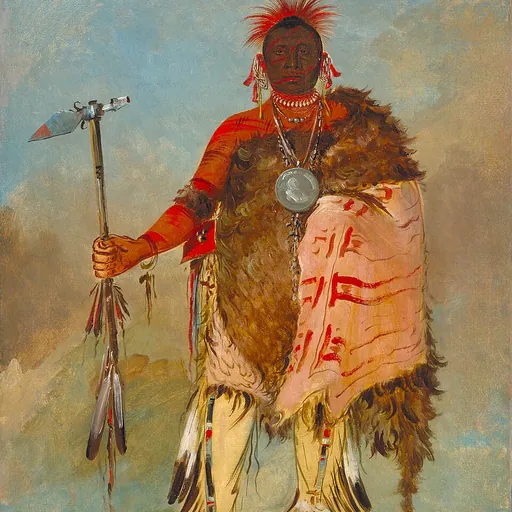
Big Elk
Native American tribal chief
About Big Elk
Lived 1765 – 1846 (aged 80–81). Big Elk was a traditional leader or chief.
Big Elk, also known as Ontopanga (1765/75–1846/1848), was a principal chief of the Omaha tribe for many years on the upper Missouri River. He is notable for his oration delivered at the funeral of Black Buffalo, the maternal grandfather of Crazy Horse, in 1813.
Big Elk led his people during a time of increasing changes, with threats from Sioux warfare, disease, and European-American encroachment. He created alliances to protect his people and prepare for a future that he thought depended on a closer relationship with the United States. He was willing to exchange land for the promise of protection for his people but was often disappointed by the failures of the US government.
History
Big Elk struggled to protect his people from encroachment by European Americans, but more importantly, from warfare by the Sioux. The Omaha suffered from smallpox epidemics in the early nineteenth century and were decimated because of poor immunity to the European introduced disease and also because of sporadic immunisation programmes to the indigenous peoples, even though they were most at risk. Big Elk was among the Native American allies of the United States during the War of 1812, through his relations with the French Creole trader Lucien Fontenelle from New Orleans, who served as an interpreter. The chief also was seeking United States aid for protection against the Sioux.
Big Elk admired some aspects of European-American culture and made strategic alliances through the marriages of his daughters: two married prominent European-American fur traders. His mixed-race grandson Logan Fontenelle worked with the US Indian agent as interpreter for the Omaha from the age of 15. As the Omaha had a patrilineal kinship system, Logan Fontenelle was not considered to belong to the tribe because his father was white, a man of French-American ancestry from New Orleans. The Omaha classified Fontenelle as a white man.
In 1843 Chief Big Elk had designated his adopted son Joseph LaFlesche as his successor; LaFlesche was a Métis fur trader of Ponca and French-Canadian descent, who lived for many years with the Omaha. Highly assimilated to the tribe, as Big Elk taught him its culture and the role of chief, LaFlesche served as principal chief from 1853/1855-1888. He was one of the six chiefs who signed the 1854 treaty with the US that ceded the last major portions of Omaha land. He encouraged the Omaha to become educated and to adopt some European-American ways.
Logan Fontenelle was increasingly important to the Omaha after 1853, serving as interpreter during their negotiations for land sales. Fontenelle served as interpreter to the chiefs in Washington, DC, during negotiation of their last treaty. He was one of the seven signatories to the 1854 treaty, perhaps because he was the only Omaha speaker who was fluent in English. He had been a prominent fur trader in the Omaha territory for years, setting up Fort Lisa in what is now North Omaha, Nebraska. Lisa returned to the fur trade after the war's conclusion. Mitain was what was known as his "country wife", and they lived together when he wintered in the Omaha territory. At the time, Lisa was legally married to a European-American woman in St. Louis, where she lived full-time. After her death in 1817, he married a second woman of European descent in St. Louis.
Lisa and Mitain had a daughter Rosalie and son Christopher together. In 1819 Lisa took Rosalie back to St. Louis with him for Catholic schooling, but Mitain refused to give him custody of Christopher. She was supported in this by Big Elk. ) LaFlesche was the son of Joseph LaFlesche, a French-Canadian fur trader with the American Fur Company, who had worked for many years with the Omaha and other nations between the Platte and the Nebraska rivers. The younger LaFlesche had started accompanying his father on trading trips at age 10, and began working for the AFC at age 16. In 1843 Big Elk designated LaFlesche as his successor, and LaFlesche seriously studied the tribal ways and customs to prepare for chieftainship. LaFlesche appeared to join the tribal council about 1849, after he had settled with the Omaha at the Bellevue Agency. LaFlesche was highly assimilated and cultured, and married Mary Gale, daughter of an American surgeon and his Iowa wife. LaFlesche served as principal chief of the Omaha from 1855 to 1888. During this period of major transition after the tribe moved to a reservation, he encouraged the Omaha to become educated in English, to accept Christianity, and to adopt some European-American ways. He and Mary encouraged education for their children, and several went to school and college in the East. They became prominent reformers and leaders among the Omaha: one of the daughters became the first Native American woman physician, another became an activist and reformer for Omaha rights, and a third became financial manager for the tribe. After Mary's death about 1855, LaFlesche married Tainne, an Omaha woman. Their son Francis La Flesche (born 1857) also became educated. He worked as an ethnologist for the Smithsonian Institution in a close partnership with the anthropologist Alice Fletcher; he wrote books and research about the Omaha and the Osage, and helped preserve their traditions.
Don’t just read it —
keep it.
Full-length biographies made to live with: read them, listen on the way to work, watch them tonight.
- E-book
- Audio
- Video
Instant download · yours to keep · every purchase keeps this site free
Important facts
People in Big Elk's life
Named in this biography and alive at the same time

Related people
Same field, nearest in time



Contemporaries
People whose lives overlapped Big Elk's





Frequently asked questions
Who was Big Elk?
Native American tribal chief
When was Big Elk born?
Big Elk was born in 1765.
When did Big Elk die?
Big Elk died in 1846.
What was Big Elk's occupation?
Big Elk was a traditional leader or chief.
Sources & further reading
Cite this page
APA: Biography.guide. (2026). Big Elk. https://biography.guide/big-elk/
MLA: "Big Elk." Biography.guide, https://biography.guide/big-elk/.
Chicago: "Big Elk." Biography.guide. https://biography.guide/big-elk/.
Data last updated: 2026-09-23 · Spot an error? Report a correction.
Portrait: Wikimedia Commons · author & licence
Page generated 2026-09-27 05:05 UTC