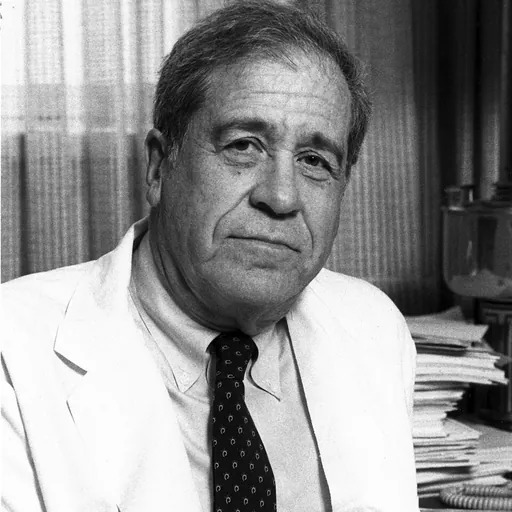
About Bernard Fisher
Lived 1918 – 2019 (aged 101). Bernard Fisher was an American university teacher and surgeon.
Bernard Fisher (August 23, 1918 – October 16, 2019) was an American surgeon and a pioneer in the biology and treatment of breast cancer. He was a native of Pittsburgh. He was Chairman of the National Surgical Adjuvant Breast Project at the University of Pittsburgh School of Medicine. His work established definitively that early-stage breast cancer could be more effectively treated by lumpectomy, in combination with radiation therapy, chemotherapy, and/or hormonal therapy, than by radical mastectomy.
The oncology journal and website OncLive described Fisher's research as "launching the breast cancer community into the modern era" and honored him with a Giants of Cancer Care award for his work that ultimately ended the standard practice of performing the Halsted radical mastectomy, a treatment that had been in place for more than 75 years. Thanks to Fisher, notes another major oncology journal, breast-cancer survival rates have improved worldwide. The Atlantic called him "a medical hero". He was awarded the Albert Lasker Award for Clinical Medical Research in 1985 "for his pioneering studies that have led to a dramatic improvement in survival and in the quality of life for women with breast cancer."
Early life and education Fisher was born in Pittsburgh, Pennsylvania, the son of Anna (Miller) and Reuben Fisher. His family was Jewish. His brother, Edwin, would eventually become a pathologist, and the brothers conducted cancer research together, particularly in their early years.
He graduated from Taylor Allderdice High School in 1936 and was inducted in their alumni hall of fame in 2009.
He graduated from the medical school at the University of Pittsburgh in 1943, then completed a surgical residency.
NSABP In the spring of 1957, having returned to the University of Pittsburgh, Fisher received a request from I.S. Ravdin, M.D., who had been his mentor at the University of Pennsylvania, and who at the time was Chairman of the Clinical Studies Panel of the Cancer Chemotherapy National Service Center at the National Institutes of Health (NIH). Ravdin asked Fisher to join 22 other surgeons in attending an NIH meeting to discuss the establishment of the Surgical Adjuvant Chemotherapy Breast Project, later known as the National Surgical Adjuvant Breast and Bowel Project (NSABP).
"I wasn’t the least bit interested in breast cancer", Fisher later said. "But since Dr. Ravdin was an army general who had operated on President Eisenhower, when he commanded me to attend the meeting, I did so. At the time of that first meeting in 1956, the idea of using clinical trials to obtain information, and certainly the idea of giving therapy following surgery, were novel approaches to treatment". Fisher was initially reluctant to relinquish his research on liver regeneration and transplantation and to take up the study of breast cancer and other malignant diseases, but he became intrigued by the subject of tumor metastasis.
Fisher later said that after that NIH meeting, "I discovered how little information there was related to the biology of breast cancer and what a lack of interest there was in understanding the disease. At the meeting, I learned about the need for randomized clinical trials and the use of biostatistics to obtain credible information from those trials". Giving up the liver regeneration and transplantation research in which he had been engaged, he began, along with his brother Edwin, a member of the University of Pittsburgh's pathology department, to study the biology of tumor metastasis. During the succeeding decades he would lead clinical trials that would result in transformative changes in the treatment of breast cancer. Fisher consequently urged his fellow breast-cancer surgeons to change their approach to the disease. Most of them resisted, however, and continued to perform radical mastectomies, and many accused Fisher and his supporters of placing women's lives at risk by not performing the radical surgery. To quote the citation of his Albert Lasker Award, Fisher "demonstrated that the regional lymph nodes were not a barrier to the dissemination of tumor cells, as postulated earlier, but were routes traversed by tumor cells to gain access to the circulating bloodstream and lymphatic system. Out of this basic work on cancer metastasis came a new model for the management of breast cancer based on the premise that the disease is systemic from its inception."
Meanwhile, Fisher had taken legal action. After being removed from his position at the NSABP, and being publicly accused by the University of Pittsburgh and NCI of having knowingly published false data, Fisher filed a defamation lawsuit. The defendants were the university; its law firm, Washington, DC–based Hogan & Hartson; the Department of Health and Human Services; the National Institutes of Health; NCI; and the Office of Research Integrity (ORI). Fisher's suit “charged that the dismissal came without due process and that the defendants violated Dr. Fisher’s right to free speech by interfering with his right to publish in medical journals.”
In 1997, after a three-year investigation the Office of Research Integrity ruled that Fisher was innocent of any scientific misconduct. and was a fellow of American College of Surgeons, from which he also was awarded the prestigious Jacobson Innovation Award in 2009.
Honors and awards Early in his career, Fisher won a Markle Scholarship. "Postoperative radiotherapy in the treatment of breast cancer: results of National Surgical Adjuvant Breast and Bowel Project (NSABP) Clinical Trial", by Bernard Fisher, Nelson H. Slack, Patrick J. Cavanaugh, Bernard Gariner, Robert G. Ravdin, Annals of Surgery, vol. 172, no. 4, pp. 711–730, 1970. "L-phenylalanine mustard (L-PAM) in the management of primary breast cancer: an update of earlier findings and a comparison with those utilizing L-PAM plus 5-fluorouracil (5FU)", by Bernard Fisher, Andrew Glass, Carol Redmond, Edwin R. Fisher, Bruce Barton, Emillie Such, Paul Carbone, Steven Economou, Roger Foster, Robert Frelick, Harvey Lerner and Martin Levitt. Cancer, vol. 39, no. 6, pp. 2883–2903, 1977. "Laboratory and clinical research in breast cancer – a personal adventure: the David A. Karnofsky memorial lecture", by Bernard Fisher, Cancer Research, vol. 40, pp. 3863–3874, 1980. "Twenty-year follow-up of a randomized trial comparing total mastectomy, lumpectomy, and lumpectomy plus irradiation for the treatment of invasive breast cancer”, by Bernard Fisher, Stewart Anderson, John Bryant, Richard G. Margolese, Melvin Deutsch, Edwin R. Fisher, Jong-Hyeon Jeong and Norman Wolmark, The New England Journal of Medicine, vol. 347, no. 16, pp. 1233–1241, 2002. "Pathobiology of small invasive breast cancers without metastases" (T1a/b, N0, M0): National Surgical Adjuvant Breast and Bowel Project (NSABP) protocol B21, by Edwin R. Fisher, Joseph P. Costantino, Marino E. Leon, Hanna Bandos, Alka S. Palekar, Bernard Fisher, Norman Wolmark. Cancer, vol. 110, no. 9, pp. 1929–1936, 2007. "Pathologic findings from the national surgical adjuvant breast project (protocol 4): Discriminants for 15-year survival", by Edwin R. Fisher, Joseph Costantino, Bernard Fisher, Carol Redmond. Cancer, vol. 71, no. S6, pp. 2141–2150, 2006. "The incidence of lung carcinoma after surgery for breast carcinoma with and without postoperative radiotherapy: Results of National Surgical Adjuvant Breast and Bowel Project (NSABP) clinical trials B04 and B06", by Melvin Deutsch, Stephanie R. Land, Mirsada Begovic, H. Samuel Wieand, Norman Wolmark, Bernard Fisher, Cancer, vol. 98, no. 7, pp. 1362–1368, 2003. "Fifteen-year prognostic discriminants for invasive breast carcinoma: National Surgical Adjuvant Breast and Bowel Project Protocol06", by Edwin R. Fisher, Stewart Anderson, Elizabeth Tan-Chiu, Bernard Fisher, Lamar Eaton, Norman Wolmark. Cancer, vol. 91, no. S8, pp. 1679–1687, 2001. "Fifteen-year prognostic discriminants for invasive breast carcinoma", by Edwin R. Fisher, Stewart Anderson, Bernard Fisher, Lamar Eaton, Norman Wolmark. Cancer, vol. 91, no. S8, pp. 1679–1687, 2001. "Pathologic findings from the National Surgical Adjuvant Breast Project (NSABP) eight-year update of Protocol B17: Intraductal carcinoma", by Edwin R. Fisher, James Dignam, Elizabeth Tan-Chiu, Joseph Costantino, Bernard Fisher, Soonmyung Paik, Norman Wolmark. Cancer, vol. 86, no. 3, pp. 429–438, 1999. "Prognosis among African-American women and white women with lymph node negative breast carcinoma: Findings from two randomized clinical trials of the National Surgical Adjuvant Breast and Bowel Project (NSABP)", by James J. Dignam, Carol K. Redmond, Bernard Fisher, Joseph P. Costantino, Brenda K. Edwards. Cancer, vol. 80, no. 1, pp. 80–90, 1997. "Pathologic findings from the National Surgical Adjuvant Breast Project (NSABP) protocol B17: Five-year observations concerning lobular carcinoma in situ", by Edwin R. Fisher, Joseph Costantino, Bernard Fisher, Alka S. Palekar, S. M. Paik, C. M. Suarez, Norman Wolmark. Cancer, vol. 78, no. 7, pp. 1403–1416, 1996.
Don’t just read it —
keep it.
Full-length biographies made to live with: read them, listen on the way to work, watch them tonight.
- E-book
- Audio
- Video
Instant download · yours to keep · every purchase keeps this site free
Important facts
People in Bernard Fisher's life
Named in this biography and alive at the same time






Related people
Same field, nearest in time



Contemporaries
People whose lives overlapped Bernard Fisher's
Frequently asked questions
Who was Bernard Fisher?
American surgeon and breast cancer researcher
When was Bernard Fisher born?
Bernard Fisher was born on 23 August 1918 in Pittsburgh.
When did Bernard Fisher die?
Bernard Fisher died on 16 October 2019 in Pennsylvania, Pittsburgh.
What was Bernard Fisher's occupation?
Bernard Fisher was a university teacher and surgeon.
What nationality was Bernard Fisher?
Bernard Fisher was American.
Sources & further reading
· DBpedia: Bernard Fisher (scientist)
Cite this page
APA: Biography.guide. (2026). Bernard Fisher. https://biography.guide/bernard-fisher-university-teacher/
MLA: "Bernard Fisher." Biography.guide, https://biography.guide/bernard-fisher-university-teacher/.
Chicago: "Bernard Fisher." Biography.guide. https://biography.guide/bernard-fisher-university-teacher/.
Data last updated: 2026-09-30 · Spot an error? Report a correction.
Portrait: Wikimedia Commons · author & licence
Page generated 2026-10-04 14:31 UTC