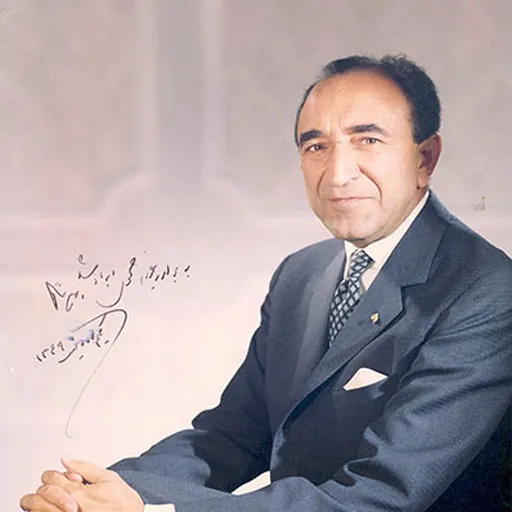
About Asadollah Alam
Lived 1919 – 1978 (aged 59). Asadollah Alam was an Iranian politician.
Asadollah Alam (; 24 July 1919 – 14 April 1978) was an Iranian politician who was prime minister under Mohammad Reza Shah from 1962 to 1964. He was also Minister of Royal Court, president of Pahlavi University and governor of Sistan and Baluchestan province.
Early life Alam was born on 24 July 1919 in Birjand to a family of Khorasani Arab origin and was educated at a British school in Iran. By a royal order from Reza Shah, Alam married Malektaj, the daughter of Qavam Al-Molk Shirazi. The son of Qavam ol-molk was then married to a sister of the Shah, Ashraf Pahlavi. Shortly after deposing the Qajar dynasty, Reza Shah intended to unite Iran's non-Qajar nobility through inter-marriage.
At the age of 28, he was appointed governor of Sistan and Baluchestan province. At the age of 30, he became Minister of Agriculture in the cabinet of Mohammad Sa'ed. He early on displayed what an American acquaintance describes as a combination of native toughness and YMCA dedication.
Assadollah Alam became the main landowner of Birjand after his father's death. He was one of Iran's first big landowners to distribute his holdings to the peasants, insisting that his servants eat the same food as his family. Once, when a would-be assassin was nabbed outside his door, Alam gave the man $40, then had him thrashed and sent into the street without his pants. Alam was subsequently made the director of the Pahlavi Foundation, a charitable trust worth at least $133 million, set up by the Shah to finance social-welfare plans out of the profits from royal holdings in banks, industries, hotels. In 1962, he became prime minister at the age of 43.
As prime minister, Assadollah Alam pledged to undertake "an anticorruption campaign with great diligence and all severity." Though the cynics snickered, Alam got free rein from the Shah, and carefully began building airtight cases against suspected grafters among Iran's leading bureaucrats and government leaders. His first major target was General Mohammed Ali Khazai, the Iranian army's chief of ordnance, who had parlayed his $6,000 salary into three houses in the suburbs of Tehran, four apartment houses in France, five automobiles, $100,000 in European banks and $200,000 in cash. A military court convicted Khazai of taking a cut out of government contracts and sentenced him to five years of solitary confinement.
In May 1963, Alam's anti-corruption drive was in full swing. In Tehran, a military tribunal sentenced General Abdullah Hedayat, Iran's first four-star general and once a close advisor of the Shah, to two years in prison for embezzling money on military housing contracts, brushed aside his plea for appeal with the brusque explanation that "more charges are pending." The former boss of the Tehran Electricity Board was in solitary confinement for five years; cases were in preparation against an ex-war minister and twelve other generals for graft.
Screaming "Down with the Shah", 10,000 people, swept through the capital, carrying pictures of Khomeini. Though the whereabouts of the Shah were kept secret, rows of white-helmeted troops, backed by tanks, immediately sealed off access to royal palaces in the city and suburbs. In the heart of the town green, they fired for 40 minutes. When the mobs entered government buildings, the troops opened up at point-blank range. The crowd fell back in confusion, regrouped, and raced down main avenues. For the first time in a decade, martial law was imposed on the city, along with a dusk-to-dawn curfew. Hoping to preserve quiet for a while, Alam also announced that troops would remain on emergency duty. Their orders: shoot to kill.
Minister of the Royal Court
In 1964, he was appointed as chancellor of Pahlavi University and a few years later served host to the King of Belgium in his visit to Fars province. Beginning in December 1966 he was the minister of court for many years. Furthermore, he was the head and bursar of the Pahlavi Foundation. He was also a supporter of the campaign of Richard Nixon, during the United States presidential elections.
As the minister of the Royal Court he was the closest man to Mohammad Reza Pahlavi, who now ran the country autocratically. Therefore, Alam became the channel through which most of the daily affairs of the country passed. Alam's memoirs, published posthumously, are detailed documents on the life and the deeds of the Shah as perceived by an insider.
List of positions held
As written by Alam himself in his memoirs in 1972. Manager of Imam Reza's shrine in Mashad, AKA "Aastaan-e Qods-e Razavi" The Shah's inspector of all universities Chairman of the board of trustees of the Pahlavi University Chairman of the board of trustees of the Aryamehr University Chairman of the board of trustees of the Pars School for Higher Education (Madreseye Aalyi-e Pars) The Shah's special liaison with foreign ambassadors (for issues too confidential to pass through the Foreign Ministry) Head of the board of trustees of the Mashad University Indispensable member of the board of trustees of the University of Tehran Indispensable member of the board of trustees of the University of Tabriz Chairman of the Royal Horse Institute (Crown Prince Reza Pahlavi was the honorary head) Chairman of the royal institute of the Rural Culture Houses (Crown Prince Reza Pahlavi was the honorary head) Chairman of the National Scouts Committee Head of Kaanun-e Kaar (Labor Institute) Deputy chairman of the (IOSS) (Princess Ashraf Pahlavi was the head) Deputy chairman of the Red Lion and Sun Society (Princess Shams Pahlavi was the head) Chairman of the Council for Support of Mothers and Infants Deputy chairman of the Kaanun-e Parvaresh-e Fekri-e Kudakaan va nojavaanaan (Institute for the Intellectual Development of Children and Young Adults) (Empress Farah Pahlavi was the head) Direct chief of the Legion of Service to Humanity Person in charge of the construction in the island of Kish Head of the board of trustees of the Pahlavi Foundation Deputy chairman of the Iranian Culture Foundation (for research and publication of classic Persian texts) In charge of the Shah's personal and monetary affairs Minister of court Cooperation in establishing University of Birjand
Illness and death Asadollah Alam was diagnosed with cancer in the late 1960s. He died at New York University Hospital in New York City in 1978, less than a year before the Iranian Revolution.
Don’t just read it —
keep it.
Full-length biographies made to live with: read them, listen on the way to work, watch them tonight.
- E-book
- Audio
- Video
Instant download · yours to keep · every purchase keeps this site free
Important facts
People in Asadollah Alam's life
Named in this biography and alive at the same time



Related people
Same field, nearest in time






Contemporaries
People whose lives overlapped Asadollah Alam's


Frequently asked questions
Who was Asadollah Alam?
Prime Minister of Iran (1919-1978)
When was Asadollah Alam born?
Asadollah Alam was born on 1 April 1919 in Birjand.
When did Asadollah Alam die?
Asadollah Alam died on 13 April 1978 in New York City.
What was Asadollah Alam's occupation?
Asadollah Alam was a politician.
What nationality was Asadollah Alam?
Asadollah Alam was Iranian.
Sources & further reading
Cite this page
APA: Biography.guide. (2026). Asadollah Alam. https://biography.guide/asadollah-alam/
MLA: "Asadollah Alam." Biography.guide, https://biography.guide/asadollah-alam/.
Chicago: "Asadollah Alam." Biography.guide. https://biography.guide/asadollah-alam/.
Data last updated: 2026-09-22 · Spot an error? Report a correction.
Portrait: Wikimedia Commons · author & licence
Page generated 2026-09-27 05:03 UTC