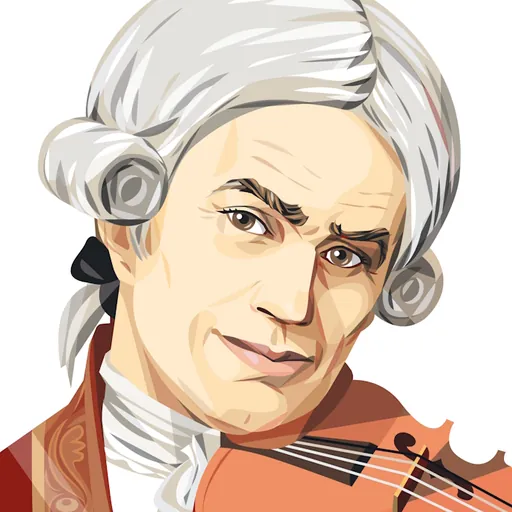
About Artemy Vedel
Lived 1767 – 1808 (aged 40–41). Artemy Vedel was a Russian composer, singer, church choirmaster, conductor, choir director and violinist.
Artemy Lukyanovich Vedel , born Artemy Lukyanovich Vedelsky, was a Ukrainian-born Russian composer of military and liturgical music. He produced works based on Ukrainian folk melodies, and made an important contribution in the music history of Ukraine. Together with Maxim Berezovsky and Dmitry Bortniansky, Vedel is recognised by musicologists as one of the "Golden Three" composers of 18th century Ukrainian classical music, and one of Russia's greatest choral composers.
Vedel was born in Kyiv, the son of a wealthy wood carver. He studied at the Kyiv-Mohyla Academy until 1787, after which he was appointed to conduct the academy's choir and orchestra. In 1788, he was sent to Moscow to work for the regional governor, but he returned home in 1791 and resumed his career at the Kyiv-Mohyla Academy. General Andrei Levanidov recruited him to lead Kyiv's regimental chapel and choir—under Levanidov's patronage, Vedel reached the peak of his creativity as a composer. He moved with Levanidov to the Kharkov Governorate, where he organised a new choir and orchestra, and taught at the Kharkiv Collegium.
His fortunes declined when the cultural life of Kharkiv was affected by decrees issued by Tsar Paul I of Russia. Lacking a patron, and with his music unable to be performed, he returned home to Kyiv in 1798, and became a novice monk of the Kyiv Pechersk Lavra. The monastery's authorities discovered handwritten threats towards the Russian royal family, and accused Vedel of writing them. He was subsequently incarcerated as a mental patient, and forbidden to compose. After almost a decade, the authorities allowed him to return to his father's house to die.
Vedel's music was censored during the period that Ukraine was part of the Soviet Union. More than 80 of his works are known, including 31 choral concertos, but many of his compositions are lost. Most of his choral music uses texts taken from the Psalms. The style of Vedel's compositions reflects the changes taking place in classical music during his lifetime; he was influenced by Ukrainian Baroque traditions, but also by new Western European operatic and instrumental styles.
Background
The tradition of Russian church music can be traced back to Dmitry Bortniansky, who revered the Russian liturgical musical tradition. The early part of the 19th century was a period that marked a low ebb in the fortunes of traditional Russian music. Bortniansky studied in Venice before eventually becoming the director of music at the court chapel in St Petersburg in 1801. Composing in an era when attempts were being made to suppress the Russian Empire's cultural heritage, Bortniansky's choral concertos, set to texts in Russian, were modelled on counterpoint, the concerto grosso and Italian instrumental music. Under him, the Imperial Court Chapel expanded its role so it influenced, and eventually controlled, church choral singing throughout the Russian Empire. at a time when classical influences were being introduced into Ukrainian choral music, such as four-voice polyphony, the soloist and the choir singing at different alternative times, and the employment of three or four sections in a work. Almost half of the population of Kyiv lived in Podil, which was one of the three walled settlements that formed the city, along with Old Kyiv and Pechersk.
The Vedelsky family adhered strictly to the Orthodox faith. Lukyan Vlasovich Vedelsky was a wealthy carver of wooden iconostases, who owned his own workshop. The name Vedel, probably an abbreviated form of Vedelsky, was how the composer signed his letters, and named himself in military documents. His father signed himself "Kyiv citizen Lukyan Vedelsky". The composer moved to Kharkiv, along with his best musicians. In Kharkov (now Kharkiv, Ukraine) Vedel organised a new gubernia (governorate) choir and orchestra, and taught singing and music at the Kharkiv Collegium, Works included the concerts "Resurrect God" and "Hear the Lord my voice" (dated 6 October 1796) and the two-choir concerto "The Lord passes me". The composer and his works were highly valued in Kharkiv; his concerts were studied and performed at the Kharkiv Collegium, and they were sung in churches. Bortniansky, who conducted the St. Petersburg State Academic Capella, praised the quality of Vedel's teaching. In September 1796, Vedel was promoted to become a senior adjutant, with the rank of captain. Levanidov was dismissed on 9 January 1797, when his corps was disbanded by Paul I, and he left Kharkiv. Paul I decreed that all regimental chapels were to be abolished, which caused Vedel to resign from the army in October 1797. He worked as a musician for the governor of the new province. Teplov, who as a young man had received an excellent musical education, treated Vedel as well as he could. The tsar wrote of Vedel on 15 May 1802: "... leave in the present captivity". His letters to Turchaninov reveal a care for oppressed people—reflected in his choice of themes for his concertos—as well as an opposition towards serfdom, which had been established in Ukraine by Catherine the Great.
Music
Compositions The first page of Vedel's manuscript of the choral concerto No. 12 ("In my trouble I cried to the Lord")
Vedel was almost entirely a liturgical composer of the a cappella choral music sung in Orthodox churches. It was acquired by Askochensky, who bequeathed it to the Kyiv Academy. According to Koshetz, Vedel's music was based on Ukrainian folk melodies.
Vedel's music was written at a time when Western music had largely emerged from the Renaissance and Baroque eras. The style of his compositions reflected two contrasting traditions. He was strongly influenced by the baroque traditions of the Ukrainian hetman culture, with its religious-mystical music linked with ideas about spiritual enlightenment, but was also influenced by developments in new operatic and instrumental styles emerging from Western Europe at that time.
Legacy Censorship and revival
Performances of Vedel's music were censored and the publication of his scores was prohibited during most of the 19th century. They were secretly distributed in manuscript form, and were known and performed, despite the ban. and the outstanding composers at a time when church music was reaching its peak in eastern Europe. They composed some of the greatest choral music to emerge from the Russian Empire.
Vedel made an important contribution in the music history of Ukraine, and musicologists consider him to the archetypal composer of the baroque style in Ukrainian music. The Vedel School in Lviv, a school of contemporary music founded in 2017 by the musician Mikhail Balog, was named in honour of the composer. There are streets named after the composer in Kyiv and Kharkiv.
Don’t just read it —
keep it.
Full-length biographies made to live with: read them, listen on the way to work, watch them tonight.
- E-book
- Audio
- Video
Instant download · yours to keep · every purchase keeps this site free
Important facts
People in Artemy Vedel's life
Named in this biography and alive at the same time

Related people
Same field, nearest in time



Contemporaries
People whose lives overlapped Artemy Vedel's




Frequently asked questions
Who was Artemy Vedel?
Ukrainian-born Russian Imperial composer, conductor, and music teacher
When was Artemy Vedel born?
Artemy Vedel was born in 1767 in Kyiv.
When did Artemy Vedel die?
Artemy Vedel died on 14 July 1808 in Kyiv.
What was Artemy Vedel's occupation?
Artemy Vedel was a composer, singer, church choirmaster, conductor, choir director and violinist.
What nationality was Artemy Vedel?
Artemy Vedel was Russian.
Sources & further reading
Cite this page
APA: Biography.guide. (2026). Artemy Vedel. https://biography.guide/artemy-vedel/
MLA: "Artemy Vedel." Biography.guide, https://biography.guide/artemy-vedel/.
Chicago: "Artemy Vedel." Biography.guide. https://biography.guide/artemy-vedel/.
Data last updated: 2026-09-20 · Spot an error? Report a correction.
Page generated 2026-09-27 05:10 UTC