
Antonis Fosterides
Greek politician and soldier
About Antonis Fosterides
Lived 1912 – 1979 (aged 66–67). Antonis Fosterides was a Greek politician, military personnel and freedom fighter.
Antonis Fosteridis (, also Φωστηρίδης, 1912–1979), also known by the nom de guerre of Çauş Anton (Τσαούς Αντών), was a Pontus-born Greek nationalist, anticommunist partisan during the Axis occupation of Greece, who served in the Hellenic Army during the Greek Civil War and, during peace time, was elected member of the Hellenic Parliament.
Early years Antonis Fosteridis (also Fostiridis) was born in 1912 in the village of Eroukli of the Bafra, Pontus region of the Ottoman Empire. His father Kyriakos fought with the Pontic irregulars against the Nationalist Turkish forces in the region in the period 1918–22,
Fosteridis was enlisted in the Greek army and served as a sergeant of the artillery. Ηe participated in the failed 1935 military coup attempt by officers loyal to Eleftherios Venizelos and was dishonorably discharged from the army.
When war was declared in October 1940 between Greece and Italy, Fosteridis was recalled and he took part in the battles fought in the mountains of Southern Albania. For the bravery he showed in combat, Fosteridis reached the rank of Second Lieutenant, the highest rank for an NCO.
Bulgaria integrated the occupied region as "new countries", carrying the title Belomórie (in Bulgarian Беломорие) and commenced a policy of violent assimilation of the native population. The immediate result of the repressive measures was the exodus of a significant number of former local administrators of the Greek government, priests, teachers, physicians, business people, and others, who sought refuge mostly in German-occupied Macedonia. The occupying authorities forbid the use of the Greek language in all signs and official documents, and expropriated lands and houses owned by Greeks to settle there Bulgarian citizens.
In late September 1941, in reaction to these measures, small groups of partisans and irregulars, organized mostly by the Communist Party, attacked Bulgarian military, administrative, and police positions. The uprising initially broke out in the villages of Doxato, where local Greeks attacked the police station and killed six or seven Bulgarian policemen, and of Prosotsani where the municipality office, the army garrison, and the police station were attacked.
The uprising was "swiftly" and "brutally" suppressed by the Bulgarian occupation authorities. In a few days, by 2 October 1941, almost all the leaders of the various groups were killed. The Bulgarian troops moved into Drama where they arrested all men between the ages of 19 and 45, and into other cities and villages of the region. They commenced reprisals by summarily executing suspects, with Bulgarian military reports listing up to 1,600 Greeks killed in the uprising and in the weeks that followed, while Greek sources claim the dead were in the thousands. The villages of Doxato, Kyrgia, Philiatra, Drymotopos, Kokkinogeia, and Platanovryssi were destroyed and most male inhabitants killed.
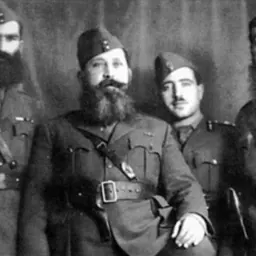
Nationalist partisan In 1942, various nationalist groups, with the objective of defending the Greek population against the occupying authorities' continued "atrocities," as well as against "treasonous" communist activity, took up arms in the mountainous areas of Eastern Macedonia and Thrace, their most significant presence being in Pangaion, Elatia, and Lekani. The structure of their groups reflected that of patriarchal clans whence they originated. Αmong the first was Fosteridis who led a Pontic band of about 15-17 men mostly from Krinides.
On 22 February 1943, the various nationalist bands of partisans, operating under the loosely unifying and unofficial title of "Nationalist Partisan Groups" (in Gr: Εθνικές Ανταρτικές Ομάδες, or Ε.Α.Ο.), unanimously recognized Fosteridis as their commander and co-coordinator, during a gathering at the village of Kastanitis of Chionovouni mountain.
Armed activity against Occupation forces and ELAS In 1943, the military strength of ELAS in North Greece was limited, mainly due to the Communist party's support of an independent Macedonia nation, in force since 1924, that would encompass the Macedonian regions of Bulgaria, Greece, and Yugoslavia, as well as the great losses suffered by its members after the 1941 uprising. Τhis was true, for obvious reasons, for the Hellenophones of the region, while the KKE position enabled the party to gain some support among the Slavophones.
In August 1943, a meeting between the various partisan organizations in the region, including ELAS and Fosteridis' EAO, with a representative of the Middle-East Allied Command present, took place in Pangaion and a unified front against the occupiers was agreed, though in terms undefined as to command and structure. By October 1943, Fosteridis brought under the EAO command more independent nationalist partisan groups. On 16 December 1943, ELAS troops attacked the Pangaion nationalist bands inflicting significant losses of life. Fosteridis rejected offers to join ELAS and managed to strengthen the resistance of the nationalists. A group of his partisans pretending to make peaceful overtures for a common celebration of New Year's Eve to an ELAS unit attacked and killed them on the dawn of 1 January 1944. This action was accompanied by economic assistance to the Fosteridis partisans by the British Allied Command, represented by Special Operations Executive Major Guy Micklethwait. which lasted from 7 to 11 May 1944. The Bulgarian army, in order to begin anti-partisan operations in the Elatia region, decided to strengthen its forces by transferring troops there from Bulgaria. The EAO partisans positioned themselves around the bridge near the village of Papades and when the Bulgarian troops, supported by their air force, tried to occupy it and advance towards what they rightly considered to be EAO's main area of local support, were met with heavy gun and mortar fire. The repeated attempts to win the bridge lasted three days and nights of combat. Eventually, the partisans withdrew after inflicting heavy casualties to the attacking troops. Fifteen EAO partisans were killed while the attackers lost 42 officers and 806 soldiers.
For the Bulgarian side, the battle near Papades represented a strategic setback since they did not proceed towards the sea. In the 1946 Paris Peace Conference, the Bulgarian side, by then a member of the Allied camp, argued that they needed "an outlet on the Aegean Sea." Stalin, on 7 June 1946, told Dimitrov and Tito that the Soviet Union supported the Bulgarian claims, arguing, “we and the Americans were not parties to the drawing of the borders and do not recognize them as just."
The departure of all Axis forces from Greece found Fosteridis of EAO, the nationalist partisans in Crete, and Napoleon Zervas leader of EDES practically the only non-communist partisans who survived the occupation after the civil conflict.
After Soviet forces, on 20 August 1944, broke through Axis defenses in Romania, and approached Bulgaria, the government in Sofia, on 27 August, announced neutrality; the last of the German troops departed, and, under intense Soviet pressure Bulgaria eventually declared war against Germany. on 7 September 1944. With Bulgaria having joined the Allied camp, at least as a "co-belligerent," the Bulgarian forces in Northern Greece started handing over civil command to EAM, the leftist national liberation front whose military wing was ELAS. Αfter an agreement between ELAS and the pro-communist Fatherland Front that had come to power in Sofia, ELAS began liberating cities in Macedonia and Thrace, with only the situation in Drama remaining uncertain. Fosteridis, jointly with the British military representative, attempted to prevent ELAS from entering Drama by coming to an agreement with General Asen Sirakov, while EAO members, joined by the British officer himself, went to the Bulgarian capital with the same purpose. These efforts failed so after a few days ELAS troops entered Drama, while, by December 1944, and following the events in Athens, ELAS commenced liquidating operations against the EAO groups in the area.
Accusations of collaboration During the internecine conflict in the time of the Occupation and continuing after the war ended in Greece, Fosteridis and the EAO partisans were accused by the communist resistance of being "collaborators" and "traitors." The Communist Party stated that Fosteridis received monetary support from the Germans in order to fight against ELAS during the war and then, after the Germans had left, by the British for the same purpose. and for getting support from the German forces, even though his activities had been confined within the Bulgarian-occupied zone. There has been no material or documented evidence of Fosteridis getting assistance from Occupation forces. He came to several understandings with them, ostensibly with military objectives, such as the agreement with General Asen Sirakov for the delivery of Drama. He was not among those who were indicted after the war as collaborators.
Civil War When the civil war started in Greece in 1946, Fosteridis organized a paramilitary group of anti-communist fighters, titled "Fosteridis Battalion," which undertook various actions in Eastern Macedonia and Thrace, and particularly in Evros Prefecture, in support of government operations. In July 1955, he joined the Progressive Party led by Spyros Markezinis. The partisan organization he commanded was recognized by successive Greek governments as part of the legitimate National Resistance. Ιn 2019, the Drama mayoralty considered a proposal by EAO veterans to dedicate a statue to Fosteridis in a city square but after protests from the Communist Party and organizations of Resistance veterans the proposal was rejected.
Don’t just read it —
keep it.
Full-length biographies made to live with: read them, listen on the way to work, watch them tonight.
- E-book
- Audio
- Video
Instant download · yours to keep · every purchase keeps this site free
Important facts
People in Antonis Fosterides's life
Named in this biography and alive at the same time


Related people
Same field, nearest in time





Contemporaries
People whose lives overlapped Antonis Fosterides's




Frequently asked questions
Who was Antonis Fosterides?
Greek politician and soldier
When was Antonis Fosterides born?
Antonis Fosterides was born in 1912 in Bafra.
When did Antonis Fosterides die?
Antonis Fosterides died on 30 August 1979 in Drama.
What was Antonis Fosterides's occupation?
Antonis Fosterides was a politician, military personnel and freedom fighter.
What nationality was Antonis Fosterides?
Antonis Fosterides was Greek.
Sources & further reading
· Wikipedia: Antonis Fosterides
Cite this page
APA: Biography.guide. (2026). Antonis Fosterides. https://biography.guide/antonis-fosterides/
MLA: "Antonis Fosterides." Biography.guide, https://biography.guide/antonis-fosterides/.
Chicago: "Antonis Fosterides." Biography.guide. https://biography.guide/antonis-fosterides/.
Data last updated: 2026-09-20 · Spot an error? Report a correction.
Page generated 2026-09-27 05:17 UTC