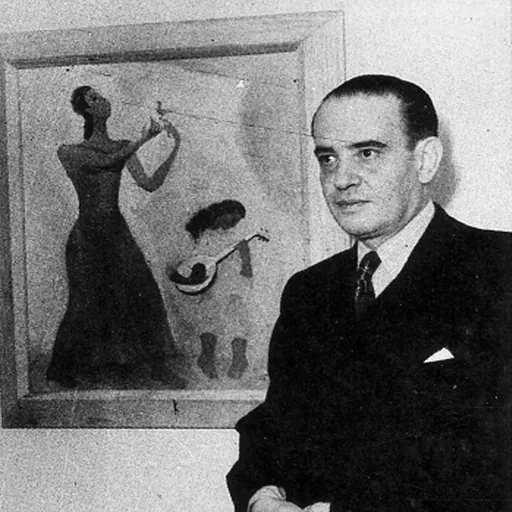
About Antonio M. Ruiz
Lived 1892 – 1964 (aged 72). Antonio M. Ruiz was a Mexican painter.
Antonio M. Ruíz (September 2, 1892 – October 9, 1964) Ruíz and his family moved to Mexico City in his childhood and he spent most of his adult life there. Gabriel Fernández Ledesma and Miguel Covarrubias. Ruiz had a cerebral hemorrhage in 1961 and died in Mexico City in 1964.
Education At first, Ruiz was sent to a religious boarding school in Morelia but then studied architecture and painting at the Academy of San Carlos, now the National School of Arts, at the age of 17 in 1914. He studied with Manuel Rodríguez Lozano, Miguel Covarrubias, Julio Castellanos, Rufino Tamayo, Agustín Lazo, Luis Ortiz Monasterio, Gabriel Fernández Ledesma and Carlos Mérida.
Career During his time at Academy of San Carlos he was a draftsman in the Ministry of Communications, the Federal Railroad Administration (in the Department of Libraries and Graphic Services) and then in the Ministry of Public Works. Ruíz showed The Orator, The Dream of Malinche during the International Surrealist Exhibition held at the Galería de Arte Mexicano in Mexico City. Critics called his two works "stylistic examples of magical realism".
Ruíz, an influential artist, did not feature in a large stand-alone exhibition. Mainly, this is due to his painting technique- which has been described as a slow process. He would take his time, sometimes only putting out three or four paintings in a year.
Style-wise, Ruíz was a painter of everyday life. Works like The Bicycle Race, Texcoco and The Shop-Window are examples of this. He also spent some time working with surrealism, as shown by his paintings The Dream of Malinche and The Orator. He was very concerned with detail and had a very specific style to his paintings. Somber was not his tone though, as he often injected humor into his paintings. As Helm puts it, Ruíz "sees the comedy without losing sight of the tragedy".
In 1963, Ruíz retired from professorship and was celebrated in the Seminario de Cultura Mexicana's retrospective of his work. Ruíz worked with Julio Castellanos on decor for Eugene O'Neill's "Different" in 1934. He also worked on scenery for "El gesticulador" in the Palacio de Bellas Artes 1947 opening season of Teatro Mexicano. Ruiz contributed as a set and costume designer for the theater production Anfitrión 38, created by Julio Bracho. Ruíz was assistant to Covarrubias in painting the six murals entitled The Fauna and Flora of the Pacific, Peoples, Art and Culture, Economy, Native Dwellings, and Native Means of Transportation. They were created for the Golden Gate International Exposition (GGIE) in 1939, later they were moved to the American Museum of Natural History in New York. All but "Art and Culture" were returned to San Francisco and displayed in the World Trade Club. That piece was lost and still no one knows of its whereabouts. Today The Flora and Fauna of the Pacific is being displayed at the M. H. de Young Memorial Museum in San Francisco.
Work at Escuela Nacional de Pintura, Escultura y Grabado "La Esmeralda" In 1943 he followed Guillermo Ruiz on his chair as director of the Escuela Nacional de Pintura, Escultura y Grabado "La Esmeralda". Ruíz reformed the "Esmeralda" basically, so that it became an official art school of the Secretaría de Educación Pública. Previously it was the School of Wood Carving of the Secretariat of Public Education.
El sueño de la Malinche
El sueño de la Malinche or The Dream of Malinche is one of Ruíz's better known works that was painted in 1939. His subject, La Malinche was the mistress of Hernán Cortés as well as his translator and guide during Spanish conquest of the Aztec Empire. She is a symbol of the indigenous people but also of the betrayal of her people, and the main reason why the conquistadors were able to defeat the indigenous people. In the painting, La Malinche lies sleeping on a modern bed, with a cracked and distressed wall behind her and a blanket drawn up around her. On the blanket lies a Mexican landscape with a colonial church as the highest point and residential areas spreading down the hills. Edward Lucie-Smith's view of the implication of this painting is that "Mexico's Indian past still slumbers beneath the trappings of the European present."
Selected works Alegoria teatral (1923) El organillero (1925) Woman Ironing (1928) The Lottery Ticket (1932) El Sueño de la Malinche (The Dream of Malinche) (1939) Schoolchildren on Parade (1936) The Shop-Window (1937) Verano (1937) The Bicycle Race, Texcoco (1938) Serenata (1938) Leader Making a Speech (1939) Marionettes (1939) The New Rich (1941) Estreno de la pulqueria (1941) Las Changuitas (1943) Fotografia de un escenario teatral suyo (1946) Felicitation para 1947 (1947) Indolandia indivisa y libre (1953) Self-Portrait (1956) The Soprano (1949)
Don’t just read it —
keep it.
Full-length biographies made to live with: read them, listen on the way to work, watch them tonight.
- E-book
- Audio
- Video
Instant download · yours to keep · every purchase keeps this site free
Important facts
People in Antonio M. Ruiz's life
Named in this biography and alive at the same time





Related people
Same field, nearest in time



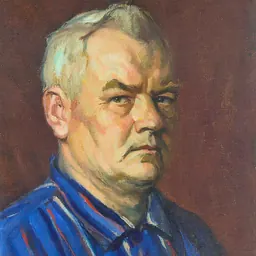
Contemporaries
People whose lives overlapped Antonio M. Ruiz's

Frequently asked questions
Who was Antonio M. Ruiz?
Mexican fine art painter and scenic designer (1892-1964)
When was Antonio M. Ruiz born?
Antonio M. Ruiz was born on 2 September 1892 in Texcoco de Mora.
When did Antonio M. Ruiz die?
Antonio M. Ruiz died on 9 October 1964 in Mexico City.
What was Antonio M. Ruiz's occupation?
Antonio M. Ruiz was a painter.
What nationality was Antonio M. Ruiz?
Antonio M. Ruiz was Mexican.
Sources & further reading
· DBpedia: Antonio Ruíz (painter)
Cite this page
APA: Biography.guide. (2026). Antonio M. Ruiz. https://biography.guide/antonio-m-ruiz/
MLA: "Antonio M. Ruiz." Biography.guide, https://biography.guide/antonio-m-ruiz/.
Chicago: "Antonio M. Ruiz." Biography.guide. https://biography.guide/antonio-m-ruiz/.
Data last updated: 2026-09-23 · Spot an error? Report a correction.
Portrait: Wikimedia Commons · author & licence
Page generated 2026-09-27 05:06 UTC