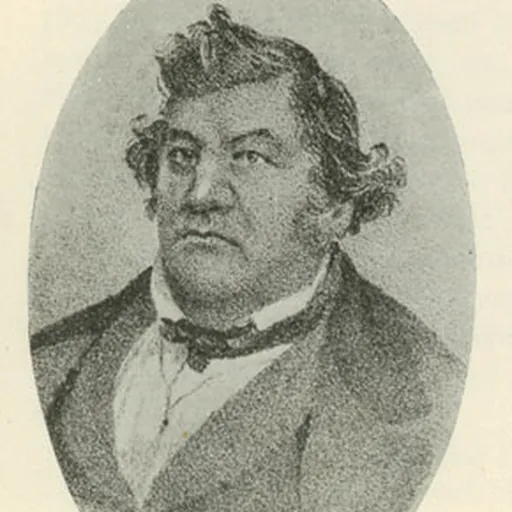
Antoine LeClaire
American philanthropist and businessman
About Antoine LeClaire
Lived 1797 – 1861 (aged 63). Antoine LeClaire was an American interpreter, known for Davenport, Iowa.
Antoine Le Claire (also LeClaire; December 15, 1797 – September 25, 1861) was an American military interpreter, businessman, philanthropist, and principal founder of Davenport, Iowa.
Biography
Early life Le Claire was born on December 15, 1797, in present-day St. Joseph, Michigan, then in the Northwest Territory. His father, François Le Claire, was French Canadian and came to the Americas with Lafayette. His mother was a Native American from the Potawatomi tribe. His father opened a trading post in Milwaukee, Wisconsin, where he traded with several Native American tribes. François supported the side of the United States during the War of 1812. He was subsequently captured by the territorial militia at his trading post in Peoria, Illinois, and held as a prisoner in Alton, Illinois. While his father was imprisoned, Antoine met General William Clark who was impressed with Le Claire's faculty with languages; Clark sent Antoine to school to improve his English and he entered government service. Le Claire spoke English, French, Spanish, and a dozen Native American dialects. He came to Fort Armstrong in 1818, where he became the interpreter for Colonel George Davenport. A short time later, he moved to Peoria, where he met and married his wife Marguerite LePage in 1820. She was born on October 16, 1802, in Portage des Sioux, St. Charles County, Missouri. She was the daughter of a French Canadian, Antoine LePage, and the granddaughter of the Sauk chief Acoqua. After Peoria the Le Claires spent a short time in Arkansas where he observed the movements of Native Americans before moving back to Fort Armstrong in 1827.
Landowner In 1832, at the end of the Black Hawk War, Le Claire was present at the peace treaty signing as an interpreter. Sauk and Meskwaki territories west of the Mississippi River were purchased by the United States government. Because he was respected by the Native Americans, the Le Claires were given three parcels of land. One of the parcels was at the head of the Rock Island Rapids on the west side of the river. The second was given to Marguerite by Keokuk, the Sauk chief. It was also located on the west side of the river and had been the location of the Meskwaki village. In 1834 he established the area's first ferry service across the river.
Davenport
George Davenport gathered a group of investors at his home on February 23, 1836, to create a company in order to develop a new town. It was to be located on the Iowa side of the Mississippi River opposite the town of Stevenson, Illinois, which is now the city of Rock Island. Antoine Le Claire was part of the group. While he owned a great deal of land, he did not have a great deal of money. The other investors paid him $1,750 for the site that now lies between the river and Seventh Street and between Harrison Street to just past Warren Street. The levee along the river was also left open for public use. The east–west streets but one were named for Native American tribes: Sac, Fox (another name for the Meskwaki), Ottawa, Chippewa, and Potawatomie. Later those streets would be renamed Second through Sixth Streets. Front Street, now River Drive, was along the levee. The north–south streets retain their original names: Ripley, Scott, Western, Gaines, Brown and Warren.
Businessman Le Claire joined with George Davenport to develop the first public house in the area, which was named the Le Claire House.
Philanthropy St. Marguerite's Church, later Davenport's first Catholic Cathedral, with the Le Claire grave in the foreground. When the first addition was made to Davenport, Le Claire set aside one of the squares for a Catholic church. In April 1837 he joined with the missionary priest Samuel Charles Mazzuchelli to lay the cornerstone for the original St. Anthony's Church. The title to the property, named Church Square, was deeded to Bishop Mathias Loras of Dubuque in 1839 to support the Catholic Church in Davenport. Because of this support Davenport was named a See City with its own bishop in 1881. Le Claire donated property two miles outside of Davenport for St. Marguerite's Cemetery. Both St. Anthony's and St. Marguerite's were named in honor of the LeClaires for their generosity. The LeClaires hosted members of the Sauk and Meskwaki tribes, who camped on their estate and were allowed to stay as long as they liked. established on LeClaire's property above the Rock Island Rapids Le Claire Township, Scott County, Iowa LeClaire Hotel, Moline, Illinois LeClaire Park, Davenport LeClaire Street, Davenport
Don’t just read it —
keep it.
Full-length biographies made to live with: read them, listen on the way to work, watch them tonight.
- E-book
- Audio
- Video
Instant download · yours to keep · every purchase keeps this site free
Important facts
People in Antoine LeClaire's life
Named in this biography and alive at the same time



Related people
Same field, nearest in time



Contemporaries
People whose lives overlapped Antoine LeClaire's






Frequently asked questions
Who was Antoine LeClaire?
American philanthropist and businessman (1797-1861)
When was Antoine LeClaire born?
Antoine LeClaire was born on 15 December 1797 in St. Joseph.
When did Antoine LeClaire die?
Antoine LeClaire died on 25 September 1861 in Davenport.
What was Antoine LeClaire's occupation?
Antoine LeClaire was an interpreter.
What was Antoine LeClaire known for?
Antoine LeClaire was known for Davenport, Iowa.
What nationality was Antoine LeClaire?
Antoine LeClaire was American.
Sources & further reading
Cite this page
APA: Biography.guide. (2026). Antoine LeClaire. https://biography.guide/antoine-leclaire/
MLA: "Antoine LeClaire." Biography.guide, https://biography.guide/antoine-leclaire/.
Chicago: "Antoine LeClaire." Biography.guide. https://biography.guide/antoine-leclaire/.
Data last updated: 2026-09-23 · Spot an error? Report a correction.
Portrait: Wikimedia Commons · author & licence
Page generated 2026-09-27 05:06 UTC