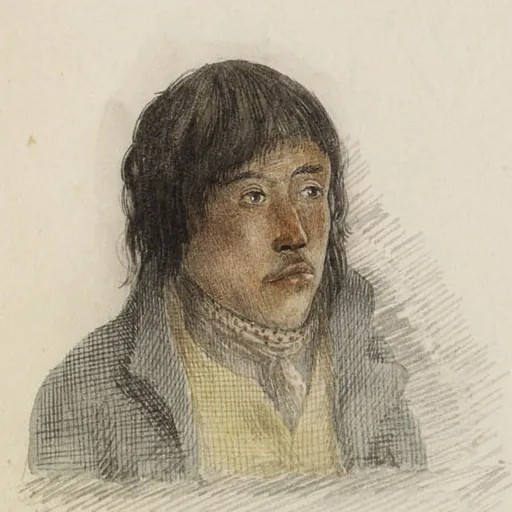
About Tatannuaq
Lived 1790 – 1834 (aged 43–44). Tatannuaq was a Canadian interpreter, hunter and writer.
Tatannuaq (, , – early 1834), also known as Tattannoeuck or Augustus, was an Inuk interpreter for two of John Franklin's Arctic expeditions in what is now Canada. Originally from a group of Inuit living north of Churchill, then part of Rupert's Land, he was employed as an interpreter at the Hudson's Bay Company (HBC) trading post in Churchill, becoming proficient in English and Cree. He explained various geographical and Inuit cultural characteristics to Franklin.
Tatannuaq was hired as one of two Inuit interpreters to accompany Franklin's 1819–1822 Coppermine expedition; during the expedition, Franklin would sometimes send him ahead of the party to scout the terrain, and he helped to communicate with groups they encountered. The expedition was plagued by starvation and by the deaths of the majority of the expedition party on the return journey. He accompanied Franklin on the 1825–1827 Mackenzie River expedition, where he served a diplomatic role and dissuaded Inuit groups from attacking the expedition. After several years of interpreter service at the HBC post at Fort Chimo, he departed to the interior to assist in locating John Ross's expedition, but died due to bad weather a short distance from Fort Resolution in early 1834. The butterfly species Callophrys augustinus and a Northwest Territories lake were named for him.
Early life Tatannuaq (also spelt Tattannoeuck) was born to an Inuit family in the 1790s, about north of Churchill, now the Kivalliq Region of Nunavut, Canada, then part of the Rupert's Land territory. His name loosely translates to or in Inuktitut. He had at least one brother.
Coppermine expedition
Beginning the expedition Following the Napoleonic Wars, the British Admiralty placed great emphasis on the discovery of a hypothetical Northwest Passage, a geographic phenomenon that would supposedly offer a viable sea route between the Atlantic and Pacific Oceans. Royal Navy officer John Franklin was appointed to travel by foot from the North American mainland to explore the Arctic coastline, hoping to meet with a concurrent naval expedition by William Edward Parry intending to traverse Lancaster Sound. Franklin hired Inuit interpreters for the expedition to advise him on the shape of the shorelines and facilitate trade with communities they met along the route.
Tatannuaq, still in Inuit territory, was hired as an interpreter for the expedition in 1820. On June 30, alongside another Inuk interpreter named Hoeootoerock, he arrived at York Factory. The two arrived at Norway House by August 14, reaching Cumberland House nine days later. From Cumberland House, they joined a large party departing towards Fort Chipewyan. Departing from the fort on October 1 alongside a fur brigade headed to Fort Resolution, they reached Great Slave Lake a week later. Although HBC trader Robert McVicar attempted to negotiate the interpreters' passage to Fort Providence aboard a North West Company (NWC) canoe, the vessel was unable to take additional weight, and the interpreters were forced to camp amidst winter weather by the HBC post at Moose Deer Island, near Fort Resolution. The two built an igloo on the island, and in December were found by NWC representative Willard Wentzel and fellow interpreter Pierre St. Germain, who escorted them to the expedition. They arrived at Franklin's post at Fort Enterprise in late January 1821.
Franklin attempted to discern the abilities of the two interpreters by comparing their speech to an Inuttitut (an Inuit dialect from northern Labrador) gospel. Presented with regional maps, Tatannuaq recognized geographical features he had not visited, such as Chesterfield Inlet, and gave details on geographic features not on the map. He explained that his community had traded with three different groups who claimed to reside in an area north of his home. In April, he constructed an igloo with Hoeootoerock and explained its construction to Franklin, who detailed the process meticulously in his diaries. Both Tatannuaq and Hoeootoerock were regarded as helpful and good-spirited interpreters by the expedition party. George Back wrote that Tatannuaq was a great chief who acted with superiority over Hoeootoerock. Tatannuaq also insisted that other expedition members treat him with similar deference to that of an officer. Tatannuaq spent time writing and smoking.
At Coppermine River
Franklin's party, departing from Fort Enterprise on June 14, 1821, was the first British mission to descend the Coppermine River since Samuel Hearne's expedition in the early 1770s, which had allegedly led to the mass killing of Inuit at Bloody Falls. Reaching the falls in July 1821, Tatannuaq and Hoeootoerock were sent ahead of the party to attempt contact with local people. The two spoke with a group of Inuit camped along the river, but the news of a visiting British expedition prompted the group to flee the area. After informing Franklin of the presence of local Inuit, Tatannuaq set out again the following day to meet with them. A brief encounter with a small group kayaking along the river was interrupted by the arrival of Franklin and a group of scouts he had recruited from the Yellowknives, causing the Inuit to once again flee.
Return
Hoeootoerock went missing following a hunting trip, carrying vital supplies including knives and ammunition.
Legacy Following Tatannuaq's death, Back and George Simpson, a colonial governor of HBC, wrote fondly of his service and character, mourning his death. Finlayson eulogized him less favourably, describing him as a good interpreter but a "bad hunter" and "drunken sot."
Don’t just read it —
keep it.
Full-length biographies made to live with: read them, listen on the way to work, watch them tonight.
- E-book
- Audio
- Video
Instant download · yours to keep · every purchase keeps this site free
Important facts
People in Tatannuaq's life
Named in this biography and alive at the same time



Related people
Same field, nearest in time



Contemporaries
People whose lives overlapped Tatannuaq's



Frequently asked questions
Who was Tatannuaq?
Inuit hunter and interpreter
When was Tatannuaq born?
Tatannuaq was born in 1790.
When did Tatannuaq die?
Tatannuaq died in 1834 in Fort Resolution, Jean River.
What was Tatannuaq's occupation?
Tatannuaq was an interpreter, hunter and writer.
What nationality was Tatannuaq?
Tatannuaq was Canadian.
Sources & further reading
Cite this page
APA: Biography.guide. (2026). Tatannuaq. https://biography.guide/tatannuaq/
MLA: "Tatannuaq." Biography.guide, https://biography.guide/tatannuaq/.
Chicago: "Tatannuaq." Biography.guide. https://biography.guide/tatannuaq/.
Data last updated: 2026-09-22 · Spot an error? Report a correction.
Portrait: Wikimedia Commons · author & licence
Page generated 2026-09-27 05:04 UTC