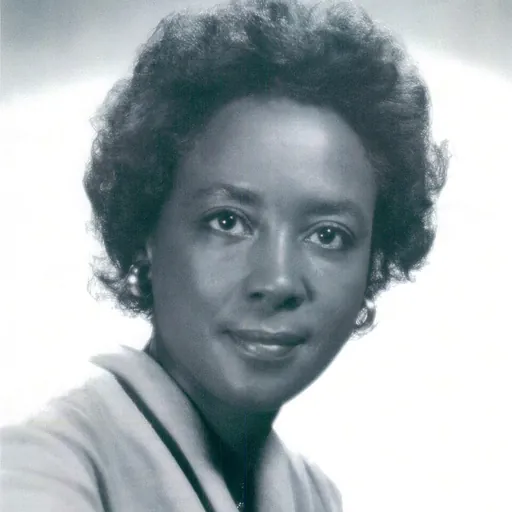
Annie Easley
American mathematician and rocket scientist
About Annie Easley
Lived 1932 – 2011 (aged 79). Annie Easley was an American mathematician, computer scientist, engineer and computer engineering.
Annie Jean Easley (April 23, 1933 – June 25, 2011) was an African American computer scientist who contributed significantly to the beginning iterations of NASA's rocket technologies.
Easley was born in 1933 in Birmingham, Alabama, and was raised by a single mother. At a young age Annie had interest in becoming a nurse, but around the age of 16 she decided to study pharmacy. an African-American Catholic university, and majored in pharmacy for about two years.
In 1977, she obtained a Bachelor of Science in Mathematics from Cleveland State University.
Career
Her career began as a human computer in 1955, doing computations for researchers by hand. Her first work was on running simulations for the newly instated Plum Brook Reactor facility. At the time of hiring, she was only one of four African American employees in the lab. Despite these troubles, she always maintained a positive attitude and tried to go out and do her best work as she famously said in a 2001 interview These skills would serve her well in the development of Centaur, a high-energy booster rocket which was dedicated to being one of the most powerful rockets in the U.S. space program. The unique fuel mix of liquid hydrogen and oxygen were in part inspired by Easley
In addition to her technical work, Easley served as an Equal Employment Opportunity (EEO) counselor at NASA, helping to mediate and resolve workplace discrimination cases. She advocated for inclusive hiring practices and was involved in recruitment outreach to colleges, encouraging more women and minorities to enter engineering and science careers. Easley retired from NASA in 1989, leaving behind a legacy of resilience, innovation, and quiet leadership that helped expand the boundaries of who could contribute to scientific advancement at the nation’s space agency.
Her 34-year career included developing and implementing computer code that analyzed alternative power technologies, supported the Centaur high-energy upper rocket stage, determined solar, wind and energy projects, and identified energy conversion systems and alternative systems to solve energy problems. During the 1970s Easley worked on a project examining damage to the ozone layer. With massive cuts in the NASA space program, Easley began working on energy problems; her energy assignments included studies to determine the life use of storage batteries, such as those used in electric utility vehicles. Her computer applications have been used to identify energy conversion systems that offer the improvement over commercially available technologies. Following the energy crisis of the late 1970s, Easley studied the economic advantages of co-generating power plants that obtained byproducts from coal and steam. After retiring in 1989, she remained an active participant in the Speaker's Bureau and the Business & Professional Women's Foundation. The interview is stored in the National Aeronautics and Space Administration Johnson Space Center Oral History Program. The 55 page interview transcript includes material on the history of the Civil Rights Movement, Glenn Research Center, Johnson Space Center, space flight, and the contribution of women to space flight. In that same Interview, Easley was asked whether she still played with gadgets and stated "I don't have the time or the desire. I will get the email and I'll send it, but I don't play with it. It's not like this fascinating thing I play with. I'd much rather be out doing something actively, like on the golf course or doing other things." She tutored elementary and high school children as well as young adults who had dropped out of school in a work-study program.
Personal life Annie Easley receives a Special Achievement Award from Director of Administration Henry Barnett (left) and Deputy Director Gene Manganiello (June 30, 1970). In 1954, Annie Easley married a man who was in the military. After her husband was discharged from the military, the two of them moved to Cleveland, Ohio to be near his family.
After divorcing her husband, Easley returned to Birmingham. As part of the Jim Crow laws that maintained racial inequality, African Americans were required to pass a literacy test and pay a poll tax in order to vote, which was outlawed in 1964 in the Twenty-fourth Amendment. She remembered the test giver looking at her application and saying only, "You went to Xavier University. Two dollars." Subsequently, she helped other African Americans prepare for the test.
Easley had always loved dressing up. She wore stockings and heels almost every day in college. Although there was no dress code in her work department, wearing pants as a woman during that time was still not normalized. However, she was one of the first to wear pants to work in the 1970s after talking to her supervisor about it.
In her first three years after retiring from NASA, Easley focused on volunteer work, often telling people she put more miles on her car as a retiree than as a worker. She traveled the world, mostly to ski, and become an independent contractor in real estate. Although she no longer tutored, she expressed that she was always willing to talk to students at career days and similar events if asked.
Selected works Performance and Operational Economics Estimates for a Coal Gasification Combined-Cycle Cogeneration Powerplant. Nainiger, Joseph J.; Burns, Raymond K.; Easley, Annie J. NASA, Lewis Research Center, Cleveland, Ohio. NASA Tech Memo 82729 Mar 1982 31p Bleed Cycle Propellant Pumping in a Gas-Core Nuclear Rocket Engine System. Kascak, A. F.; Easley, A. J. National Aeronautics and Space Administration. Lewis Research Center, Cleveland, Ohio. Report No.: NASA-TM-X-2517; E-6639 March 1972 Effect of Turbulent Mixing on Average Fuel Temperatures in a Gas-Core Nuclear Rocket Engine. Easley, A. J.; Kascak, A. F.; National Aeronautics and Space Administration. Lewis Research Center, Cleveland, Ohio. Report No.: NASA-TN-D-4882 Nov 1968
Don’t just read it —
keep it.
Full-length biographies made to live with: read them, listen on the way to work, watch them tonight.
- E-book
- Audio
- Video
Instant download · yours to keep · every purchase keeps this site free
Important facts
People in Annie Easley's life
Named in this biography and alive at the same time

Related people
Same field, nearest in time


Contemporaries
People whose lives overlapped Annie Easley's


Frequently asked questions
Who was Annie Easley?
American mathematician and rocket scientist
When was Annie Easley born?
Annie Easley was born on 23 April 1932 in Birmingham.
When did Annie Easley die?
Annie Easley died on 25 June 2011 in Cleveland.
What was Annie Easley's occupation?
Annie Easley was a mathematician, computer scientist, engineer and computer engineering.
What nationality was Annie Easley?
Annie Easley was American.
Sources & further reading
Cite this page
APA: Biography.guide. (2026). Annie Easley. https://biography.guide/annie-easley/
MLA: "Annie Easley." Biography.guide, https://biography.guide/annie-easley/.
Chicago: "Annie Easley." Biography.guide. https://biography.guide/annie-easley/.
Data last updated: 2026-09-22 · Spot an error? Report a correction.
Portrait: Wikimedia Commons · author & licence
Page generated 2026-09-27 05:31 UTC