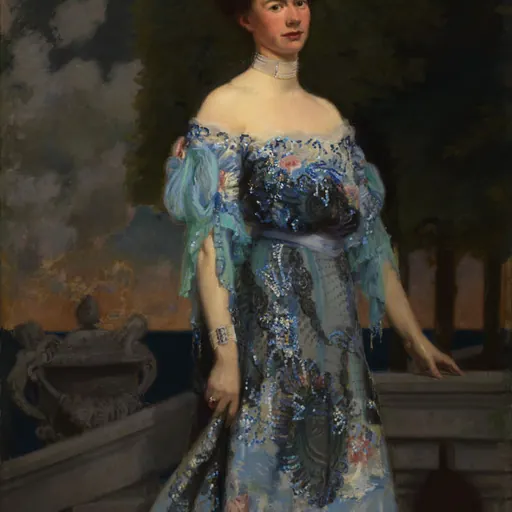
Anne Mills Archbold
American philanthropist, benefactor, and botanical collector
About Anne Mills Archbold
Lived 1873 – 1968 (aged 94). Anne Mills Archbold was an American philanthropist, botanical collector, big game hunter and traveler.
Anne Mills Archbold (November 24, 1873 – March 26, 1968) was an American heiress, big game hunter and philanthropist. Her father was the wealthy oil tycoon John Dustin Archbold and Archbold traveled extensively including to study in Paris and Florence. In 1903 she commissioned an unusual house in Bar Harbor, Maine, inspired by Tuscan villas. She married Armar Dayrolles Saunderson, son of British politician Edward James Saunderson, in 1906 having met in Tibet and had a short engagement. The couple had four children and Archbold became a keen hunter, donating trophies to several natural history museums.
Archbold separated from Saunderson in 1922, fleeing Britain on a Standard Oil steamship with her children, who had been made wards of court. After a divorce settlement, Archbold gave her English estate, Foxlease, to the Girl Guides. She settled in Washington, D.C., and became active in women's rights, as a member of the National Woman's Party and a supporter of the Equal Rights Amendment. She made donations to hospitals and social welfare programs and in 1924, with banker Charles C. Glover, she donated of land to the National Capital Planning Commission; this became Glover-Archbold Park. Archbold fought several legal campaigns to save the park from highway development.
Early life Archbold was born in New York City on November 24, 1873; the second child of American oil tycoon John Dustin Archbold and his wife Annie Eliza Mills, she had a younger brother and two sisters. Her father became very wealthy after his small refining company was bought out by John D. Rockefeller and he rose rapidly in Rockefeller's Standard Oil company. The family moved to the Cedar Cliff estate in Tarrytown, New York, in 1885. The family wealth allowed Archbold to travel extensively, from around 1890, and she received part of her education in Paris and Florence.
Glover-Archbold Park On November 10, 1924, with Washington banker Charles C. Glover, Archbold donated of land around the Foundry Branch of the Potomac River to the National Capital Planning Commission. The land now forms the majority of Glover-Archbold Park. Archbold was keen to establish the land, which contained excellent examples of beech, elm, and oak trees characteristic of the area before settlement, as a greenspace safeguarded from urban encroachment for the use of citizens of the city.
The park was threatened in 1947 with plans for a 4-lane highway to run through it. Archbold and Glover's son opposed the development, with Archbold noting "It is beautifully wooded, with a wealth of wild flowers and bird life. Quiet pathways lead down its sides along the meandering creek bed with its sycamore-tulip tangles, furnishing restful retreats for adults and fascinating children. Such a beautiful park cannot be eliminated if Washington is to grow as a living organism with its parts in proper balance". Another highway plan came under the Federal-Aid Highway Act of 1956, threatening around half of the park. Archbold opposed the scheme, retaining the Douglas, Obear & Campbell law firm at a cost of $10,000. Archbold secured the support of Secretary of the Interior Stewart Udall and, after a public meeting, the plans were amended on January 7, 1958, to save the park. The campaign led to proposals that the park be transferred to the NPS, though this was not immediately achieved.
A revived plan in 1959 was also opposed by Archbold in the District Court, again retaining Douglas, Obear & Campbell at a cost of $25,500, though the case was dropped when the so-called "Northwest Freeze" of the National Capital Transportation Act 1960 prohibited any highway development in an area of northwest DC. A further plan in 1962 to site part of the Three Sisters Bridge and associated highway on the park was defeated with Archbold paying $4,500 in legal fees. After this scheme was dropped in 1967 legislation passed transferring the park to the National Park Service.
Death and legacy Archbold died of a heart attack at her winter home in Nassau on March 26, 1968. After a funeral at Hillandale she was buried at Ivy Hill Cemetery in Upperville, Virginia, near her son John's Foxlease Farms estate. Her estate won a 1972 case in the United States Court of Claims for her Glover-Archbold Park legal fees to be counted as tax-deductible charitable contributions.
Don’t just read it —
keep it.
Full-length biographies made to live with: read them, listen on the way to work, watch them tonight.
- E-book
- Audio
- Video
Instant download · yours to keep · every purchase keeps this site free
Important facts
People in Anne Mills Archbold's life
Named in this biography and alive at the same time



Related people
Same field, nearest in time


Contemporaries
People whose lives overlapped Anne Mills Archbold's


Frequently asked questions
Who was Anne Mills Archbold?
American philanthropist, benefactor, and botanical collector (1873-1968)
When was Anne Mills Archbold born?
Anne Mills Archbold was born on 24 November 1873 in Titusville.
When did Anne Mills Archbold die?
Anne Mills Archbold died on 26 March 1968 in Nassau.
What was Anne Mills Archbold's occupation?
Anne Mills Archbold was a philanthropist, botanical collector, big game hunter and traveler.
What nationality was Anne Mills Archbold?
Anne Mills Archbold was American.
Sources & further reading
· Wikipedia: Anne Mills Archbold
· DBpedia: Anne Mills Archbold
Cite this page
APA: Biography.guide. (2026). Anne Mills Archbold. https://biography.guide/anne-mills-archbold/
MLA: "Anne Mills Archbold." Biography.guide, https://biography.guide/anne-mills-archbold/.
Chicago: "Anne Mills Archbold." Biography.guide. https://biography.guide/anne-mills-archbold/.
Data last updated: 2026-09-22 · Spot an error? Report a correction.
Portrait: Wikimedia Commons · author & licence
Page generated 2026-09-27 05:02 UTC