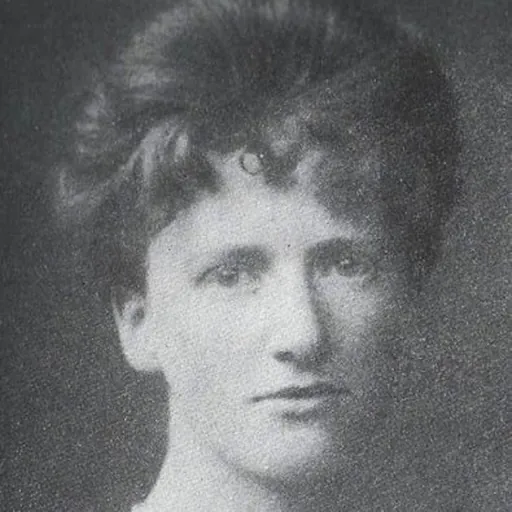
Eglantyne Jebbs
British social reformer, founder of "Save the Children"
About Eglantyne Jebbs
Lived 1876 – 1928 (aged 52). Eglantyne Jebbs was a British philanthropist and social reformer, known for Declaration of the Rights of the Child and Save the Children.
Eglantyne Jebb (25 August 1876 – 17 December 1928) was a British social reformer who founded the Save the Children organisation at the end of World War I to relieve the effects of famine in Austria-Hungary and Germany. She drafted the document that became the Declaration of the Rights of the Child.
Early life and family Eglantyne Jebb was born on August 25, 1876 in Ellesmere, Shropshire, to barrister Arthur Jebb and his wife and distant cousin, Eglantyne Louisa Jebb. She grew up at "The Lyth", her family's nearby estate. The Jebbs were a wealthy family. Her mother had founded the Home Arts and Industries Association, to promote Arts and Crafts among young people in rural areas; her sister Louisa Wilkins would help found the Women's Land Army in World War I. Another sister, Dorothy, who married the Labour MP Charles Roden Buxton, campaigned against the demonisation of the German people after the war and served as a faculty member at Wellesley College, Massachusetts, United States, in 1929, teaching courses in English literature.
Eglantyne's paternal aunt, Louisa Jebb, was a Victorian "new woman" who introduced her and her five siblings to carpentry, fishing, and lead bullets casting. Louisa inspired her niece to go to university at a time when very few women did, having attended Newnham College, Cambridge, herself. Jebb taught for a year at St. Peter's School, Marlborough (built in 1904, closed July 2017). This convinced Jebb that teaching was not her vocation.
Jebb moved to Cambridge in 1901 to look after her sick mother. There, encouraged by Mary Marshall and Florence Keynes, she became involved in the Charity Organisation Society, which aimed to bring a modern scientific approach to charity work.
In the run-up to World War I, the Cambridge Independent Press, a weekly Liberal-supporting newspaper, covered Jebb's political campaign in Cambridge. In 1907, Jebb was appointed to the Education Committee of Cambridge Borough Council, although in her first year she attended only 13 of a possible 31 meetings. Jebb sat on the committee of the newly formed League for Physical Education and Improvement, but resigned citing pressures from other workloads.
Under the supervision of Florence Keynes, Jebb and Keynes' daughter, Margaret Hill, set up and ran the Boys' Employment Registry, shortly followed by a similar one for girls. In 2014, a blue plaque was mounted above 82 Regent Street where the employment registry had been sited.
In 1913, Jebb was influenced by Charles Roden Buxton to undertake a journey to Macedonia on behalf of the Macedonian Relief Fund.
Save the Children Fund
Jebb's focus shifted to organising relief. On 15 April 1919, the Council set up a fund to raise money for the German and Austrian children – the Save the Children Fund. Unexpectedly, this organisation, launched at the Royal Albert Hall in London on 19 May 1919, quickly raised a large sum of money from the British public.
The success of the Fund led her and her sister Dorothy to attempt to set up an international movement for children. In 1920, the International Save the Children Union (Union Internationale de Secours à l'Enfant) was founded in Geneva, with the British Save the Children Fund and the Swedish Rädda Barnen as leading members.
In London, Jebb was in charge, and she ensured that the Fund adopted the professional approach she had learnt in the Charity Organisation Society. A manager, Lewis Golden, was recruited to put the organisation on a businesslike foundation. He adopted the innovative – and controversial – approach of taking full-page advertisements in national newspapers; it was highly effective, and raised very substantial amounts of income for the Fund's work.
As the problems in central Europe receded, a new focus of the Fund's attention became a refugee crisis in Greece and the surrounding areas, a consequence of the continuing conflict in the area. In 1921, just as this situation was coming under control, there was a new and bigger emergency, the Russian famine of 1921 affecting the people of Soviet Russia. A new fundraising effort brought a surge of donations, and Save the Children brought a shipment of 600 tons of food and medical supplies to Russia. for her involvement to the cause of the children rights.
Legacy In 1919, Jebb and her sister Dorothy Buxton, who converted to the Society of Friends with her husband, founded Save the Children in England and the following year as an international organisation based in Geneva.
Save the Children remains active today. A blue plaque was put up in Marlborough to Eglantyne Jebb who had founded Save the Children. In error, the plaque stated Eglantyne Mary Jebb (a distant relative); it was corrected in 2019.
An expanded version of Jebb's Declaration of the Rights of the Child was adopted by the United Nations in 1959; it was one of the main inspirations behind the 1989 UN Convention on the Rights of the Child.
The Church of England remembers her life and service annually with a commemoration in its liturgical calendar on 17 December. In 2016, Jebb was featured in a series of six British stamps dedicated to humanitarians, and multiple pictures of her hang in the London National Portrait Gallery.
Don’t just read it —
keep it.
Full-length biographies made to live with: read them, listen on the way to work, watch them tonight.
- E-book
- Audio
- Video
Instant download · yours to keep · every purchase keeps this site free
Important facts
People in Eglantyne Jebbs's life
Named in this biography and alive at the same time



Related people
Same field, nearest in time



Contemporaries
People whose lives overlapped Eglantyne Jebbs's

Frequently asked questions
Who was Eglantyne Jebbs?
British social reformer, founder of "Save the Children" (1876-1928)
When was Eglantyne Jebbs born?
Eglantyne Jebbs was born on 25 August 1876 in Ellesmere.
When did Eglantyne Jebbs die?
Eglantyne Jebbs died on 17 December 1928 in Geneva.
What was Eglantyne Jebbs's occupation?
Eglantyne Jebbs was a philanthropist and social reformer.
What was Eglantyne Jebbs known for?
Eglantyne Jebbs was known for Declaration of the Rights of the Child and Save the Children.
What nationality was Eglantyne Jebbs?
Eglantyne Jebbs was British.
Sources & further reading
Cite this page
APA: Biography.guide. (2026). Eglantyne Jebbs. https://biography.guide/eglantyne-jebbs/
MLA: "Eglantyne Jebbs." Biography.guide, https://biography.guide/eglantyne-jebbs/.
Chicago: "Eglantyne Jebbs." Biography.guide. https://biography.guide/eglantyne-jebbs/.
Data last updated: 2026-09-23 · Spot an error? Report a correction.
Portrait: Wikimedia Commons · author & licence
Page generated 2026-09-27 05:06 UTC