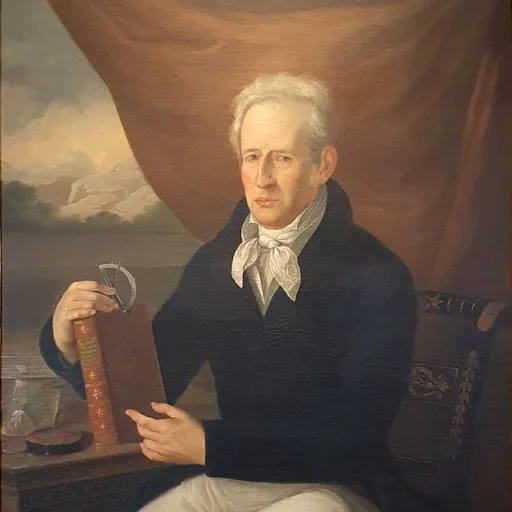
About Andrés Manuel del Río
Lived 1764 – 1849 (aged 84). Andrés Manuel del Río was a Spanish and Mexican chemist, mineralogist, naturalist, university teacher, geologist and writer, known for Vanadium.
Andrés Manuel del Río y Fernández (10 November 1764 – 23 March 1849) was a Spanish scientist, naturalist and engineer who discovered compounds of vanadium in 1801. He proposed that the element be given the name panchromium, or later, erythronium, but his discovery was not credited at the time, and his names were not used.
Education Andrés del Río studied analytical chemistry and metallurgy in Spain, where he was born. He received his bachelor's degree from the University of Alcalá de Henares in 1780 at the age of fifteen. The government gave him a scholarship to enter the Royal Academy of Mines in Almadén, Spain, as of June 1782. He showed great aptitude. In 1783 he was given a travel grant by the Spanish Ministry of Mines. He used it to study in Paris, with the chemist Jean Darcet at the Collège de France. After Lavoisier's arrest, Del Río escaped to England. In 1793, Elhúyar offered Del Río a position as chair at the newly organized college. Del Rio refused the chair of chemistry, but accepted that of mineralogy. Del Río arrived at the port of Veracruz on 20 October 1794, on the ship San Francisco de Alcántara out of Cádiz.
Once in his new position, del Río dedicated himself to teaching and scientific investigation. On 27 April 1795 he opened the first course in mineralogy ever presented in New Spain. described it as "a monumental work, which... will be an object of veneration and consultation".
German naturalist, Alexander von Humboldt, making a survey of resources in Spanish-held colonies for Spain, reported favorably that it was in Mexico where the best work of mineralogy in Spanish had been published, the Elementos de Orictognosia of Señor Del Rio.
In 1820 del Río was named a deputy to the Spanish Cortes. He was a liberal who argued for the independence of New Spain. He was in Madrid when Mexico gained its independence. Invited to remain in Spain, he nevertheless returned to Mexico (in 1821), which he considered his homeland.
In 1829, amidst the Spanish attempts to reconquer Mexico, the government of independent Mexico expelled the Spaniards resident in the country, with some notable exceptions. Del Río was one of the exceptions. The expulsion had a major impact on the work of the College of Mining. The director, Fausto Elhúyar, was forced to resign and leave the country. and was elected president of the Geological Society of Philadelphia. John Hurtel of Philadelphia published a new edition of del Rio's book in 1832. Del Rio returned to Mexico in 1834 and again occupied the chair of mineralogy at the college. He was also given the chair of geology.
The following year he gave samples containing the new element to Alexander von Humboldt, who sent them on to Hippolyte Victor Collet-Descotils in París for his analysis. Collet-Descotils's analysis found (mistakenly) that the samples contained only chromium. Humboldt, in turn, rejected del Río's claim of the discovery of a new element, and del Río himself concluded his discovery had been an error.
In 1830, 27 years after its initial discovery, Professor Nils Gabriel Sefström of Sweden rediscovered the element in a sample of iron of Taberg. He gave it its current name, vanadium, in honor of the Scandinavian goddess of love and beauty, Vanadis. In the same year, Friedrich Wöhler, the German chemist who had synthesized urea, analyzed some of del Río's samples of brown lead ore of Zimapán and demonstrated that Sefström's vanadium and del Rio's erythronium were the same.
Del Rio was bitter about Humboldt's mistake in not confirming the discovery of vanadium, and strongly reproached him.
Death and recognition
Andrés Manuel del Río died at 84 in 1849, after a long and productive academic career.
The Chemical Society of Mexico instituted the prestigious National Chemistry Prize "Andrés Manuel Del Río" in 1964, with the object of giving public recognition to the work done by chemical professionals who have made extraordinary contributions to raise the level and prestige of the profession. It is awarded with a medal containing the likeness of del Río and a commemorative plaque. Andrés Manuel Del Río, Luis E. Miramontes, inventor of the first oral contraceptive, and Mario J. Molina, winner of the Nobel Prize in Chemistry in 1995, are the three Mexican chemists of outstanding world significance. Miramontes won the "Andrés Manuel Del Río" Prize in 1986.
Selected scientific works Elementos de Orictognesia o del conocimiento de los fósiles, prepared for use in the Real Seminario de Mineria de México, 1795. Analyse des deux nouvelles espéces minérales composées de séléniure de zinc et de sulfure de mercure. Annales des Mines, Paris, 5, 1829. Découverte de l'iodure de mercure au Mexique. Annales des Mines, Paris, 5, 1829. Elementos de Orictognesia, o del conocimiento de los fósiles según el sistema de Bercelio; y según los principios de Abraham Góttlob Wérner, con la sinonimia inglesa, alemana y francesa, para uso del Seminario Nacional de Minería de México. Philadelphia, 1832.
Don’t just read it —
keep it.
Full-length biographies made to live with: read them, listen on the way to work, watch them tonight.
- E-book
- Audio
- Video
Instant download · yours to keep · every purchase keeps this site free
Important facts
People in Andrés Manuel del Río's life
Named in this biography and alive at the same time



Related people
Same field, nearest in time


Contemporaries
People whose lives overlapped Andrés Manuel del Río's





Frequently asked questions
Who was Andrés Manuel del Río?
Spanish scientist (1764-1849)
When was Andrés Manuel del Río born?
Andrés Manuel del Río was born on 10 November 1764 in Madrid.
When did Andrés Manuel del Río die?
Andrés Manuel del Río died on 23 March 1849 in Mexico City.
What was Andrés Manuel del Río's occupation?
Andrés Manuel del Río was a chemist, mineralogist, naturalist, university teacher, geologist and writer.
What was Andrés Manuel del Río known for?
Andrés Manuel del Río was known for Vanadium.
What nationality was Andrés Manuel del Río?
Andrés Manuel del Río was Spanish and Mexican.
Sources & further reading
· Wikipedia: Andrés Manuel del Río
· DBpedia: Andrés Manuel del Río
Cite this page
APA: Biography.guide. (2026). Andrés Manuel del Río. https://biography.guide/andres-manuel-del-rio/
MLA: "Andrés Manuel del Río." Biography.guide, https://biography.guide/andres-manuel-del-rio/.
Chicago: "Andrés Manuel del Río." Biography.guide. https://biography.guide/andres-manuel-del-rio/.
Data last updated: 2026-09-20 · Spot an error? Report a correction.
Portrait: Wikimedia Commons · author & licence
Page generated 2026-09-27 04:58 UTC