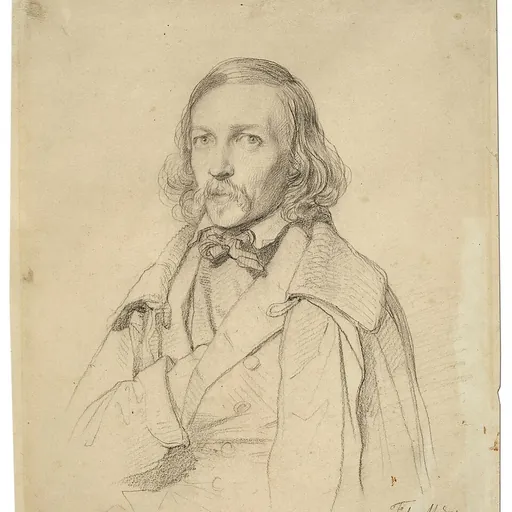
About Andreas Müller
Lived 1811 – 1890 (aged 79). Andreas Müller was a German painter, restorer, university teacher, graphic artist and artist.
Andreas Johann Jacob Heinrich Müller (19 February 1811, Kassel – 29 March 1890, Düsseldorf)
Biography
He was the son of a court painter, who, in 1817, became Director of the Grand Ducal gallery in Darmstadt. His younger brother, Karl was also an artist. He received his first art lessons from his father then, in 1833, enrolled at the Academy of Fine Arts, Munich, where he studied with Julius Schnorr von Carolsfeld and Peter von Cornelius. The following year, to improve his oil painting techniques, he transferred to the Kunstakademie Düsseldorf, under the direction of Friedrich Wilhelm von Schadow. Under the influence of Ernst Deger, he turned to religious art, which had already begun to interest him in Munich. His first work in that genre, "Three Singing Angels", was purchased by Prince Adolphus, Duke of Cambridge in 1836.
This enabled him to accompany Deger to Italy in 1837 where, in Rome, he joined the Nazarene movement. In 1840, he married Maria Katharina Schweden (1814–1883), the daughter of a Master saddler. The following year, he returned to Düsseldorf with Maria and his newborn son, Joseph.
Together with Deger, his brother Karl, and Franz Ittenbach, he was commissioned by Count Franz Egon von Fürstenberg-Stammheim to create wall paintings at the Apollinariskirche, Remagen. That project occupied him from 1843 to 1851. Most of the work was done under his direction, but his personal contribution consisted of four panels near the transept, depicting the life of Saint Apollinaris. He also did smaller figures of various patron saints, associated with the noble families who were financing the work.
In 1855, he was appointed a Professor at the Kunstakademie, succeeding , who had retired. In that position, he taught art history and served as curator of the Krahe Art Collection. In 1872, he and a group of young students were able to save the collection, during a fire that destroyed much of Düsseldorf Castle. Several of his own works, in his studio, including an almost completed altarpiece, were lost. It took him until 1877 to redo it.
His teaching left him less time to devote to his paintings. Nevertheless, he became involved in restorative work; notably on an Assumption by Rubens, at the request of Adolf I, Prince of Schaumburg-Lippe. A major restoration at , also on behalf of Prince Adolf, was incomplete when he suffered a major stroke in 1881. It left him paralyzed and unable to speak until his death in 1890, shortly after his seventy-ninth birthday.
Don’t just read it —
keep it.
Full-length biographies made to live with: read them, listen on the way to work, watch them tonight.
- E-book
- Audio
- Video
Instant download · yours to keep · every purchase keeps this site free
Important facts
People in Andreas Müller's life
Named in this biography and alive at the same time


Related people
Same field, nearest in time

Contemporaries
People whose lives overlapped Andreas Müller's





Frequently asked questions
Who was Andreas Müller?
German historical painter (1811-1890)
When was Andreas Müller born?
Andreas Müller was born on 19 February 1811 in Kassel.
When did Andreas Müller die?
Andreas Müller died on 29 March 1890 in Düsseldorf.
What was Andreas Müller's occupation?
Andreas Müller was a painter, restorer, university teacher, graphic artist and artist.
What nationality was Andreas Müller?
Andreas Müller was German.
Sources & further reading
· DBpedia: Andreas Müller (painter)
Cite this page
APA: Biography.guide. (2026). Andreas Müller. https://biography.guide/andreas-muller-painter/
MLA: "Andreas Müller." Biography.guide, https://biography.guide/andreas-muller-painter/.
Chicago: "Andreas Müller." Biography.guide. https://biography.guide/andreas-muller-painter/.
Data last updated: 2026-09-20 · Spot an error? Report a correction.
Page generated 2026-09-27 05:09 UTC