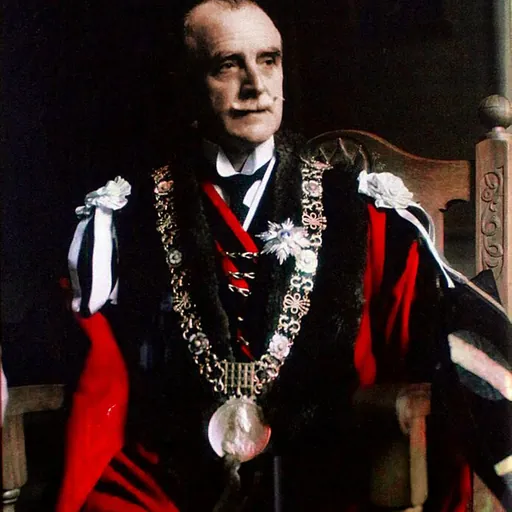
About Alfred Byrne
Lived 1882 – 1956 (aged 73). Alfred Byrne was an Irish politician.
Alfred Byrne (17 March 1882 – 13 March 1956) was an Irish politician who served as a Member of Parliament (MP), as a Teachta Dála (TD) and as Lord Mayor of Dublin. He was known as the "Shaking Hand of Dublin". His childhood home was at 36 Seville Place, a terraced house with five rooms just off the North Strand in Dublin. Byrne dropped out of school at the age of 13, and was soon juggling jobs as a grocer's assistant and a bicycle mechanic. Eventually he used his savings to buy a pub on Talbot Street.
Early political career
Byrne became an Alderman on Dublin Corporation in 1914. He was a member of the Dublin Port and Docks Board, a significant position for a politician from the Dublin Harbour constituency. In the records of the Oireachtas his occupation is given as company director. He was elected as MP for Dublin Harbour in a by-election on 1 October 1915, following the death of William Abraham, as a candidate of the Irish Parliamentary Party. The Easter Rising in 1916 was followed by the rapid decline of the Irish Parliamentary Party and the rise of Sinn Féin. At the 1918 general election Byrne was defeated by a Sinn Féin candidate, Philip Shanahan.
Byrne was elected as an independent TD supporting the Anglo-Irish Treaty for Dublin Mid at the general election to the 3rd Dáil in 1922. From 1923 to 1928 he represented Dublin North. He was an elected member of Seanad Éireann, for a six-year term from 1928. He vacated his Dáil seat on 4 December 1928. He resigned from the Seanad on 10 December 1931 and returned to the Dáil in 1932. He remained a TD until his death in 1956, representing Dublin North (1932–1937) and Dublin North-East (1937–1956). In several elections he secured more votes than any other politician in the country.
Lord Mayor (1930–1939)
Byrne was elected as Lord Mayor of Dublin in 1930, serving in the post for nine consecutive years. When cycling or walking around the city he dispensed lollipops to children, who were often seen chasing him down the street. With a handshake and a few words for all, his eternal canvassing soon earned him the first of his nicknames: the Shaking Hand of Dublin. Every morning he would find up to fifty people waiting for him in the Mansion House. None had appointments. All were met. Byrne answered 15,000 letters in his first year as Lord Mayor. Many were from Dubliners looking for a job, a house, some advice or a reference. One morning in 1931 a journalist watched the Lord Mayor attend to his correspondence. Within an hour he accepted "seventeen invitations to public dinners, one invitation to a public entertainment and eight invitations to public functions." Then he dictated forty-three sympathetic letters to men and women looking for employment. Byrne stood firm: "For the punishment of trifling offences the home of the children is better than any institution." In 1938, Byrne was favoured by the press for the presidency of Ireland, a ceremonial role created in the new Constitution, but he was outgunned by the political establishment.
Relations with the United States and the United Kingdom
When, in 1935, Byrne became the first Lord Mayor of Dublin to visit North America in 40 years, he was granted the freedom of Toronto, and The New York Times hailed the arrival of a "champion showman". As Lord Mayor, Byrne felt obliged to join the men on top of the fire engine as they set off on the 85-mile journey in the middle of the night.
Anti-communist connections In August 1936, Byrne addressed the inaugural meeting of the anti-communist Irish Christian Front, some of whose members later expressed anti-Semitic views. In 1938, as Lord Mayor, he presented a gift of a replica of the Ardagh Chalice to Italian naval cadets visiting Dublin on board two warships, who had been welcomed by the Irish government despite the protests of Dubliners. A photograph exists of Byrne giving a fascist salute along with Eoin O'Duffy, commander of the Blueshirts, around 1933.
Final term as Lord Mayor (1954) In 1954, Byrne was elected as Lord Mayor for a record tenth time. This time he did not live in the Mansion House, but stayed in Rathmines with his family, taking the bus to work each morning. He was just as devoted to the job. When flooding damaged 20,000 houses in Fairview and North Strand, he rose from his sick bed to organise a relief fund.
Death Alfie Byrne died on 13 March 1956. An obituary in The Irish Times noted: The Irish Times noted that "one of the largest groups of people gathered at the Five Lamps, one of the few places at which Alderman Byrne always made a speech during his election campaign for Dublin North-East."
Legacy The press called him the "Shaking Hand of Dublin", Alfred the Great, and The Lord Mayor of Ireland, but most people knew him simply as Alfie. As one of the most popular Dublin-born politicians of the 20th century, he did not write a memoir. The Dublin Bay North branch of Young Fine Gael was renamed 'Alfie Byrne YFG'.
Alfie Byrne also holds the distinction of being the only person to serve as Councillor, Alderman, Lord Mayor of Dublin, MP, TD and Senator.
Don’t just read it —
keep it.
Full-length biographies made to live with: read them, listen on the way to work, watch them tonight.
- E-book
- Audio
- Video
Instant download · yours to keep · every purchase keeps this site free
Important facts
Family & relationships
People in Alfred Byrne's life
Named in this biography and alive at the same time

Related people
Same field, nearest in time




Contemporaries
People whose lives overlapped Alfred Byrne's


Frequently asked questions
Who was Alfred Byrne?
Irish politician (1882–1956)
When was Alfred Byrne born?
Alfred Byrne was born on 17 March 1882 in Dublin.
When did Alfred Byrne die?
Alfred Byrne died on 13 March 1956 in Dublin.
What was Alfred Byrne's occupation?
Alfred Byrne was a politician.
What nationality was Alfred Byrne?
Alfred Byrne was Irish.
Sources & further reading
Cite this page
APA: Biography.guide. (2026). Alfred Byrne. https://biography.guide/alfred-byrne/
MLA: "Alfred Byrne." Biography.guide, https://biography.guide/alfred-byrne/.
Chicago: "Alfred Byrne." Biography.guide. https://biography.guide/alfred-byrne/.
Data last updated: 2026-09-20 · Spot an error? Report a correction.
Portrait: Wikimedia Commons · author & licence
Page generated 2026-09-27 04:58 UTC