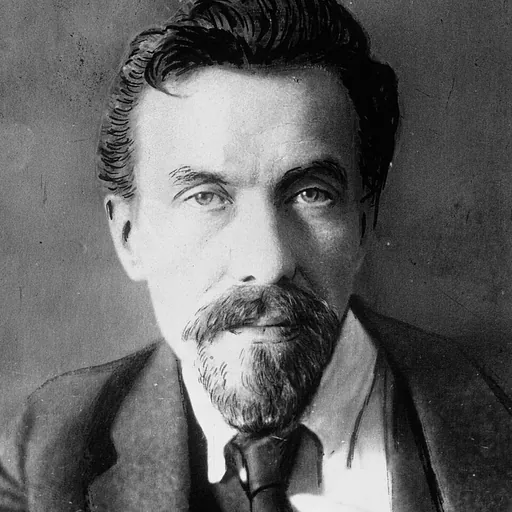
About Alexei Rykov
Lived 1881 – 1938 (aged 57). Alexei Rykov was a Russian politician.
Alexei Ivanovich Rykov (25 February 188115 March 1938) was a Russian Bolshevik revolutionary and a Soviet politician and statesman, most prominent as premier of Russia and the Soviet Union from 1924 to 1929 and 1924 to 1930 respectively. He was one of the accused in Joseph Stalin's show trials during the Great Purge.
Rykov joined the Russian Social Democratic Labour Party in 1898. After it split into Bolshevik and Menshevik factions in 1903, he joined the Bolshevik faction led by Vladimir Lenin. Months prior to the October Revolution of 1917, he became a member of the Petrograd and Moscow Soviets and was elected to the Bolshevik Party Central Committee during the Sixth Congress of the Bolshevik Party. On 26 May 1921, he was appointed Deputy Chairman of the Council of Labor and Defense of the Russian SFSR under Lenin. With Lenin increasingly sidelined by ill health, Rykov became his deputy at the Sovnarkom (Council of People's Commissars) on 29 December. Rykov joined the ruling Politburo on 3 April 1922, after the 11th Party Congress. A government reorganization in the wake of the formation of the Soviet Union in December 1922 resulted in Rykov's appointment as Chairman of the USSR Supreme Council of National Economy and Deputy Chairman of the USSR Council of People's Commissars on 6 July 1923.
Joseph Stalin, General Secretary of the Communist Party. Alexei Rykov, Chairman of the Council of People's Commissars (Prime Minister). Lev Kamenev, Deputy Chairman of the Council of People's Commissars (Deputy Prime Minister). Grigory Zinoviev, Chairman of the Comintern's , April 1925
After Lenin's death on 21 January 1924 Rykov gave up his position as Chairman of the USSR Supreme Council of National Economy and became Chairman of the Council of People's Commissars of the USSR and, simultaneously, of the Sovnarkom of the RSFSR, on 2 February 1924.
Along with Nikolai Bukharin and Mikhail Tomsky, Rykov led the moderate wing of the Communist Party in the 1920s, promoting a partial restoration of the market economy under NEP policies. The moderates supported Joseph Stalin, Grigory Zinoviev, and Lev Kamenev against Leon Trotsky and the Left Opposition in 1923–24. After Trotsky's defeat and Stalin's break with Zinoviev and Kamenev in 1925, Rykov, Bukharin and Tomsky supported Stalin against the United Opposition of Trotsky, Zinoviev and Kamenev in 1926–27. After Kamenev voiced opposition to Stalin at the 14th Party Congress in December 1925, he lost his position as Chairman of the Soviet Council of Labor and Defense—which he had assumed from Lenin following Lenin's death—and was replaced by Rykov on 19 January 1926.
Under his leadership vodka was heavily taxed, and became known as "Rykovka". Some of his political opponents claimed that he was a heavy drinker, but in reality he was an abstainer.
Rise of Stalin and demise (1927–1938)
Rykov's Premiership encompassed drastic change in the power structure of the Soviet Union. From 1924 to 1930 the role of the Communist Party—informally led by Stalin who, as General Secretary, controlled Party membership—increasingly usurped powers from the legitimate governmental structures. Although an exact date cannot be given for Stalin's rise to power, the United Opposition—which consisted of Kamenev, Zinoviev, and Trotsky—was defeated and its followers were expelled from the Party by December 1927. After the defeat of the United Opposition, Stalin adopted more radical policies and came into conflict with the moderate wing of the party. The two factions maneuvered behind the scenes throughout 1928. In February–April 1929 the conflict came to a head and the moderates, branded the Right Opposition, or "Rightists", were defeated and forced to "admit their mistakes" in November 1929. Rykov lost his position as Premier of the Russian SFSR to Sergei Syrtsov on 18 May 1929, but retained his other two posts. On 19 December 1930, after admitting another round of "mistakes", he was replaced by Vyacheslav Molotov as both Soviet Premier and Chairman of the Council of Labor and Defense. Two days later, Rykov was expelled from the Politburo, taking with him any chance of political advancement. As Stalin's Great Purge intensified in early 1937, Rykov and Bukharin were expelled from the Communist Party and arrested at the February–March 1937 meeting of the Central Committee on 27 February. On 13 March 1938, at the Trial of the Twenty-One, Rykov, Bukharin, Nikolay Krestinsky, Christian Rakovsky, Genrikh Yagoda, and sixteen other Soviet officials were found guilty of treason (having plotted with Trotsky against Stalin) and sentenced to death by the Military Collegium. Rykov wrote a letter to the collegium requesting clemency but failed to get them to overturn the verdict. Rykov was executed by firing squad on March 14, 1938, after being found guilty of treason and other charges. Yevgenia Ginzburg, who was also arrested in 1937, recorded being approached inside Butyrka prison by "a woman of about 55, with an expression of acute suffering on her face" who demanded: "Have they tried them yet? They've shot them, haven't they?" Ginzburg was told this was Rykov's wife, vainly seeking news of her husband. Nina Rykov was shot on 4 March 1938.
Their daughter Natalya, born 1916, worked for the NKVD as a teacher until her father's arrest, when she was sent into administrative exile in Tomsk, where she was arrested on 1 March 1938 and sentenced to eight years in the gulag for 'anti-soviet agitation'. On completing her sentence in 1946, she was sentenced to five years exile in East Kazakhstan, but before that had expired, she was arrested again and exiled to the Yenisey region of Krasnoyarsk. could not work, and had to depend on her husband, Walter Perli (1907–1961), a former officer in the Estonian army, arrested during the Soviet occupation of Estonia in 1940, whom she married in exile in June 1949. Chamberlin remembered Rykov as "perhaps the most humanly attractive figure in the Soviet leadership" and a lost opportunity for Russia:
"His manner was simple, kindly, unaffected, what one might expect from a Russian provincial teacher or doctor. And I was rather struck by the expression of brooding sadness on his face; it was a reasonable guess that he felt more keenly than most men in the seats of power the contrast between the old revolutionary ideals and the hard realities of the present. It was one of the missed chances of Soviet history that Rykov and his considerable following in the Communist Party, those who believed in a milder approach to the peasants, could not have found support in the top leadership of the Red Army for a coup that would have eliminated Stalin during the grim years, 1929–33, when there was enough popular discontent with the sharply deteriorating situation with food and manufactured goods to have made such a move psychologically feasible."
Don’t just read it —
keep it.
Full-length biographies made to live with: read them, listen on the way to work, watch them tonight.
- E-book
- Audio
- Video
Instant download · yours to keep · every purchase keeps this site free
Important facts
People in Alexei Rykov's life
Named in this biography and alive at the same time




Related people
Same field, nearest in time





Contemporaries
People whose lives overlapped Alexei Rykov's



Frequently asked questions
Who was Alexei Rykov?
Premier of Russia and the Soviet Union (1881-1938)
When was Alexei Rykov born?
Alexei Rykov was born on 25 February 1881 in Saratov.
When did Alexei Rykov die?
Alexei Rykov died on 15 March 1938 in Moscow.
What was Alexei Rykov's occupation?
Alexei Rykov was a politician.
What nationality was Alexei Rykov?
Alexei Rykov was Russian.
Sources & further reading
Cite this page
APA: Biography.guide. (2026). Alexei Rykov. https://biography.guide/alexei-rykov/
MLA: "Alexei Rykov." Biography.guide, https://biography.guide/alexei-rykov/.
Chicago: "Alexei Rykov." Biography.guide. https://biography.guide/alexei-rykov/.
Data last updated: 2026-09-23 · Spot an error? Report a correction.
Portrait: Wikimedia Commons · author & licence
Page generated 2026-09-27 05:07 UTC