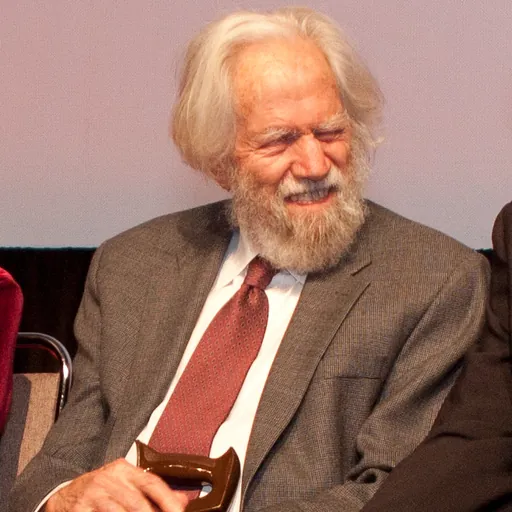
Alexander Shulgin
American medicinal chemist, biochemist, pharmacologist, psychopharmacologist, and author
About Alexander Shulgin
Lived 1925 – 2014 (aged 88). Alexander Shulgin was an American biochemist, pharmacologist, chemist, writer and pharmacist, known for 2Cs, DOx and MDMA.
Early life and career Shulgin was born on June 17, 1925, to Theodore Stevens Shulgin (1893–1978) and Henrietta D. (Aten) Shulgin (1894–1960). His father was born in Chelyabinsk, Russia and was a refugee of the Russian Revolution; his mother was born in Illinois. Theodore and Henrietta were public school teachers in Alameda County, California.
Shulgin studied organic chemistry at Harvard University as a scholarship student, and was enrolled there at the age of 16. Speaking of the experience, Shulgin said "I learned there was a great deal inside me".
Mexacarbate (Zectran)-containing pesticide manufactured by Dow; photo taken at the Farm in 2009.
Shulgin's professional activities continued to lean in the direction of psychopharmacology, furthered by his personal experiences with psychedelics. But during this period he was unable to do much independent research. His opportunity for further research came in 1961 after his development of mexacarbate (brand name Zectran), the first biodegradable pesticide and a highly profitable product. He also served as an expert witness for the DEA and received several awards from them. Though Ariadne was not psychedelic, it was still psychoactive, producing feelings of well-being and mental alertness analogously to sub-hallucinogenic doses of DOM and DOET. Shulgin set up a chemical synthesis laboratory in a small building behind his house, which gave him a great deal of career autonomy. Shulgin used this freedom to synthesize and test the effects of potentially psychoactive drugs.
In 1976, Shulgin was reintroduced to MDMA by a student in the medicinal chemistry group he advised at San Francisco State University. MDMA had been synthesized in 1912 by Merck and patented in 1913 as an intermediate of another synthesis in order to block competitors, but was never explored in its own right. Shulgin went on to develop a new synthesis method, and in 1976, introduced the chemical to Leo Zeff, a psychologist from Oakland, California. Zeff used the substance in his practice in small doses as an aid to talk therapy. Zeff introduced the substance to hundreds of psychologists and lay therapists around the nation, including Ann Gotlieb, whom Alexander Shulgin met in 1979 and married in 1981.
With his wife Ann, Shulgin published the books PiHKAL: A Chemical Love Story (Phenethylamines I Have Known and Loved) in 1991 and TiHKAL: The Continuation (Tryptamines I Have Known and Loved) in 1997. These books documented his and others' work with hundreds of phenethylamines, tryptamines, and lysergamides, including their chemical syntheses, properties and effects, and discussion. Richard Meyer, spokesman for DEA's San Francisco Field Division, has stated that, "It is our opinion that those books are pretty much cookbooks on how to make illegal drugs. Agents tell me that in clandestine labs that they have raided, they have found copies of those books." He had also been working in the 2000s to identify the active constituents of Pachycereus pringlei (cardón or elephant cactus), a psychedelic cactus native to northwestern Mexico that does not contain mescaline, though these efforts were ultimately unsuccessful. He published the book The Simple Plant Isoquinolines in 2003. Shulgin ran a web column called Ask Dr. Shulgin Online through the Center for Cognitive Liberty & Ethics (CCLE) from 2001 to 2005. His final book published during his life, The Shulgin Index, Volume One: Psychedelic Phenethylamines and Related Compounds, was published in 2011. A second volume on tryptamines was also being prepared but was ultimately never completed. His book The Nature of Drugs: History, Pharmacology, and Social Impact, based on his lectures for a pharmacology course he taught at San Francisco State University in the late 1980s, was published posthumously in two volumes in 2021 and 2023.
Personal life, health, and death Shulgin was married to Nina Shulgin (née Gordon) until her death from a stroke in 1977. He had a son with her, Theodore "Ted" Shulgin. He is said to have been almost blind in 2010. On November 16, 2010, Shulgin suffered a stroke, from which he largely recovered. Also at the close of 2010, a skin-grafting surgery saved his left foot from being amputated. Around this time, Shulgin began showing early signs of dementia, mostly severe loss of short-term memory. With progression of the dementia since 2010, his wife, Ann Shulgin, had been trying to sell part of their property to raise more money to cover care costs. On April 17, 2014, Ann Shulgin reported on Facebook that her husband had developed liver cancer, and in a May 31 update on Facebook she said that, although appearing frail, he seemed to be experiencing his last moments in peace and without pain. Shulgin died at his home on June 2, 2014, at the age of 88. When asked which psychedelic he would recommend for someone who had not previously had a psychedelic experience, Shulgin would often say 2C-B. He was a member of Mensa International and frequently attended Mensa events in California. SiHKAL: Shulgins I Have Known and Loved (2010; Hamilton's Pharmacopeia web series; Vice Media) by Hamilton Morris The Love Drug (2016; I Am Rebel, S01E03; National Geographic) by Hamilton Morris Synthetics (2020; The Business of Drugs, S01E02; Netflix) by Nick Carew – partial, includes Ann Shulgin interview Better Living Through Chemistry (2021) by Connie Littlefield
Don’t just read it —
keep it.
Full-length biographies made to live with: read them, listen on the way to work, watch them tonight.
- E-book
- Audio
- Video
Instant download · yours to keep · every purchase keeps this site free
Important facts
more
Shulgin Rating Scale, TiHKAL, TryptaminesPeople in Alexander Shulgin's life
Named in this biography and alive at the same time




Related people
Same field, nearest in time



Contemporaries
People whose lives overlapped Alexander Shulgin's


Frequently asked questions
Who was Alexander Shulgin?
American medicinal chemist, biochemist, pharmacologist, psychopharmacologist, and author (1925–2014)
When was Alexander Shulgin born?
Alexander Shulgin was born on 17 June 1925 in Berkeley.
When did Alexander Shulgin die?
Alexander Shulgin died on 2 June 2014 in Berkeley.
What was Alexander Shulgin's occupation?
Alexander Shulgin was a biochemist, pharmacologist, chemist, writer and pharmacist.
What was Alexander Shulgin known for?
Alexander Shulgin was known for 2Cs, DOx, MDMA, Phenethylamines, PiHKAL and Shulgin Index.
What nationality was Alexander Shulgin?
Alexander Shulgin was American.
Sources & further reading
· Wikipedia: Alexander Shulgin
Cite this page
APA: Biography.guide. (2026). Alexander Shulgin. https://biography.guide/alexander-shulgin/
MLA: "Alexander Shulgin." Biography.guide, https://biography.guide/alexander-shulgin/.
Chicago: "Alexander Shulgin." Biography.guide. https://biography.guide/alexander-shulgin/.
Data last updated: 2026-09-21 · Spot an error? Report a correction.
Portrait: Wikimedia Commons · author & licence
Page generated 2026-09-27 04:59 UTC