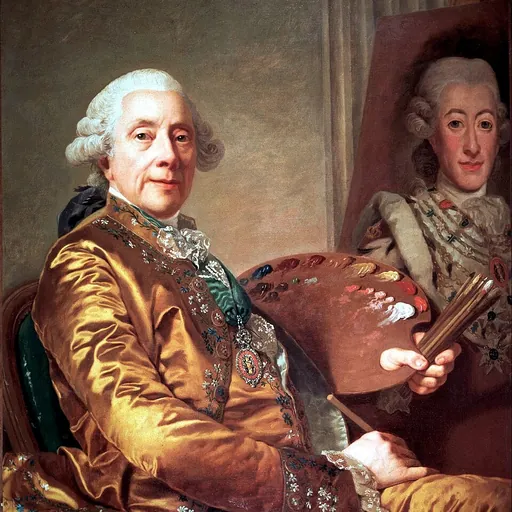
About Alexander Roslin
Lived 1718 – 1793 (aged 74). Alexander Roslin was a Swedish painter, portraitist and visual artist.
Alexander Roslin (; spelled Alexandre in French, ; 15 July 17185 July 1793) was a Swedish painter who worked in Scania, Bayreuth, Paris, Italy, Warsaw and St. Petersburg, primarily for members of aristocratic families. He combined insightful psychological portrayal with a skillful representation of fabrics and jewels.
His style combined Classicist tendencies with the lustrous, shimmering colours of Rococo, a jocular, elegant and ornate style. He lived in France from 1752 until 1793, a period that spanned most of his career. The painting by Roslin depicting Jeanne Sophie de Vignerot du Plessis, Countess of Egmont Pignatelli, was bought by the Minneapolis Institute of Art in 2006 for US$3 million. Roslin also has pieces displayed at the Metropolitan Museum of Art.
Life
Alexander Roslin was born on 15 July 1718, in Malmö, Sweden, the son of naval physician Hans Roslin and Catherine Wertmüller. After showing an unusual talent for drawing and painting, he trained in drawing at Karlskrona under Admiralty Captain Lars Ehrenbill (1697–1747) in order to become a naval draughtsman, and then began to paint miniatures. At the age of sixteen he became apprenticed to the court painter Georg Engelhard Schröder in Stockholm, studying painting there until 1741 and beginning to paint large portraits in oils. In 1741, Roslin settled in Gothenburg, and the following year moved to Scania, where he remained until 1745 painting portraits and also creating religious paintings for the church at Hasslöv. In 1747, he moved to Italy to study the works of the great masters. While in Italy he portrayed, among others, the family of Philip, Duke of Parma in 1752. In the same year Roslin moved to Paris, at the age of 34, where he settled for the rest of his life. The couple had three sons and three daughters. This painting was purchased by the Swedish National Museum in 2013.
Career In Paris he was a protégé of François Boucher and his work rapidly became fashionable. He was chosen as a member of the French Art Academy, to which his wife also belonged. Around the 1760s he started using daring colouring in his paintings, such as in the portrait of his wife, The Lady with the Veil (1768), and the Jennings Family (1769).
Roslin had great technical skill in painting the surfaces and texture of precious materials such as fabrics and jewels, but was also adept at capturing his sitters at their best. and also psychological insight,
He was often surrounded by Swedish visitors to Paris, such as Peill. He was also a good friend of the influential Swedish politician Count Carl Gustaf Tessin. Catherine tried to persuade him to stay in her service, but Roslin declined and returned to France. Stylistically, his paintings are Classicist in some respects, but primarily Rococo. From 1753 Roslin exhibited 18 times at the Salon.
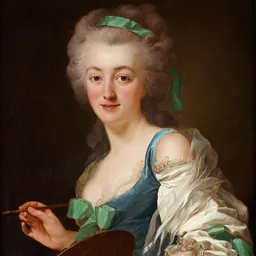
Roslin's popularity with both his foreign and his Swedish audiences during his lifetime is undisputed. He was one of the foremost portrait painters of his time, widely known for his masterful ability to reproduce his sitters' fashionable garments with their silks, lace, pearls and gold filaments. Roslin's ability to capture the personality of the people he depicted made him popular with his clients and allows us, even today a few hundred years later, to still feel close to the people he painted. He flattered and beautified his subjects according to the Rococo ideal. Roslin's portrait of Anne Vallayer-Coster is praised particularly and became much debated after the Salon. In Le Véridique au Salon, published in 1783, it was described as one that "belonged to the artist's best". The picture has been compared to the contemporary artist Elisabeth Vigée-Lebrun's celebrated self-portrait. Roslin depicted his model in a cool colour scale; in green, white, and blue, with the artist's attributes of palette and brushes, a common way for artists to depict themselves. Because of this, Roslin's painting was sometimes misinterpreted by art historians as a self-portrait by Vallayer-Coster.
Gallery
Don’t just read it —
keep it.
Full-length biographies made to live with: read them, listen on the way to work, watch them tonight.
- E-book
- Audio
- Video
Instant download · yours to keep · every purchase keeps this site free
Important facts
Family & relationships
People in Alexander Roslin's life
Named in this biography and alive at the same time
Related people
Same field, nearest in time



Contemporaries
People whose lives overlapped Alexander Roslin's




Frequently asked questions
Who was Alexander Roslin?
Swedish painter (1718–1793)
When was Alexander Roslin born?
Alexander Roslin was born on 15 July 1718 in Malmö Sankt Petri församling.
When did Alexander Roslin die?
Alexander Roslin died on 5 July 1793 in Paris.
What was Alexander Roslin's occupation?
Alexander Roslin was a painter, portraitist and visual artist.
What nationality was Alexander Roslin?
Alexander Roslin was Swedish.
Sources & further reading
Cite this page
APA: Biography.guide. (2026). Alexander Roslin. https://biography.guide/alexander-roslin/
MLA: "Alexander Roslin." Biography.guide, https://biography.guide/alexander-roslin/.
Chicago: "Alexander Roslin." Biography.guide. https://biography.guide/alexander-roslin/.
Data last updated: 2026-09-20 · Spot an error? Report a correction.
Page generated 2026-09-27 05:09 UTC