
About François Boucher
Lived 1703 – 1770 (aged 66). François Boucher was a French painter, printmaker, carpets designer, illustrator, etcher and draftsperson.
François Boucher ( , ; ; 29 September 1703 – 30 May 1770) was a French painter, draughtsman and etcher, who worked in the Rococo style. Boucher is known for his idyllic and voluptuous paintings on classical themes, decorative allegories, and pastoral scenes. He was perhaps the most celebrated painter and decorative artist of the 18th century.
Life A native of Paris, Boucher was the son of a lesser known painter Nicolas Boucher, who gave him his first artistic training. At the age of seventeen, a painting by Boucher was admired by the painter François Lemoyne. Lemoyne later appointed Boucher as his apprentice, but after only three months, he went to work for the engraver Jean-François Cars.
In 1720, he won the elite Grand Prix de Rome for painting, but did not take up the consequential opportunity to study in Italy until five years later, due to financial problems at the Académie royale de peinture et de sculpture. His morceau de réception (reception piece) was his Rinaldo and Armida of 1734.
Boucher died on 30 May 1770 in his native Paris. His name, along with that of his patron Madame de Pompadour, had become synonymous with the French Rococo style, leading the Goncourt brothers to write: "Boucher is one of those men who represent the taste of a century, who express, personify and embody it."
Boucher is famous for saying that nature is "trop verte et mal éclairée" (too green and badly lit).
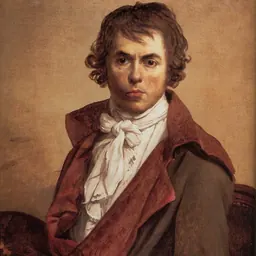
Boucher was associated with the gemstone engraver Jacques Guay, whom he taught to draw. He also mentored the Moravian-Austrian painter Martin Ferdinand Quadal as well as the neoclassical painter Jacques-Louis David in 1767. Later, Boucher made a series of drawings of works by Guay which Madame de Pompadour then engraved and distributed as a handsomely bound volume to favored courtiers.
Painting
Boucher took inspiration from artists such as Peter Paul Rubens and Antoine Watteau. Boucher's early works celebrate the idyllic and tranquil portrayal of nature and landscape with great elan. However, his art typically forgoes traditional rural innocence to portray scenes with a definitive style of eroticism as his mythological scenes are passionate and intimately amorous rather than traditionally epic. Boucher's paintings of a flirtatious shepherd and shepherdess in a woodland setting, featured in The Enjoyable Lesson (The Flute Players) of 1748 and An Autumn Pastoral (The Grape Eaters) of 1749, were based upon characters in a 1745 play by Boucher's close friend Charles-Simon Favart. Boucher's characters in those paintings later inspired a pair of figurines created by the Sèvres Porcelain Manufactory, –66. Marquise de Pompadour (mistress of King Louis XV), whose name became synonymous with Rococo art, was a great admirer of his work. Marquise de Pompadour is often referred to as the "godmother of Rococo" During two decades' involvement with the Beauvais tapestry workshops Boucher produced designs for six series of hangings in all, like the tapestry showing Psyche and the Basketmaker from 1741 to 1742.
Boucher was also called upon for designs for court festivities organized by that section of the King's household called the Menus-Plaisirs du Roi and for the opera and for royal châteaux Versailles, Fontainebleau and Choisy. His designs for all of the aforementioned augmented his earlier reputation, resulting in many engravings from his work and even reproduction of his designs on porcelain and biscuit-ware at the Vincennes and Sèvres factories. The death of Oudry in 1755 put an end to its contribution to Beauvais but his collaboration with the Gobelins lasted until 1765, when he stepped down from his position as an inspector.
Drawings and prints
Boucher was a prolific and varied draftsman. His drawings served not only as preparatory studies for his paintings and as designs for printmakers but also as finished works of art for which there was a great demand by collectors. Boucher followed standard studio practices of the time, by first working out the overall composition of his major canvases, and then making chalk studies for individual figures, or groups of figures. He also relied on oil and gouache sketches in the preparation of major commissions.
Gradually he made more and more sketches as independent works for the market. The Adoration of the Shepherds (Metropolitan Museum of Art), a free and painterly sketch in gouache, was long considered a preparatory sketch for Madame de Pompadour's private altarpiece La lumière du monde (ca. 1750, Musée des Beaux-Arts, Lyon). Recent scholarship suggests, however, that it was made at least 10 years later as an autonomous work. In the last decade of his career the artist began to favor brown chalk, a fabricated medium.
Boucher was also a gifted engraver and etcher. Boucher etched some 180 original copperplates. He made many etchings after Watteau. He thus helped propagate a taste for reproductions of drawings. When his own drawings began to sell, 266 of them were etched in stipple substitutes by Gilles Demarteau. These were printed in red ink so they resembled red chalk drawings which could be framed as little pictures. They could then be hung in the small blank spaces of the elaborately decorated paneling of luxury dwellings.
Boucher's most original inventions were decorative, and he contributed to the fashionable style of chinoiserie, after having etched 12 'Figures Chinoises' (Chinese figures) by Watteau.
Gallery
Works by François Boucher This is an incomplete list of works by François Boucher.
Death of Meleager , Los Angeles County Museum of Art Project for a Cartouche , Los Angeles County Museum of Art The Birth of Adonis and The Death of Adonis , Museo del Prado, Madrid The Rape of Europa , Wallace Collection, London Imaginary Landscape with the Palatine Hill from Campo Vaccino (1734), Metropolitan Museum of Art, New York Monument to Mignard , Los Angeles County Museum of Art Venus and Mercury Instructing Cupid (1738), Los Angeles County Museum of Art Cupid Wounding Psyche (1741), Los Angeles County Museum of Art Daphnis and Chloe (1743), Wallace Collection, London Erigone Conquered (Erigone vaincue) (1745), Wallace Collection, London Les Confidences Pastorales , Los Angeles County Museum of Art Shepherd Piping to a Shepherdess , Wallace Collection, London Arion on the Dolphin (1748), Princeton University Art Museum Pastoral with a Bagpipe Player (1749), Wallace Collection, London Pastoral with a Couple near a Fountain (1749), Wallace Collection, London Pompadour at Her Toilette (1750), Harvard Art Museums Sketch for a Portrait of Madame de Pompadour , Waddesdon Manor, Waddesdon The Interrupted Sleep (1750), Metropolitan Museum of Art The Love Letter (1750), National Gallery of Art The Muse Clio , Wallace Collection, London The Toilette of Venus (1751), Metropolitan Museum of Art The Setting of the Sun (1752), Wallace Collection, London The Rising of the Sun (1753), Wallace Collection, London Shepherd Boy Playing Bagpipes (c. 1754), Museum of Fine Arts, Boston Cupid a Captive (c. 1754), Wallace Collection, London Mars and Venus surprised by Vulcan (c. 1754), Wallace Collection, London Pastoral Make-Up (La toillette pastorale) (1754), Wallace Collection, London The Judgment of Paris (1754), Wallace Collection, London Venus and Vulcan (1754), Wallace Collection, London Landscape with a Watermill (1755), National Gallery, London Venus in the Workshop of Vulcan (1757), Yale University Art Gallery Fishing (1757), Grand Trianon Lovers in a Park (1758), Timken Museum of Art, San Diego The Dovecote (1758), Saint Louis Art Museum, Missouri Madame de Pompadour (1759), Wallace Collection, London Pan and Syrinx (1759), National Gallery, London Shepherd and Shepherdess Reposing (1761), Wallace Collection, London Study of a standing nude young woman seen from behind, raising drapery (1762), Miguel Urrutia Art Museum, Bogotá Angelica and Medoro (1763), Metropolitan Museum of Art Jupiter, in the Guise of Diana, and Callisto (1763), Metropolitan Museum of Art The Judgment of Paris , Musée des Beaux-Arts de Mulhouse Aurora Heralding the Arrival of the Morning Sun (1765), National Gallery of Art Virgin and Child with the Young Saint John the Baptist and Angels (1765), Metropolitan Museum of Art Halt at the Spring (1765), Museum of Fine Arts, Boston The Bird Has Flown (1765), Snite Museum of Art, University of Notre Dame Return from Market (1767), Museum of Fine Arts, Boston Shepherd's Idyll (1768), Metropolitan Museum of Art Washerwomen (1768), Metropolitan Museum of Art Jupiter and Callisto (1769), Wallace Collection, London
Don’t just read it —
keep it.
Full-length biographies made to live with: read them, listen on the way to work, watch them tonight.
- E-book
- Audio
- Video
Instant download · yours to keep · every purchase keeps this site free
Important facts
more
Francois, the elder Boucher, Fransua Bushe, Francis Boucher, Suite de Boucher., M. Boucher pere, Fr Boucher, F. Boucher, pere Boucher, f. bouchor, Françis Boucher, boucher fr., fr. boucher, Bouchers, Baucher, Bouché, Bouchez, Bouche, Le Boucher, Boucher, French, Bouchet, franc.s boucher, Bouchey, Boucher pere, Françios Boucher, franqois boucher, boucher f., F.Boucher, BouPeople in François Boucher's life
Named in this biography and alive at the same time




Related people
Same field, nearest in time


Contemporaries
People whose lives overlapped François Boucher's



Frequently asked questions
Who was François Boucher?
French painter (1703–1770)
When was François Boucher born?
François Boucher was born on 29 September 1703 in Paris.
When did François Boucher die?
François Boucher died on 30 May 1770 in Paris.
What was François Boucher's occupation?
François Boucher was a painter, printmaker, carpets designer, illustrator, etcher and draftsperson.
What nationality was François Boucher?
François Boucher was French.
Sources & further reading
Cite this page
APA: Biography.guide. (2026). François Boucher. https://biography.guide/francois-boucher/
MLA: "François Boucher." Biography.guide, https://biography.guide/francois-boucher/.
Chicago: "François Boucher." Biography.guide. https://biography.guide/francois-boucher/.
Data last updated: 2026-09-25 · Spot an error? Report a correction.
Page generated 2026-09-27 05:12 UTC