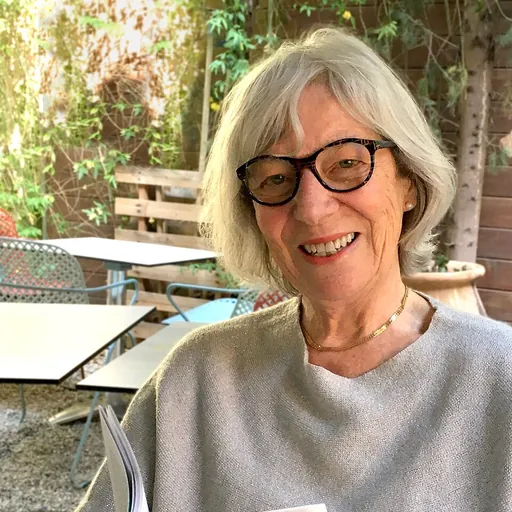
About Agnès Verlet
Born 1947. Agnès Verlet is a French university teacher, docent and psychoanalyst.
Agnès Verlet (14 July 1947, Paris) is a French academic, psychoanalyst, and writer.
Early life and education Agnès Verlet was born on 14 July 1947 in the 16th arrondissement of Paris into a family of museum conservators. She also studied art history (licentiate) and musicology (first prize in musical aesthetics from the National Conservatory of Music in Paris).
In 1988, she defended a thesis on Chateaubriand and Vanities at the University of Paris 3 under the supervision of Philippe Berthier (Marc Fumaroli, Jean-Claude Berchet, and Jean-Claude Bonnet were on the jury).
She is a member of the Maison des écrivains et de la littérature and the Société des gens de lettres (SDGL).
Publications Yseult et Tristan, play, L'Harmattan, 1978. La Messagère de rien, novel, Séguier, 1997. Pierres parlantes. Florilège d'épitaphes parisiennes du Moyen ge à la fin du XVIIIe siècle, anthology, Commission des travaux historiques de la Ville de Paris, 2000.
Chateaubriand. Les aventures du dernier Abencerage, Gallimard, 2006. Écrire des rêves, anthology, Gallimard, 2006. Les Violons brulés, novel, Éditions de la Différence, 2006, reissued in 2014.
Editorial contributions From 2004 to 2015, collaboration with Gallimard Folioplus classiques for cross-readings of images with an integral text and its commentary.
Colette, Dialogues de bêtes/ Gauguin, Arearea. Camus, The Stranger/ Hopper, Conference at Night. Charles Juliet, Fragments/Giacometti, Portrait of the Artist's Mother. Van Gogh, Letters to Theo/ Van Gogh, Wheatfield with Crows. Céline, Journey to the End of the Night/ Bruegel, The Fight Between Carnival and Lent. Writing about Painting (anthology) / Hubert Robert, Plan for the Great Gallery of the Louvre. Pierre Peju, The Little Chartreuse/ Vieira da Silva, The Luminous Exit. Luigi Pirandello, Six Characters in Search of an Author/ Ensor, Ensor with Masks. Benjamin Constant, Adolphe/ Ingres, Madame de Senonnes. Marguerite Yourcenar, Oriental Tales/ Gustave Moreau, Orpheus. Molière, Amphitryon/ Lorenzo Lippi, Allegory of Simulation. Malraux, Man's Fate/ Goya, The Third of May 1808. Correspondence between Mothers and Daughters/ Leonardo da Vinci, Saint Anne, the Virgin, and Child Jesus. Chateaubriand Memoirs from Beyond the Grave IX to XII/ Poussin, The Plague of Azoth. André Gide, The Counterfeiters/ Delacroix, The Battle of Jacob with the Angel. Balzac, The Duchess of Langeais/ Bernini, Saint Teresa. Zola, L'Assommoir/ Rubens, The Kermis, or Village Wedding. Racine, Phèdre/ Cabanel, Phèdre. The Encyclopedia (anthology)/ Lemonnier, An Evening at Madame Geoffrin's. Balzac, The Elixir of Long Life/ Rembrandt, Self-Portrait with Saskia. Molière, The Precious Ridicules / Claude Deruet, The Air. Alain-Fournier, The Lost Domain/ Watteau, The Embarkation for Cythera. Tristan and Isolde (Bédier) / Anonymous, 15th-century miniature. Camus, The Just Assassins/ Fautrier, Hostage Head. Kafka, Letter to His Father/ Kokoschka, Self-Portrait. Rimbaud, Illuminations/ Robert Delaunay, The Red Tower. Quignard, All the World's Mornings/ Baschenis, Still Life with Musical Instruments. Racine, Mithridates/ Delacroix, Horses Fighting in a Stable. Hugo, Pauca Meae/ Odilon Redon, Ophelia. Aloysius Bertrand, Gaspard of the Night/ Teniers, The King Drinks. Duras, The Pain/ Matisse, The Black Door. Balzac, The Quest of the Absolute/Thomas Wyck, Alchemist in His Laboratory. Radiguet, The Ball of the Count d'Orgel/ Seurat, The Circus. Semprun, Literature or Life/ Zoran Music, Dalmatian Landscape. Victor Hugo, The Intervention / Édouard Manet, The Railway Duras, The Music/ Hopper, Automat. Apollinaire, Alcools/Picasso, Saltimbanques. Proust, Swann's Way/ Bonnard, Terrace at Vernon Oscar Wilde, The Picture of Dorian Gray/ Lucian Freud, Self-Portrait. Bernardin de Saint-Pierre, Paul and Virginie/ Joseph Vernet, Storm Stephan Zweig, Chess Story/ Marcel Duchamp, The Chess Game. Beaumarchais, The Barber of Seville/ Fragonard, Young Musician. Maupassant, A Life/ Courbet, The Wave. Sophocles, Oedipus Rex/ Bacon, Oedipus After Ingres. Madame de La Fayette, The Princess of Montpensier/ Rubens, Portrait of Brigida Spinola Doria. Musset, Don't Trifle with Love/ Picasso, The Kiss.
Don’t just read it —
keep it.
Full-length biographies made to live with: read them, listen on the way to work, watch them tonight.
- E-book
- Audio
- Video
Instant download · yours to keep · every purchase keeps this site free
Important facts
People in Agnès Verlet's life
Named in this biography and alive at the same time





Related people
Same field, nearest in time
Contemporaries
People whose lives overlapped Agnès Verlet's




Frequently asked questions
Who is Agnès Verlet?
French professor of literature
When was Agnès Verlet born?
Agnès Verlet was born in 1947 in 16th arrondissement of Paris.
What is Agnès Verlet's occupation?
Agnès Verlet is a university teacher, docent and psychoanalyst.
What nationality is Agnès Verlet?
Agnès Verlet is French.
Sources & further reading
Cite this page
APA: Biography.guide. (2026). Agnès Verlet. https://biography.guide/agnes-verlet/
MLA: "Agnès Verlet." Biography.guide, https://biography.guide/agnes-verlet/.
Chicago: "Agnès Verlet." Biography.guide. https://biography.guide/agnes-verlet/.
Data last updated: 2026-09-21 · Spot an error? Report a correction.
Portrait: Wikimedia Commons · author & licence
Page generated 2026-09-27 05:00 UTC