
About Abe Waddington
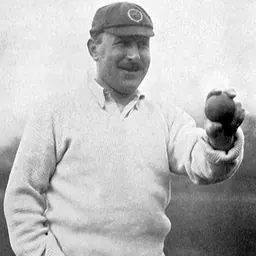
Lived 1893 – 1959 (aged 66). Abe Waddington was a British cricketer and association football player.
Abraham "Abe" Waddington, sometimes known as Abram Waddington (4 February 1893 – 28 October 1959), was a professional cricketer for Yorkshire, who played in two Test matches for England, both against Australia in 1920–21. Between 1919 and 1927 Waddington made 255 appearances for Yorkshire, and in all first-class cricket played 266 matches. In these games, he took a total of 852 wickets with his left arm fast-medium bowling. Capable of making the ball swing, Waddington was admired for the aesthetic quality of his bowling action. He was a hostile bowler who sometimes sledged opposing batsmen and questioned umpires' decisions, behaviour which was unusual during his playing days.
Waddington first played for Yorkshire after the First World War, when the team had been weakened by injuries and retirements. He made an immediate impression in 1919, his first season; he took 100 wickets and was largely responsible for Yorkshire's victory in the County Championship that year. After a similarly successful season in 1920, he was selected for the 1920–21 Marylebone Cricket Club (MCC) tour of Australia, during which he appeared in two of the five Tests. However, the England team were outclassed; used in an unfamiliar tactical role, Waddington took just one wicket and never played for England again. He continued to be effective for Yorkshire, particularly against the weaker counties, but was often inconsistent. His reputation as an uncompromising opponent was cemented when he was found guilty of dissent and inciting the crowd in a game against Middlesex. A succession of injuries reduced his effectiveness and he retired from first-class cricket in 1927. He continued to play league cricket and worked for the family business, a fat-refining firm, but maintained his connection with Yorkshire cricket.
In the early 1920s, Waddington played several football matches for Halifax Town as a goalkeeper, and after his retirement from cricket enjoyed some success as an amateur golfer. He was in trouble with the police on more than one occasion and after the Second World War was charged with defrauding his wartime employers, the Ministry of Food; he was found not guilty. He died in 1959 at the age of 66.
Early life Abraham Waddington Hodgson suggests that he was chosen as "the discovery of the first post-war period". Wisden stated that the "chief cause of failure was the bowling". and missed the first five games. He played only one first-class match before the first Test, but took wickets in several minor matches. He did not play another Test until the fourth, where he bowled five overs for 31 runs. Considered a failure —Waddington did not play for England again and was never seriously considered for a recall. but the team finished third. Both Waddington and Yorkshire were more successful the following year: In July, he slipped on wet grass when he was about to bowl against Leicestershire at Fartown Ground, Huddersfield; the subsequent shoulder injury effectively ended his season, apart from one match against Lancashire in which he bowled just six overs. The injury affected the remainder of his career and his bowling was never as effective. In total, before his injury, he took 65 wickets at 18.23 in 1923.
On his return in 1924, Waddington bowled little in his first matches, In the return match at Sheffield in July, the Yorkshire players seemed determined to have revenge but could only secure a draw. Critics thought that the Yorkshire bowlers appealed excessively to the umpires, and the Middlesex players were barracked by the crowd. The journalist Alfred Pullin described the match as "a sorry exhibition of ill feeling and bad manners." and the Yorkshire president Lord Hawke persuaded him to write a letter of apology to the MCC secretary. and these events probably cost Macaulay a place in the England Test team. The Yorkshire cricketer and journalist Bill Bowes later recalled a story in circulation that Waddington had deliberately tripped and injured the Middlesex player J. W. Hearne around this period, although he did not specify if it was during the 1924 Sheffield match. Waddington ended the season with 69 wickets at an average of 21.55, but appeared less effective than before his injury.
Decline Waddington took more than 100 wickets in a season for the final time in 1925. Although his form was mixed, he achieved some good performances. Wisden attributed Yorkshire's championship victory to their bowlers and suggested that "Waddington enjoyed a well-merited success". In total, he took 109 wickets at an average of 20.24. He took 78 wickets at an average of 23.30, The effectiveness of the other bowlers was similarly reduced, and combined with a cautious, safety-first approach, Yorkshire had a mixed season and finished third. Waddington took 45 wickets at 32.02, However, in what was his last season, he scored his only first-class century, an innings of 114 against Worcestershire. At the end of the season, Waddington was offered a new contract despite his decline in bowling and continuing problems from his injured shoulder. He turned it down, ending his county cricket career. The following season, Yorkshire awarded him a testimonial of £1,000.
Style and personality Waddington bowled with control, maintaining a good length while his action made the ball swing away from the batsman. For variation, he delivered an off-cutter and when he bowled, the ball seemed to increase its speed after bouncing. He often bowled around the wicket. His curved run-up began from the on side of the wicket, and he ran behind the umpire. He then released the ball from the corner of the bowling crease, creating a sharp angle for the batsman to face, sometimes using short deliveries with a ring of leg side fielders. Waddington modelled his bowling on that of George Hirst, a fellow left-arm paceman who also acted as a coach and mentor to him in his early career, but Derek Hodgson notes that the two men were very different in personality: Waddington was far more quick-tempered than Hirst. and "so lovely that one simply cannot deny he is a good bowler." he was inclined to be dismissed through playing irresponsible shots. But Sutcliffe suggested that Waddington did not possess the required patience: "He used to hit up a brilliant 30 or 40 before making a perfectly silly shot". called him "a genial fellow in the dressing room; a man with a rare personality, proof of which is shown by the fact that whenever there was a discussion of any kind in the dressing room, Abe generally ruled it, to all intents and purposes, the chairman." The cricket writer Jim Kilburn wrote that "at his best, [Waddington] was a magnificently hostile bowler with one of the most beautiful actions ever seen in cricket, and his pace and break-back were a problem for the greatest of batsmen". The historian Leslie Duckworth summed him up: "Yes, a man of temper, Waddington, but a fine cricketer." and for Accrington in 1929 and 1930. He maintained friendships with several members of the Yorkshire team and was a pallbearer at Kilner's funeral in 1928. In 1954–55, the Yorkshire player and England captain Len Hutton invited Waddington to accompany the members of the MCC team to Australia. En route by sea, the team visited the grave of Hedley Verity, the Yorkshire bowler who was killed in Italy in the Second World War and buried there. Including his visit as a player, Waddington made five trips to Australia.
Waddington had success in other sports, especially as an amateur football goalkeeper. He was with Bradford City in the 1920–21 football season, but did not play a match for them. For the 1921–22 season, he played for Halifax Town, making seven appearances in the Football League. He was a good enough golfer to represent Yorkshire, to partner Henry Cotton, Sutcliffe wrote that leading golfers told him that had Waddington not been a cricketer, he had the talent to have succeeded as a golfer, although he was prone to carelessness in his play. In 1950, he was fined and banned from driving for a year after being found drunk while attempting to start up his car. In mitigation, his lawyer claimed he was suffering from "overwork, worry and insomnia."
At the start of the Second World War, Waddington was appointed chairman of the North Eastern Division Advisory Committee for the Control of Oils and Fats and became an agent of the Ministry of Food. His responsibilities included arranging for the storage of fats. When the war concluded, he was charged with conspiracy to defraud the Ministry of Food when it was discovered that a letter detailing amounts of money had been altered. Waddington was acquitted when a judge ruled that there was no way that it could be proven that he had known of the alteration to the letter, or that he was in any way responsible.
Waddington was married twice. In 1925, he married Mabel Fawell; none of his Yorkshire teammates were aware that he was getting married. In 1952, he married Doris Garforth; on this occasion, many of his former cricketing colleagues attended. After a long illness, Waddington died in a Scarborough nursing home on 28 October 1959 aged 66. He was cremated in Bradford.
Don’t just read it —
keep it.
Full-length biographies made to live with: read them, listen on the way to work, watch them tonight.
- E-book
- Audio
- Video
Instant download · yours to keep · every purchase keeps this site free
Important facts
People in Abe Waddington's life
Named in this biography and alive at the same time




Related people
Same field, nearest in time


Contemporaries
People whose lives overlapped Abe Waddington's



Frequently asked questions
Who was Abe Waddington?
Cricket player of England. (1893-1959)
When was Abe Waddington born?
Abe Waddington was born on 4 February 1893 in Clayton.
When did Abe Waddington die?
Abe Waddington died on 28 October 1959 in Scarborough.
What was Abe Waddington's occupation?
Abe Waddington was a cricketer and association football player.
What nationality was Abe Waddington?
Abe Waddington was British.
Sources & further reading
Cite this page
APA: Biography.guide. (2026). Abe Waddington. https://biography.guide/abe-waddington/
MLA: "Abe Waddington." Biography.guide, https://biography.guide/abe-waddington/.
Chicago: "Abe Waddington." Biography.guide. https://biography.guide/abe-waddington/.
Data last updated: 2026-09-20 · Spot an error? Report a correction.
Page generated 2026-09-27 05:21 UTC