
About Zhao Jiliang
Lived 883 – 946 (aged 62–63). Zhao Jiliang was a politician.
Zhao Jiliang (883–946), courtesy name Dezhang , was an official of the Chinese Former Jin, Later Tang, and Later Shu dynasties, serving as a chancellor under the Later Shu.
During Former Jin Zhao Jiliang was born in 883 and from Jiyin (濟陰, in modern Heze, Shandong). His father Zhao Yin was a magistrate of Gushu County during Tang dynasty. As of 922, he was serving as the records officer at Wei Prefecture (魏州, in modern Handan, Hebei), then an important city in Jin, which then occupied the territory north of the Yellow River, in enmity to Later Liang, which occupied the territory south of the Yellow River. That year, it was said that Li Cunxu the Prince of Jin was rebuking him because many of Wei's residents owed back taxes, which Zhao was responsible for collecting. This led to this dialogue between him and Li:
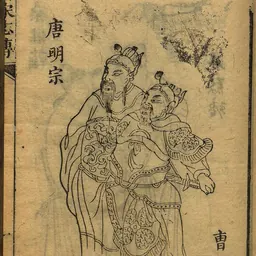
Li saw his point, was pleased, and thanked him for the advice. From that point on, he valued Zhao and had Zhao participate in policy decisions. Zhao Jiliang served in Emperor Zhuangzong's administration, initially as an assistant to the director of salt and iron monopolies (鹽鐵判官, Yantie Panguan) and the minister of husbandry (太僕卿, Taipu Qing). However, he was shortly after killed in a mutiny himself at the capital Luoyang. One of the rebelling generals, Emperor Zhuangzong's adoptive brother Li Siyuan, took the throne (as Emperor Mingzong). Shortly after, Emperor Mingzong's new chancellor, Ren Huan, who was then serving as the director of the three financial agencies (including salt and iron monopolies) had been one of the generals in the Former Shu campaign, felt that the treasury could be replenished from the storage from the former Former Shu lands, as they were rich lands. He thus sent Zhao to the former Former Shu capital Chengdu to requisition the stored wealth, having Zhao commissioned as the director of transport for the Three Chuans (i.e., Former Shu's former territory Xichuan (西川, headquartered at Chengdu), Dongchuan (東川, headquartered in modern Mianyang, Sichuan), and Shannan West (山南西道, headquartered in modern Hanzhong, Shaanxi) Circuits). When Zhao got there, however, Meng Zhixiang the military governor of Xichuan, who controlled the main parts of the former Former Shu territory and who was commissioned by Emperor Zhuangzong (not Emperor Mingzong), only allowed him to ship the wealth previously stored by Former Shu and refused to also surrender tax revenues to him or let him take office as the director of transport for the three circuits. However, as they had previously been friends, Meng requested that he be allowed to keep Zhao as his deputy military governor. The imperial government (reluctantly) agreed.
The relationships between Emperor Mingzong's administration and Meng, as well as with Dong Zhang the military governor of Dongchuan (who, like Meng, was commissioned by Emperor Zhuangzong) later deteriorated to a point where the administration suspected the two military governors of planning rebellion, and the two military governors were intimidated into in fact planning such a rebellion. In spring 930, Meng sent Zhao as an emissary to Dongchuan's capital Zi Prefecture to enter into an alliance with Dong against the imperial government. Upon Zhao's return to Chengdu, however, he informed Meng, "Lord Dong is greedy, cruel, and contentious; he is overly ambitious and not sufficiently thoughtful, and he will surely one day create trouble for Xichuan."
In fall 930, upon hearing news from Xichuan's attaché in Luoyang, Su Yuan , that the imperial government was preparing a major operation against Xichuan and Dongchuan, Meng consulted Zhao as to how to respond. Zhao suggested that he request that Dongchuan first capture the imperially-held Sui (遂州, in modern Suining, Sichuan) and Lang (閬州, in modern Langzhong, Sichuan) Prefectures, and then their joint forces could defend Jiange Pass (劍閣關, in modern Guangyuan, Sichuan) to prevent imperial forces from advancing on Xichuan and Dongchuan. Meng agreed, and after Sui and Lang fell to the joint Xichuan and Dongchuan forces, the imperial forces, under command of Emperor Mingzong's son-in-law, Shi Jingtang, abandoned the campaign in spring 931. (However, given the subsequent events, it was not clear whether Zhao actually reported to Wutai or remained at Chengdu.)
During Later Shu Emperor Mingzong died in late 933 and was succeeded by his son Emperor Min. In spring 934, Meng Zhixiang declared himself emperor of a new state of Shu (known historically as Later Shu), as its Emperor Gaozu.
By summer 934, Meng was extremely ill. He created his son Meng Renzan crown prince, and shortly after wrote a will in which he trusted Meng Renzan to Zhao, Li Renhan, Zhao Tingyin, the chief of staff Wang Chuhui, and the imperial guard generals Zhang Gongduo and Hou Hongshi . He died that night. Wang decided not to immediately announce the emperor's death, but instead visited Zhao Jiliang to inform him. When he went to Zhao's mansion to inform him, however, he broke down in tears. Zhao pointed out that given that there were many powerful generals with strong armies, the right thing to do was to immediately announce Meng Renzan's succession, not to deeply mourn the emperor. He also instructed Wang to visit Li to see what Li's attitude was. When Wang visited Li, however, Li only saw him while accompanied by heavy guard, causing Wang to hesitate to inform him of Meng Zhixiang's death that night. The next day, Meng Zhixiang's death and his will were announced. Meng Renzan took the throne (and changed his name to Meng Chang). Shortly after, Zhang, as well as Meng Chang's close associates Han Jixun , Han Baozhen , and An Siqian , accused Li of plotting treason. Meng Chang, after consulting Zhao Jiliang and Zhao Tingyin, had Li arrested and put to death. He died in fall 946.
Notes and references
Spring and Autumn Annals of the Ten Kingdoms , vol. 51. Zizhi Tongjian, vols. 271, 275, 277, 278, 279, 282.
Don’t just read it —
keep it.
Full-length biographies made to live with: read them, listen on the way to work, watch them tonight.
- E-book
- Audio
- Video
Instant download · yours to keep · every purchase keeps this site free
Important facts
People in Zhao Jiliang's life
Named in this biography and alive at the same time





Related people
Same field, nearest in time



Contemporaries
People whose lives overlapped Zhao Jiliang's


Frequently asked questions
Who was Zhao Jiliang?
Chinese chancellor
When was Zhao Jiliang born?
Zhao Jiliang was born in 883.
When did Zhao Jiliang die?
Zhao Jiliang died in 946.
What was Zhao Jiliang's occupation?
Zhao Jiliang was a politician.
Sources & further reading
Cite this page
APA: Biography.guide. (2026). Zhao Jiliang. https://biography.guide/zhao-jiliang/
MLA: "Zhao Jiliang." Biography.guide, https://biography.guide/zhao-jiliang/.
Chicago: "Zhao Jiliang." Biography.guide. https://biography.guide/zhao-jiliang/.
Data last updated: 2026-09-20 · Spot an error? Report a correction.
Page generated 2026-09-27 05:13 UTC