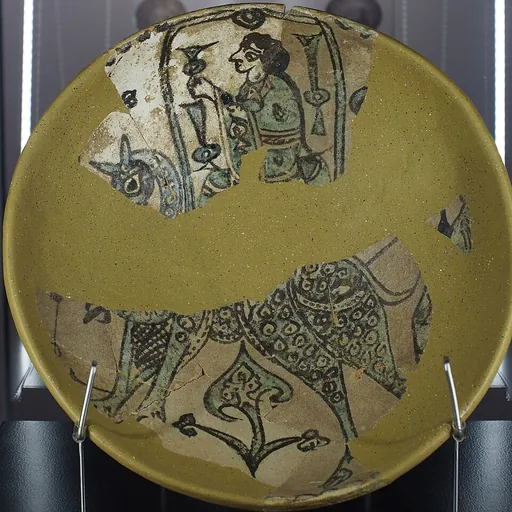
Abd-ar-Rahman III
Final Emir of Córdoba (r. 912–929); founder and 1st Caliph of Córdoba (r. 929–961)
About Abd-ar-Rahman III
Lived 891 – 961 (aged 70). Abd-ar-Rahman III was a politician.
ʿAbd al-Raḥmān ibn Muḥammad ibn ʿAbd Allāh ibn Muḥammad ibn ʿAbd al-Raḥmān ibn al-Ḥakam al-Rabdī ibn Hishām ibn ʿAbd al-Raḥmān al-Dākhil al-Marwānī al-Umawī al-Qurashī (; 890–961), or simply ʿAbd al-Raḥmān III, was the Umayyad Emir of Córdoba from 912 to 929, at which point he founded the Caliphate of Córdoba, serving as its first caliph until his death. Abd al-Rahman won the laqab (sobriquet) in his early 20s when he supported the Maghrawa Berbers in North Africa against Fatimid expansion and later claimed the title of Caliph for himself. His half-century reign was known for its religious tolerance.
Life
Early years Lineage and appearance
Abd al-Rahman was born in Córdoba, on 18 December 890. His year of birth is also given as 889 and 891. He was the grandson of Abdullah ibn Muhammad al-Umawi, seventh independent Umayyad emir of al-Andalus. His parents were Abdullah's son Muhammad and Muzna (or Muzayna), a Christian concubine. His paternal grandmother was also a Christian, the royal infanta Onneca Fortúnez, daughter of the captive king Fortún Garcés of Pamplona. Abd al-Rahman was thus nephew in the half-blood of queen Toda of Pamplona. He is described as having "white skin, blue eyes and attractive face; good looking, although somewhat sturdy and stout. His legs were short, to the point that the stirrups of his saddle were mounted just one palm under it. When mounted, he looked tall, but on his feet he was quite short. He dyed his beard black." He had reddish-blond hair, which he reportedly dyed black to appear more "Arab".
Harem youth Muhammad was assassinated by his brother Al-Mutarrif, who had allegedly grown jealous of the favour Muhammad had gained in the eyes of their father Abdallah. Al-Mutarrif had accused Muhammad of plotting with the rebel Umar ibn Hafsun, and Muhammad had been imprisoned. According to some sources, the emir himself was behind Muhammad's fall, as well as Al-Mutarrif's death in 895. Abd al-Rahman spent his youth in his mother's harem. Al-Mutarrif's sister, known as al-Sayyida ("the Lady"), was entrusted with his education. She made sure that Abd al-Rahman's education was conducted with some rigour. It was claimed that he had learned and known the local Mozarabic language.
Accession to throne Emir Abdallah died at the age of 72. Despite four of his sons (Aban, Abd al Rahman, Muhammad and Ahmad) being alive at the time of his death, all of them were passed over for succession. Abdallah instead chose as his successor his grandson, Abd al-Rahman III (the son of his first son). This came as no surprise, since Abdallah had already demonstrated his affection for his grandson in many ways, namely by allowing him to live in his own tower (something he did not allow for any of his sons), and allowing him to sit on the throne on some festive occasions. Most importantly, Abdallah gave Abd al-Rahman his ring, the symbol of power, when Abdallah fell ill prior to his death.
Abd al-Rahman succeeded Abdallah the day after his death, 16 October 912.
Early rule
During the first 20 years of his rule, Abd al-Rahman avoided military action against the northern Christian kingdoms, Asturias and the Kingdom of Navarre. The Muwallad rebels were the first problem he confronted. Those powerful families were supported by Iberians who were openly or secretly Christians and had acted with the rebels. These elements, which formed the bulk of the population, were not averse to supporting a strong ruler who would protect them against the Arab aristocracy. Abd al-Rahman moved to subdue them by means of a mercenary army that included Christians.
He first had to suppress the rebel Umar ibn Hafsun. On 1 January 913 an army, led by the eunuch Badr, conquered the fortress of Écija, at some from the capital. All the city's fortifications were destroyed, aside from the citadel, which was left as the residence of the governor and a garrison for the emirati troops.
In the following spring, after sixty-five days of meticulous preparations, Abd al-Rahman personally led an expedition to the south of his realm. His troops were able to recover the Kūras (provinces) of Jaén and Granada, while a cavalry detachment was sent to free Málaga from ibn Hafsun's siege. He also obtained the capitulation of Fiñana (in the modern province of Almería), after setting fire to its suburbs. Subsequently, he moved against the castle of Juviles in the Alpujarras. After devastating the surrounding countryside to deprive the castle of any resources, he encircled it. Finding it difficult to bombard with catapults, he ordered the construction of a platform where his siege engines could be mounted to greater effect, and cut the water supply. The Muwallad defenders surrendered after a few days: their lives, apart from fifty-five die-hards who were beheaded, were spared in exchange for their allegiance to the emir. The campaign continued in a similar vein, lasting for a total of ninety days. Abd al-Rahman forced the defeated Muwallad to send hostages and treasures to Córdoba, in order to secure their continued submission.
During the first year of his reign, Abd al-Rahman took advantage of the rivalries between the Banu Hajjaj lords of Seville and Carmona to force them to submit. He initially sent a special corps (hasam) under Ahmad ibn Muhammad ibn Hudayr, governor of Écija, to Seville, to obtain their submission. This attempt failed, but gained him the support of Muhammad ibn Ibrahim ibn Hayyay, lord of Carmona, and a cousin of the Sevillan lord, Ahmad ibn Maslama. When the latter was surrounded by Umayyad troops, he sued for help to Ibn Hafsun, but the latter was defeated by the besiegers and returned to Bobastro. Abd al-Rahman next went after the forts in the provinces of Elvira, Granada, and Jaén, all of which were either directly or indirectly controlled by Hafsun.
The Levente and Algarve rebels The continued expeditions against the Hafsunids did not distract Abd al-Rahman III from the situation in other regions in al-Andalus, which recognized him only nominally, if not being in open revolt. Most of the loyal governors of the cities were in a weak position, such as the governor of Évora, who could not prevent an attack by the king of Galicia (and future king of León), Ordoño II, who captured the city in the summer of 913, taking back a sizable booty and 4,000 prisoners and massacring many Muslims. The caliphate was thought only to belong to the Emperor who ruled over the sacred cities of Mecca and Medina, and his ancestors had until then been content with the title of emir. But the force of this tradition had weakened over time; and the title increased Abd al-Rahman's prestige with his subjects, both in Iberia and Africa. and silver dirhams, replacing the "al-Andalus" title with his name.
In his new role as caliph, he achieved the surrender of Ibn Marwan of Badajoz in 930 as well as the surrender of the Banu Dānis of Alcácer do Sal. On the southern front, to counter the increasing Fatimid power in North Africa, abd al-Rahman ordered the construction of a fleet based in Almeria. The caliph helped the Maghrawa Berbers conquer Melilla (927), Ceuta (931)
In the end he was able to create a protectorate covering the northern and central Maghreb, supporting the Idrisid dynasty; the Caliphate's influence in the area disappeared after a Fatimid offensive in 958, after which abd al-Rahman kept only the strongholds of Ceuta and Tangiers.
War with the Christian kingdoms of the north Even before al-Andalus was firmly under his rule, he had restarted the war against King Ordoño II of León, who had taken advantage of the previous troublesome situation to capture some boundary areas and menace the Umayyad territory. In 917 the then emir had sent a large army under his general Ahmad ibn Abi Abda against León, but this force was destroyed at the Battle of San Esteban de Gormaz in September of that year.
Recognizing he had underestimated the power of Ordoño II, in 920 Abd al-Rahman mustered another powerful army to reclaim the territories lost after the previous campaign. He captured the forts of Osma and San Esteban de Gormaz.
The succession crisis which struck León after Ordoño II's death in the same year caused hostilities to cease until Ramiro II gained the throne in 932; a first attempt by him to assist the besieged rebels in Toledo was repelled in 932, despite the Christian king capturing Madrid.
In 934, after reasserting supremacy over Pamplona and Álava, Abd al-Rahman forced Ramiro to retreat to Burgos, and forced the Navarrese queen Toda, his aunt, to submit to him as a vassal and withdraw from direct rule as regent for her son García Sánchez I. In 937 Abd al-Rahman conquered some thirty castles in León. Next he turned to Muhammad ibn Hashim al-Tugib, governor of Zaragoza, who had allied with Ramiro but was pardoned after the capture of his city.
Despite early defeats, Ramiro and García were able to crush the caliphal army in 939 at the Battle of Simancas, and almost kill Abd al-Rahman,
Abd al-Rahman spent the rest of his years in his new palace outside Córdoba. He died on 15 October 961 and was succeeded by his son al-Hakam II.
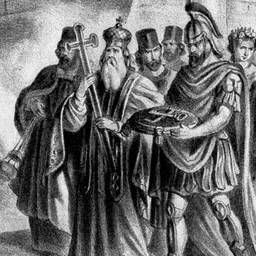
Legacy Abd al-Rahman III receiving ambassador John of Gorze of Otto I the Great at the Medina Azahara, by Dionisio Baixeras Verdaguer, 1885. Abd al-Rahman was a great humanist and patron of arts, especially architecture. A third of his revenue sufficed for the ordinary expenses of government, a third was hoarded, and a third was spent on buildings. European kingdoms sent emissaries, including from Otto I of Germany and the Byzantine emperor. 6= 7= 8= 8. Muhammad I, Emir of Córdoba 10= 10. Fortún Garcés, King of Pamplona 11= 11. Oria 12= 13= 14= 15=
Notes and references
Don’t just read it —
keep it.
Full-length biographies made to live with: read them, listen on the way to work, watch them tonight.
- E-book
- Audio
- Video
Instant download · yours to keep · every purchase keeps this site free
Important facts
Family & relationships
People in Abd-ar-Rahman III's life
Named in this biography and alive at the same time




Related people
Same field, nearest in time


Contemporaries
People whose lives overlapped Abd-ar-Rahman III's




Frequently asked questions
Who was Abd-ar-Rahman III?
final Emir of Córdoba (r. 912–929); founder and 1st Caliph of Córdoba (r. 929–961)
When was Abd-ar-Rahman III born?
Abd-ar-Rahman III was born on 7 January 891 in Córdoba.
When did Abd-ar-Rahman III die?
Abd-ar-Rahman III died on 15 October 961 in Córdoba.
What was Abd-ar-Rahman III's occupation?
Abd-ar-Rahman III was a politician.
What nationality was Abd-ar-Rahman III?
Abd-ar-Rahman III's recorded nationality: Emirate of Córdoba, Caliphate of Córdoba.
Sources & further reading
· Wikipedia: Abd-ar-Rahman III
Cite this page
APA: Biography.guide. (2026). Abd-ar-Rahman III. https://biography.guide/abd-ar-rahman-iii/
MLA: "Abd-ar-Rahman III." Biography.guide, https://biography.guide/abd-ar-rahman-iii/.
Chicago: "Abd-ar-Rahman III." Biography.guide. https://biography.guide/abd-ar-rahman-iii/.
Data last updated: 2026-09-22 · Spot an error? Report a correction.
Portrait: Wikimedia Commons · author & licence
Page generated 2026-09-27 05:02 UTC