
About Yuki Katsura
Lived 1913 – 1991 (aged 77). Yuki Katsura was a Japanese painter.
Yuki Katsura (桂ゆき, Katsura Yuki, also Katsura Yukiko, 10 October 1913 – 5 February 1991) was a Japanese artist whose career spanned from the prewar to the postwar eras. During her six-decade career, Katsura did not conform to one particular artistic genre or style, instead employing a variety of approaches including painting, mixed media collage, and caricature to depict a range of subjects using folkloric allegory, religious iconography, realism, and experiments into abstraction. She was trained in both Japanese and Western painting styles and traditions, which was a rare accomplishment for a woman of her time. Katsura engaged with subjects that responded to critical socio-political events in mid-century Japan, such as societal expectations for Japanese women, the militarization of Japan, the post-war occupation, the rise of nuclear power, and gender equality. and is considered influential to the genesis of the Japanese avant-garde before and after the Asia Pacific War.
Katsura has been the subject of several large museum retrospectives in Japan, including the Shimonoseki Municipal Museum of Art (1991); Ibaraki Prefectural Museum of Modern Art (1998); and the Museum of Contemporary Art, Tokyo (2013). While she is very well-known in her native Japan, Katsura was left out of the canonization of Japanese art and art market in a Western context for many years. In the 2010s, she became the subject of more curatorial and art historical interest and publications in English.
Katsura's artworks are included in the collections of the Museum of Modern Art, Kamakura & Hayama; Ohara Museum of Art; Itabashi Art Museum; the Museum of Contemporary Art Tokyo; the Yokohama Museum of Art; and the University of Arizona Museum of Art. She was able to begin experimenting with styles and approaches at her new school, as many of her teachers there, including Fujita and Tōgō, had been to Europe and were proponents of abstraction and Surrealism.
Katsura has largely been categorized as having three primary styles: collage, detailed depiction of surface textures, and caricature. According to curator Naoko Seki of the 2013 "A Fable [ある寓話]" retrospective of Katsura's work at the Museum of Contemporary Art Tokyo Museum, these are the fundamental methods of Katsura's artistic expression; the comprehensive retrospective of her artwork at MOT was thus organized into these categories for the exhibition. Katsura claimed that cork "was a motif that touched her soul" and a "collage technique that no one [else had] imitated." The artist sought to directly engage with the textuality of these material experiments, thus establishing herself as a pioneer in Japanese modern art. These inventive explorations allowed Katsura to make a name for herself in art circles, and by the age of 22 she had held two solo exhibitions in Tokyo—the first with the support of painter Ebihara Kinosuke at Kindai Gallery in 1935, and the second at Galerie Nichido in 1938, upon recommendation of her teacher Fujita Tsuguharu.
Katsura participated in annual Nika-ten exhibitions of the Nika-kai (Second Section Society) from 1935 to 1943. In 1940, Katsura and Yoshihara were both commended as being at the forefront of Japanese abstract art by the English-language newspaper the Japan Times.
Katsura stopped using cork when the war began, but returned to it in the late 1970s, showing many cork assemblages at her major solo exhibition, "Yuki Katsura: Works from the 1978–1979" at Tokyo Gallery in 1979. Many of Katsura's prewar artworks, especially her cork-based compositions, were destroyed in the wartime devastation of Tokyo.
Notable works Sun (Cork), 日なた (コルク) (1935) Letter, 手紙 (1936) Diary, 日記 (1938/1979) Genji, 源氏 (1938/1979) Soil, 土 (1939)
During the Asia Pacific War, 1938–1945 Katsura continued to paint as much as she could during the Asia Pacific War, though materials quickly became scarce and the state's co-option of Japan's leading artists to contribute to wartime propaganda was imminent. In March 1938, the National Mobilization Law went into effect, marking the beginning of Japan's total war initiative that mobilized civilians into the aid of the Imperial war effort. That same year, Katsura produced Human I and Human II, two paintings that Namiko Kunimoto has analyzed as "refuti[ng] the rising tides of nationalistic aggression." She also became an organizing secretary of the short-lived Japan Avant-garde Artists Club (Nihon Abangyarudo Bijutsuka Kurabu)in 1947, a group which contributed to the regrouping of significant artists after the war and held two Modern Art exhibitions with the backing of the Yomiuri Shimbun. In 1950, Katsura was recommended as a full member of the Nika-kai, and served as a juror until 1956. Yoru no Kai included prominent Marxists such as along with Abe Kōbō, Haniya Yutaka, Hanada Kiyoteru, and others. She also created many illustrations for Hanada during these years. Similarly, Namiko Kunimoto analyzed Women's Day (1953), asserting that Katsura's painting demonstrates an ambiguous reaction to the promises of female equality, writing that it "conveys the double registers of hope and confusion predominant in the postwar period."
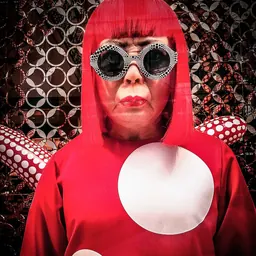
Human and Fish and We’re all Suffering, both painted in 1954, are considered to be two of Katsura's most overtly political works as they were painted following the Daigo Fukuryū Maru (Lucky Dragon) nuclear incident that resulted in the irradiation of 23 Japanese fishermen caused failed American Castle Bravo test at Bikini Atoll. She employed a variety of approaches to coloration and the layering of material and relief in these works, and they were quite well received both in the U.S.A. and in Japan. Katsura came in contact with a young Yayoi Kusama (Katsura was nearly 20 years older); in 1960 they both exhibited their work at Gres Gallery in Washington D.C., alongside Kawabata Minoru, Okada Kenzō, Onosato Toshinobu, and Yamaguchi Takeo. While living in New York, Katsura was also included in the "11th PREMIO LISSONE International Art Exhibition," held in Lissone, Italy, in 1959, alongside artists such as Kawabata Minoru, Shiraga Kazuo, Fukushima Hideko, Motonaga Sadamasa, and Yves Klein.
Katsura continued to incorporate the wrinkling, textural quality of the layered washi paper into many of her later works, even when she returned to folkloric caricature and zoomorphic subjects upon her return to Japan.
Notable works
Gonbe and Crow, ゴンベとカラス (1966) Mask, マスク (1970) Fox and Badger, 狐と狸 (1973) Adam and Eve, アダムとエブ (1983) Sweet Potatoes, あまいも (1987)
Publications A Woman Alone Enters a Primitive Village: Memoirs from Africa and America [Onna hitori genshi bu — raku ni hairu: afurika, amerika no taikenki], 1962 The Fox's Journey [Kitsune no Dairyokō], 1974 The New Fox's Journey [Shin Kitsune no Dairyokō], 1974 Sequel to the Fox's Journey [Zoku Kitsune no Dairyokō], 1974
Don’t just read it —
keep it.
Full-length biographies made to live with: read them, listen on the way to work, watch them tonight.
- E-book
- Audio
- Video
Instant download · yours to keep · every purchase keeps this site free
Important facts
People in Yuki Katsura's life
Named in this biography and alive at the same time


Related people
Same field, nearest in time

Contemporaries
People whose lives overlapped Yuki Katsura's



Frequently asked questions
Who was Yuki Katsura?
painter in Japan (1913-1991)
When was Yuki Katsura born?
Yuki Katsura was born on 10 October 1913 in Tokyo.
When did Yuki Katsura die?
Yuki Katsura died on 5 February 1991 in Tokyo.
What was Yuki Katsura's occupation?
Yuki Katsura was a painter.
What nationality was Yuki Katsura?
Yuki Katsura was Japanese.
Sources & further reading
Cite this page
APA: Biography.guide. (2026). Yuki Katsura. https://biography.guide/yuki-katsura/
MLA: "Yuki Katsura." Biography.guide, https://biography.guide/yuki-katsura/.
Chicago: "Yuki Katsura." Biography.guide. https://biography.guide/yuki-katsura/.
Data last updated: 2026-09-20 · Spot an error? Report a correction.
Page generated 2026-09-27 05:18 UTC