About Yayoi Kusama
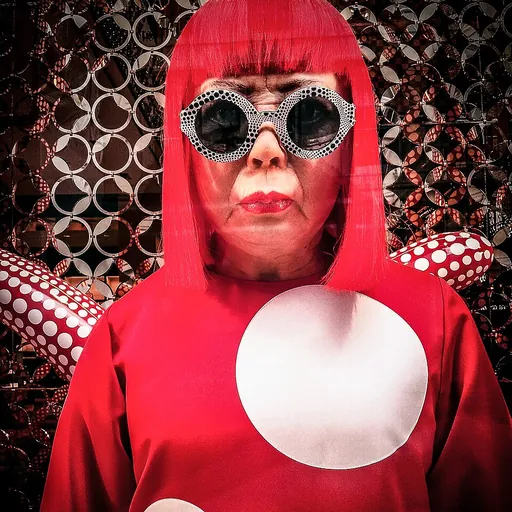
Lived 1929 – 2026 (aged 97). Yayoi Kusama was a Japanese conceptual artist, sculptor, novelist, painter, draftsperson and photographer.
was a Japanese contemporary artist who worked primarily in sculpture and installation. She was also active in painting, performance, video art, fashion, poetry, fiction, and other arts. Her work was based in conceptual art and shows some attributes of feminism, minimalism, surrealism, , pop art, and abstract expressionism, and is infused with autobiographical, psychological, and sexual content. She was acknowledged as one of the most important artists to have come out of Japan, and was one of the world's top-selling female artists and ranked #19 in Sotheby's 2023 list of the top 50 artists. Her work influenced her contemporaries, including Andy Warhol and Claes Oldenburg.
Kusama was raised in Matsumoto, and trained at the Kyoto City University of Arts for a year in a Japanese painting style called nihonga. She was inspired by American abstract impressionism. She moved to New York City in 1958 and was a part of the New York avant-garde scene throughout the 1960s, especially in the pop-art movement. Embracing the rise of the hippie counterculture of the late 1960s, she came to public attention when she organized a series of happenings in which naked participants were painted with brightly colored polka dots. She experienced a period in the 1970s during which her work was largely overlooked, but a revival of interest in the 1980s brought her art back into public view. Kusama continued to create art in various museums around the world, from the 1950s onwards.
She was open about her mental health and resided in a mental health facility from the 1970s until her death. She said that art had become her way to express her mental problems. "I fight pain, anxiety, and fear every day, and the only method I have found that relieved my illness is to keep creating art", she told an interviewer in 2012. "I followed the thread of art and somehow discovered a path that would allow me to live."
Life and career
Early life: 1929–1949 Yayoi Kusama was born on 22 March 1929 in Matsumoto, Nagano. Born into a family of merchants who owned a plant nursery and seed farm, Kusama began drawing pictures of pumpkins in elementary school and created artwork she saw from hallucinations, works of which would later define her career. Her mother was physically abusive, Her traumatic childhood, including her hallucinations, can be said to be the origin of her artistic style. The pumpkins which are monumental in her art came from a visit to a big seed-harvesting ground with her grandfather when she was young. She said that she was "enchanted by their charming and winsome form" as well as their "generous unpretentiousness" even though they generally may not inspire too much respect.
When Kusama was ten years old, she began to experience vivid hallucinations which she described as "flashes of light, auras, or dense fields of dots". These hallucinations included flowers that spoke to Kusama, and patterns in fabric that she stared at coming to life, multiplying, and engulfing or expunging her, Kusama's art became her escape from her family and her own mind when she began to have hallucinations.
During the Pacific War, when Kusama was 13, she was sent to work in a military factory where she was tasked with making parachutes for the Imperial Japanese Army. Discussing her time in the factory, she said that she spent her adolescence "in closed darkness" although she could always hear the air raid sirens and see U.S. B-29s flying overhead during daytime.
Early success in Japan: 1950–1956 By 1950, she was depicting abstract natural forms in watercolor, gouache, and oil paint, primarily on paper. She began covering surfaces—walls, floors, canvases, and later, household objects, and naked assistants—with the polka dots that became distinctive traits of her work. Her first show took place in Japan in 1952.
The vast fields of polka dots, or "infinity nets", as she called them, were taken directly from her hallucinations. The earliest recorded work in which she incorporated these dots was a drawing in 1939 at age 10, in which the image of a Japanese woman in a kimono, presumed to be the artist's mother, is covered and obliterated by spots. Her first series of large-scale, sometimes more than -long canvas paintings, Infinity Nets, were entirely covered in a sequence of nets and dots that alluded to hallucinatory visions.
On her 1954 painting Flower (D.S.P.S), Kusama said:
New York City: 1957–1972 After living in Tokyo and France, Kusama left Japan at the age of 27 for the United States. She stated that she began to consider Japanese society "too small, too servile, too feudalistic, and too scornful of women". She stayed there for a year She arrived in New York City in 1958 where the majority of her well known collections were born: Infinity Networks and sculptures. Her first exhibition that earned great success was in 1959 at the Brata Gallery and then she went on to pioneering body art performances and "happenings". During her time in the U.S , she quickly established her reputation as a leader in the avant-garde movement and received praise for her work from the anarchist art critic Herbert Read.
In 1961, she moved her studio into the same building as Donald Judd and sculptor Eva Hesse; Hesse became a close friend. In the early 1960s, Kusama began to create so-called soft sculptures by covering items such as ladders, shoes, and chairs with white phallic protrusions. Despite the micromanaged intricacy of the drawings, she turned them out fast and in bulk, establishing a rhythm of productivity which she maintained for the rest of her life. She established other habits too, like having herself routinely photographed with new work and regularly appearing in public wearing her signature bob wigs and colorful, avant-garde fashions. Kusama's piece received the most attention from attendees and critics, and by September Oldenburg was exhibiting sewn soft sculpture, some pieces of which were very similar to Kusama's; Oldenburg's wife apologized to Kusama at the exhibit. According to Fordham professor of art Midori Yamamura, Oldenburg likely was inspired by Kusama's work to use sewn pieces himself, pieces which made him an "international star". Kusama became depressed over the incident. A similar incident occurred soon after when Kusama exhibited a boat she had covered in soft sculpture, with photographs of the boat completely covering the walls of the exhibit space, which was very innovative. Andy Warhol remarked on the exhibit, and not long after covered the walls of an exhibit space with photos of a cow, for which he drew significant attention. Kusama became very secretive about her studio work. Helaine Posner, of the Neuberger Museum of Art, said it was likely some combination of sexism and racism that kept Kusama, who was creating work of equal importance to men who were using her ideas and taking the credit for them, from getting the same kinds of backing.
border = 0 quoted = 1 salign = right — Yayoi Kusama
From 1963, Kusama continued her series of Mirror/Infinity rooms. In these complex infinity mirror installations, purpose-built rooms lined with mirrored glass contain scores of neon-colored balls, hanging at various heights above the viewer. Standing inside on a small platform, an observer sees light repeatedly reflected off the mirrored surfaces to create the illusion of a never-ending space.
During the following years, Kusama was enormously productive, and by 1966, she was experimenting with room-size, freestanding installations that incorporated mirrors, lights, and piped-in music. She counted Judd and Joseph Cornell among her friends and supporters. However, she did not profit financially from her work. Around this time, Kusama was hospitalized regularly from overwork, and O'Keeffe persuaded her own dealer Edith Herbert to purchase several works to help Kusama stave off financial hardship. She was not able to make the money she believed she deserved, and her frustration became so extreme that she attempted suicide.
In 1968, Kusama presided over the happening Homosexual Wedding at the Church of Self-obliteration at 33 Walker Street in New York and performed alongside Fleetwood Mac and Country Joe and the Fish at the Fillmore East in New York. As soon as the piece was installed on a lawn outside the Italian pavilion, Kusama, dressed in a golden kimono,
During her time in New York, Kusama had a brief relationship with Judd.
Return to Japan: 1973–1977
In 1973, Kusama returned to Japan. Her reception from the Japanese art world and press was unsympathetic; one art collector recalled considering her a "scandal queen". a psychiatric hospital in Shinjuku, Tokyo. She lived at the hospital for the rest of her life, by choice. Kusama is often quoted as saying: "If it were not for art, I would have killed myself a long time ago."
From this base, she continued to produce artworks in a variety of media, as well as launching a literary career by publishing several novels, a poetry collection, and an autobiography. Her painting style shifted to highly colored acrylics on canvas, on an amped-up scale.
Following the success of the Japanese pavilion at the Venice Biennale in 1993, a dazzling mirrored room filled with small pumpkin sculptures in which she resided in color-coordinated magician's attire, Kusama went on to produce a huge, yellow pumpkin sculpture covered with an optical pattern of black spots. The pumpkin came to represent for her a kind of alter-ego or self-portrait. The "Pumpkin", made of fiberglass-reinforced plastic, was installed in 1994 on a pier on Naoshima, Kagawa, becoming iconic as her profile grew in the following decades; it was reinstalled in 2022 after being destroyed by a typhoon a year earlier. Kusama's later installation I'm Here, but Nothing (2000–2008) is a simply furnished room consisting of table and chairs, place settings and bottles, armchairs and rugs; however, its walls are tattooed with hundreds of fluorescent polka dots glowing in the UV light. The result is an endless infinite space where the self and everything in the room is obliterated.
The multi-part floating work Guidepost to the New Space, a series of rounded "humps" in fire-engine red with white polka dots, was displayed in Pandanus Lake. Perhaps one of Kusama's most notorious works, various versions of Narcissus Garden have been presented worldwide venues including Le Consortium, Dijon, 2000; Kunstverein Braunschweig, 2003; as part of the Whitney Biennial at Central Park, New York in 2004; and at the Jardin de Tuileries in Paris, 2010.
Kusama continued to work as an artist in her ninth decade. She harkened back to earlier work by returning to drawing and painting; her work remained innovative and multi-disciplinary, and a 2012 exhibition displayed multiple acrylic-on-canvas works. Also featured was an exploration of infinite space in her Infinity Mirror rooms. These typically involve a cube-shaped room lined in mirrors, with water on the floor and flickering lights; these features suggest a pattern of life and death. A 1996 residency at Mattress Factory also resulted in two of these rooms being installed, alongside Dots Obsession. The two infinity rooms, Infinity Dots Mirrored Room and Repetitive Vision, remain on view.
From 2015 to 2016, the first retrospective exhibition in Scandinavia, curated by Marie Laurberg, travelled to four major museums in the region, opening at Louisiana Museum of Modern Art in Denmark and continuing to Henie Onstad Kunstsenter Museum in Norway, Moderna Museet in Sweden, and Helsinki Art Museum in Finland. This major show contained more than 100 objects and large-scale mirror room installations. It presented several early works that had not been shown to the public since they were first created, including a presentation of Kusama's experimental fashion design from the 1960s.
On 25 February 2017, Kusama's All the Eternal Love I Have for the Pumpkins exhibit, one of the six components to her Infinity Mirror rooms at the Hirshhorn Museum, was temporarily closed for three days following damage to one of the exhibit's glowing pumpkin sculptures. The room, which measures and was filled with over 60 pumpkin sculptures, was one of the museum's most popular attractions ever. Allison Peck, a spokeswoman for the Hirshhorn, said that the museum "has never had a show with that kind of visitor demand", with the room totalling more than 8,000 visitors between its opening and its temporary closure. While there were conflicting media reports about the cost of the damaged sculpture and how exactly it was broken, Peck said that "there is no intrinsic value to the individual piece. It is a manufactured component to a larger piece." The exhibit was reconfigured to make up for the missing sculpture, and a new one was to be produced for the exhibit by Kusama. The Infinity Mirrors exhibit became a sensation among art critics as well as on social media. Museum visitors shared 34,000 images of the exhibition to their Instagram accounts, and social media posts using the hashtag #InfiniteKusama garnered 330 million impressions, as reported by the Smithsonian the day after the exhibit's closing. The works provided the perfect setting for Instagram-able selfies which inadvertently added to the performative nature of the works.
Later in 2017, the Yayoi Kusama Museum opened in Tokyo, featuring her works.
On 9 November 2019, Kusama's Everyday I Pray For Love exhibition was shown at David Zwirner Gallery until 14 December. The exhibition incorporated sculptures and paintings, and included the debut of her Infinity Mirrored Room – Dancing Lights That Flew Up To The Universe. The catalogue, published by David Zwirner books, contained texts and poems.
In January 2020, the Hirshhorn announced it would debut new Kusama acquisitions, including two Infinity Mirror Rooms, at a forthcoming exhibition called One with Eternity: Yayoi Kusama in the Hirshhorn Collection. The name of the exhibit was derived from an open letter Kusama wrote to then-President-elect Richard Nixon in 1968, writing: "let's forget ourselves, dearest Richard, and become one with the absolute, all together in the altogether."
In November 2021, a monumental exhibition offering an overview of Kusama's main creative periods over the past 70 years, with some 200 works and four Infinity Rooms (unique mirror installations) debuted at the Tel Aviv Museum of Art. The retrospective spanned almost 3,000 m2 across the museum's two buildings, in six galleries and included two new works from 2021: A Bouquet of Love I Saw in the Universe, and Light of the Universe Illuminating the Quest for Truth.
In late December 2022, the Hong Kong's M+ museum opened a retrospective on Kusama's career entitled Yayoi Kusama: 1945 to Now. The exhibition, which showed until May 2023, was the largest retrospective of her art in Asia, not including her home country.
The Pérez Art Museum Miami held a showing of Kusama's work. Yayoi Kusama: LOVE IS CALLING was on view and accessible to the public throughout 2024.
In 2024, Kusama unveiled a new Infinity Mirror Room titled Infinity Mirrored Room – Beauty Described by a Spherical Heart as part of her solo exhibition Every Day I Pray for Love at the Victoria Miro Gallery in London. The installation featured mirrored spheres suspended within a darkened space, continuing Kusama's exploration of repetition, reflection, and the dissolution of the self through immersive environments.
Kusama died at a hospital in Tokyo, on 14 August 2026 from multiple organ failure, at the age of 97. Her death was announced on 27 August.
Mental health Kusama struggled with her mental health, suffering from obsessive–compulsive disorder (OCD) as well as hallucinations and mania. Because of her struggles she took up permanent residence at starting in 1977. She has stated that starting at age 10 she began to have hallucinations of dots, flower, pumpkins, and patterned fabrics that involved them coming to life and speaking to her and enveloping her, a theme often seen in her later works. She has described this as "self-obliteration" and also that her works involving softer materials and/or colors are a way to process and reduce the intensity of her feelings and experiences.
In her early life Kusama was forced by her mother to spy on her father's infidelity, potentially resulting in her "disgust towards sex". Her mother also attempted to stop her from practicing art, taking away Kusama's art materials in hopes to deter her. Additionally, because she lived in Japan during World War II she was sometimes physically unsafe as well.
Meaning and origins of her work Curator Mika Yoshitake has said that Kusama's works on display are meant to immerse the whole person into her accumulations, obsessions, and repetitions. Kusama's use of infinite and repetitive patterns started as a way to cope with intrusive thoughts related to her mental health, and these ideas later shaped her immersive artistic environments. Claire Voon has described one of Kusama's mirror exhibits as being able to "transport you to quiet cosmos, to a lonely labyrinth of pulsing light, or to what could be the enveloping innards of a leviathan with the measles".
Creating these feelings amongst audiences was intentional. These experiences seem to be unique to her work because Kusama wanted others to sympathise with her in her troubled life.
In 1962, Kusama created her work Accumulation of Stamps, 63. The medium used are pasted labels and ink on paper with dimensions of 23 3/4 x 29" (60.3 x 73.6 cm). The piece was donated by architect Philip Johnson to the Department of Drawings and Prints at the Museum of Modern Art. Kusama experienced hallucinations of flowers, dots, and nets during her childhood. These visions engulfed her surroundings, covering everything from ceilings to windows and walls. She saw the same pattern expand to encompass her body and the entire universe. To cope with her condition, Kusama adopted repeated forms in her art, using store-bought labels and stickers. She did not view her art as an end in itself but rather as a means to address her disability that originated in her childhood. The process of repetition, evident in her collages, reflects her artistic approach. Consequently, many of her artworks bear titles that include words like "accumulation" and "infinity".
Art critic for The Australian newspaper, Christopher Allen, called Kusama "one of the world's most determinedly vacuous artists".
Works and publications
Performance In Kusama's Walking Piece (1966), a performance that was documented in a series of eighteen color slides, Kusama walked along the streets of New York City in a traditional Japanese kimono while holding a parasol. The kimono suggested traditional roles for women in Japanese custom. The parasol, however, was made to look inauthentic, as it was actually a black umbrella, painted white on the exterior and decorated with fake flowers. Kusama walked down unoccupied streets in an unknown quest. She then turned and cried without reason, and eventually walked away and vanished from view.
This performance, through the association of the kimono, involved the stereotypes that Asian-American women continued to face. However, as an avant-garde artist living in New York, her situation altered the context of the dress, creating a cross-cultural amalgamation. Kusama was able to highlight the stereotype in which her white American audience categorized her, by showing the absurdity of culturally categorizing people in the world's largest melting pot.
Film In 1968, Kusama and Jud Yalkut's collaborative work Kusama's Self-Obliteration won a prize at the Fourth International Experimental Film Competition in Knokke, Belgium and the Second Maryland Film Festival and the second prize at the Ann Arbor Film Festival. The 1967 experimental film, which Kusama produced and starred in, depicted Kusama painting polka dots on everything around her, including bodies.
Fashion In 1968, Kusama established Kusama Fashion Company Ltd, and began selling avant-garde fashion in the "Kusama Corner" at Bloomingdale's. In 2009, she designed a handbag-shaped cell phone entitled Handbag for Space Travel, My Doggie Ring-Ring, a pink dotted phone in accompanying dog-shaped holder, and a red and white dotted phone inside a mirrored, dotted box dubbed Dots Obsession, Full Happiness With Dots, for Japanese mobile communication giant KDDI Corporation's "iida" brand. Each phone was limited to 1,000 pieces. That same year, she worked with Marc Jacobs, who visited her studio in Japan in 2006, on a line of Louis Vuitton products, including leather goods, ready-to-wear, accessories, shoes, watches, and jewelry. The products were released in 2012 at a SoHo pop-up shop, which was decorated with Kusama's trademark tentacle-like protrusions and polka-dots. Eventually, six other pop-up shops opened around the world. When asked about her collaboration with Jacobs, Kusama said that "his sincere attitude toward art" is the same as her own. Louis Vuitton created a second set of products in 2023.
In 2024, a Kusama limited edition yellow and black leather monogram Louis Vuitton pumpkin bag sold for $151,200 at Christie's in New York, setting a new world record price for a Louis Vuitton handbag.
Writing In 1977, Kusama published a book of poems and paintings, 7. One year later, her first novel Manhattan Suicide Addict appeared. Between 1983 and 1990, she finished the novels The Hustler's Grotto of Christopher Street (1983), The Burning of St Mark's Church (1985), Between Heaven and Earth (1988), Woodstock Phallus Cutter (1988), Aching Chandelier (1989), Double Suicide at Sakuragazuka (1989), and Angels in Cape Cod (1990), alongside several issues of the magazine S&M Sniper in collaboration with photographer Nobuyoshi Araki. published in 2003 that depicts her life from growing up in Japan, her departure to the United States, and her return to her home country, where she resided until her death in 2026. Infinity Net includes her poetry and photographs of her exhibitions.
In October 2023, Kusama apologized for a number of racist comments against Black people in her writing, some of which had previously been excluded from English-language translations of her work.
Beyond her visual art, Kusama maintained a prolific literary career, producing novels, poetry and autobiographical work that often explores themes of obsession, mental health, sexuality, and her experiences living between Japan and the United States. Her writing formed an important parallel strand of her wider artistic career, reflecting many of the personal ideas and recurring themes that also appear throughout her paintings, installations, and performances.
Commissions Kusama completed several major outdoor sculptural commissions, mostly in the form of brightly hued monstrous plants and flowers, for both public and private institutions, including Pumpkin (1994) for the Fukuoka Municipal Museum of Art; The Visionary Flowers (2002) for the Matsumoto City Museum of Art; Tsumari in Bloom (2003) for Matsudai Station, Niigata; Tulipes de Shangri-La (2003) for Euralille in Lille, France; Red Pumpkin (2006) for Naoshima, Kagawa; Hello, Anyang with Love (2007) for Pyeonghwa Park (now referred as World Cup Park) in Anyang, South Korea; and The Hymn of Life: Tulips (2007) for the Beverly Gardens Park in Los Angeles. In 1998, she realized a mural for the hallway of the Gare do Oriente subway station in Lisbon. Alongside these monumental works, she produced smaller-scale outdoor pieces, including Key-Chan and Ryu-Chan, a pair of dotted dogs. All the outdoor works are cast in highly durable fiberglass-reinforced plastic, then painted in urethane to glossy perfection.
In 2010, Kusama designed a Town Sneaker-styled bus, which she titled Mizutama Ranbu (Wild Polka Dot Dance) and whose route travels through her hometown of Matsumoto. That same year, Kusama conceived her floor installation Thousands of Eyes as a commission for the new Queen Elizabeth II Courts of Law in Brisbane.
Select exhibitions Rodenbeck, J. F. "Yayoi Kusama: Surface, Stitch, Skin". Zegher, M. Catherine de. Inside the Visible: An Elliptical Traverse of 20th Century Art in, of, and from the Feminine. Cambridge, Massachusetts: MIT Press, 1996. Kusama, Yayoi, and Damien Hirst. Yayoi Kusama Now. New York: Robert Miller Gallery, 1998. Kusama, Yayoi, and Lynn Zelevansky. Love Forever: Yayoi Kusama, 1958–1968. Los Angeles: Los Angeles County Museum of Art, 1998. Kusama, Yayoi. Yayoi Kusama. Vienna: Kunsthalle Wien, 2002. Kusama, Yayoi. Yayoi Kusama. Paris: Les Presses du Reel, 2002. Kusama, Yayoi. Kusamatorikkusu = Kusamatrix. Tokyo: Kadokawa Shoten, 2004. Kusama, Yayoi, and Tōru Matsumoto. Kusama Yayoi eien no genzai = Yayoi Kusama: eternity-modernity. Tokyo: Bijutsu Shuppansha, 2005. Applin, Jo, and Yayoi Kusama. Yayoi Kusama. London: Victoria Miro Gallery, 10 October – 17 November 2007. Kusama, Yayoi. Yayoi Kusama. Gagosian Gallery, New York, 16 April – 27 June 2009; Gagosian Gallery, Beverly Hills, 30 May – 17 July 2009. Morris, Frances, and Jo Applin. Yayoi Kusama. London: Tate Publishing, 2012. David Zwirner Gallery. Yayoi Kusama: EVERY DAY I PRAY FOR LOVE, New York, 9 November – 14 December 2019. Pérez Art Museum Miami. Yayoi Kusama: LOVE IS CALLING, 9 March 2023 – 11 February 2024. National Gallery of Victoria, Melbourne, Australia. Yayoi Kusama, 15 December 2024 – 21 April 2025
Illustration work Andersen, Hans Christian and Yayoi Kusama. "The Little Mermaid by Hans Christian Andersen & Yayoi Kusama: A Fairy Tale of Infinity and Love Forever". Louisiana Museum of Modern Art, 2016. Carroll, Lewis and Yayoi Kusama. Lewis Carroll's Alice's Adventures in Wonderland. London: Penguin Classics, 2012.
Chapters Nakajima, Izumi. "Yayoi Kusama between abstraction and pathology". Pollock, Griselda, ed. Psychoanalysis and the Image: Transdisciplinary Perspectives. Malden, Massachusetts: Blackwell Pub, 2006. pp. 127–160. Klaus Podoll, "Die Künstlerin Yayoi Kusama als pathographischer Fall". Schulz R, Bonanni G, Bormuth M, eds. Wahrheit ist, was uns verbindet: Karl Jaspers' Kunst zu philosophieren. Göttingen, Wallstein, 2009. p. 119. Cutler, Jody B. "Narcissus, Narcosis, Neurosis: The Visions of Yayoi Kusama". Wallace, Isabelle Loring, and Jennie Hirsh. Contemporary Art and Classical Myth. Farnham, Surrey: Ashgate, 2011. pp. 87–109. Gipson, Ferren. "Yayoi Kusama" in Women's Work, pp. 75–79, Frances Lincoln, 2022
Autobiography, writing Kusama, Yayoi. A Book of Poems and Paintings. Tokyo: Japan Edition Art, 1977. Kusama, Yayoi. Kusama Yayoi: Driving Image = Yayoi Kusama. Tokyo: PARCO shuppan, 1986. Kusama, Yayoi, Ralph F. McCarthy, Hisako Ifshin. Violet Obsession: Poems. Berkeley: Wandering Mind Books, 1998. Kusama, Yayoi, Ralph F. McCarthy. Hustlers Grotto: Three Novellas. Berkeley, California: Wandering Mind Books, 1998. Kusama, Yayoi. Infinity Net: The Autobiography of Yayoi Kusama. Chicago: University of Chicago Press, 2011. Kusama, Yayoï, and Isabelle Charrier. Manhattan Suicide Addict. Dijon: Presses du Réel, 2005.
Catalogue raisonné, etc. Kusama, Yayoi. Yayoi Kusama: Print Works. Tokyo: Abe Corp, 1992. Hoptman, Laura, Akira Tatehata, and Udo Kultermann. Yayoi Kusama. London: Phaidon Press, 2003. Kusama, Yayoi, and Hideki Yasuda. Yayoi Kusama Furniture by Graf: Decorative Mode No. 3. Tokyo: Seigensha Art Publishing, 2003. Kusama, Yayoi. Kusama Yayoi zen hangashū, 1979–2004 = All Prints of Kusama Yayoi, 1979–2004. Tokyo: Abe Shuppan, 2006. Kusama, Yayoi, and Akira Tatehata. Yayoi Kusama: I Who Have Arrived in Heaven. New York: David Zwirner, 2014. Kusama, Yayoi, Laura Hoptman, Akira Tatehata, Udo Kultermann, Catherine Taft. Yayoi Kusama. London: Phaidon Press, 2017. Yoshitake, Mika, Chiu, Melissa, Dumbadze, Alexander Blair, Jones, Alex, Sutton, Gloria, Tezuka, Miwako. Yayoi Kusama : Infinity Mirrors. Washington, D.C. . OCLC 954134388
Exhibitions In 1959, Kusama had her first solo exhibition in New York at the Brata Gallery, an artist's co-op. She showed a series of white net paintings which were enthusiastically reviewed by Donald Judd (both Judd and Frank Stella then acquired paintings from the show).
Exhibition list
Kusama's Obliteration Room (2015) was inspired by the earlier Infinity Mirror Room.
1983: Yayoi Kusama's Self-Obliteration (Performance) at Video Gallery SCAN, Tokyo 1987: Kusama's first major retrospective exhibit is held at the Kitakyushu Municipal Museum of Art 1993: Represented Japan at the Venice Biennale 1998: Love Forever: Yayoi Kusama,1958–1969, LACMA 1998–1999: Love Forever: Yayoi Kusama,1958–1969 – exhibit traveled to Museum of Modern Art, New York 7 February 2004 – 9 May 2004: Kusamatrix, Mori Art Museum, Tokyo 5 June 2004 – 22 August 2004: Kusamatrix traveled to Art Park Museum of Contemporary Art, Sapporo Art Park, Hokkaido) 26 October 2004 – 19 December 2004: Eternity – Modernity, National Museum of Modern Art, Tokyo 2007: FINA Festival 2007. Kusama created Guidepost to the New Space, an outdoor installation for Birrarung Marr beside the Yarra River in Melbourne. In 2009, the Guideposts were re-installed at Fairchild Tropical Botanic Garden, this time displayed as floating "humps" on a lake. 10 October 2007 – 17 November 2007: Yayoi Kusama, Victoria Miro Gallery, London 24 February 2009 – 8 June 2009: The Mirrored Years traveled to Museum of Contemporary Art in Sydney 27 September 2009 – 7 February 2010: The Mirrored Years traveled to City Gallery Wellington 2010: Museum Boijmans Van Beuningen purchased the work Infinity Mirror Room – Phalli's Field. As of 13 September of that year, the mirror room is permanently exhibited in the entrance area of the museum. 11 May – 12 September 2011: Yayoi Kusama, Museo Reina Sofía, Madrid 9 February – 5 June 2012: Yayoi Kusama, Tate Modern, London. Described as "akin to being suspended in a beautiful cosmos gazing at infinite worlds, or like a tiny dot of fluorescent plankton in an ocean of glowing microscopic life", the exhibition features a retrospective spanning Kusama's entire career 30 June 2013 – 16 September 2013: "Obsesión Infinita" (Infinite Obsession), MALBA, Buenos Aires 22 May 2014 – 27 June 2014: Yayoi Kusama: Obsessão Infinita, Instituto Tomie Ohtake, São Paulo 7 March 2015 – 7 June 2015: Yayoi Kusama: Obsesión Infinita, Centro de las Artes 660 / CA 660 (Fundación CorpArtes), Las Condes, Santiago, Chile. 17 September 2015 – 24 January 2016: In Infinity, Louisiana Museum of Modern Art, Humlebæk 12 June 2015 – 9 August 2015: Yayoi Kusama: Infinity Theory, Garage Museum of Contemporary Art, Moscow. This was Kusama's first solo exhibition in Russia 19 February 2016 – 15 May 2016: Yayoi Kusama – I uendeligheten, Henie Onstad Kunstsenter, Oslo 12 June 2016 – 18 September 2016: Kusama: At the End of the Universe, Museum of Fine Arts, Houston, Houston, Texas 1 May 2016 – 30 November 2016: Yayoi Kusama: Narcissus Garden, The Glass House, New Canaan, Connecticut 25 May 2016 – 30 July 2016: Yayoi Kusama: Sculptures, Paintings & Mirror Rooms, Victoria Miro Gallery, London 25 May 2016 – 30 July 2016: Yayoi Kusama: My Eternal Soul, Victoria Miro Gallery, Mayfair 7 October 2016 – 22 January 2017: Yayoi Kusama: In Infinity, organised by the Louisiana Museum of Modern Art in cooperation with Henie Onstad Kunstsenter, Moderna Museet/ArkDes and Helsinki Art Museum in Helsinki 5 November 2016 – 17 April 2017: Dot Obsessions – Tasmania, MONA: Museum of Old and New Art, Hobart 23 February 2017 – 14 May 2017: Yayoi Kusama: Infinity Mirrors, a traveling museum show originating at the Hirshhorn Museum and Sculpture Garden, Washington, D.C. 9 June 2017 – 3 September 2017: Yayoi Kusama: Life is the Heart of a Rainbow, National Gallery Singapore October 2017 – January 2018: Yayoi Kusama: Infinity Mirrors, exhibition traveled to The Broad, Los Angeles, California 1 October 2017 – 29 April 2018: Yayoi Kusama: All the Eternal Love I Have for the Pumpkins, Dallas Museum of Art, Dallas, Texas 4 November 2017 – 11 February 2018: Yayoi Kusama: Life is the Heart of a Rainbow and Obliteration Room, Gallery of Modern Art, Brisbane, Brisbane 3 May 2018 – 28 February 2019: Yayoi Kusama: Infinity Pumpkins, Forever Museum of Contemporary Art, Gion 3 March 2018 – 27 May 2018: Yayoi Kusama: Infinity Mirrors, exhibition traveled to Art Gallery of Ontario, Toronto, Ontario 12 May 2018 – 9 September 2018: Yayoi Kusama: Life is the Heart of a Rainbow, Museum of Modern and Contemporary Art in Nusantara, Jakarta 7 July 2018 – 30 September 2018: Yayoi Kusama: Infinity Mirrors, exhibition traveled to Cleveland Museum of Art, Cleveland, Ohio 5 July 2018 – 28 October 2018: Yayoi Kusama: Where The Lights In My Heart Go, exhibition traveled to DeCordova Sculpture Park and Museum, Lincoln, Massachusetts 26 July 2018 – Spring 2019: Yayoi Kusama: With All My Love for the Tulips, I Pray Forever (2011) 22 March 2019 – 1 September 2019: Yayoi Kusama, Museum Voorlinden, Wassenaar 9 November 2019 – 14 December 2019: Yayoi Kusama: Everyday I Pray For Love, David Zwirner Gallery, New York 4 April 2020 – 19 September 2020: Yayoi Kusama: One with Eternity: Yayoi Kusama in the Hirshhorn Collection, Washington, DC 10 April 2021 – 31 October 2021: Kusama: Cosmic Nature, New York Botanical Garden, New York 23 April 2021 – 15 August 2021: Yayoi Kusama: A Retrospective, Martin-Gropius-Bau, Berlin 18 May 2021 – 28 April 2024: Yayoi Kusama: Infinity Mirror Rooms, Tate Modern, London 15 November 2021 – 23 April 2022: Yayoi Kusama: A Retrospective, exhibition traveled to Tel Aviv Museum of Art 12 November 2022 – 14 May 2023: Yayoi Kusama: 1945 to Now, M+, Hong Kong 20 November 2022 – 1 March 2023: Yayoi Kusama: My Soul Blooms Forever, Museum of Islamic Art, Doha 9 March 2023 – 11 February 2024: Yayoi Kusama: LOVE IS CALLING, Pérez Art Museum Miami, Florida 11 May 2023 – 21 July 2023: Yayoi Kusama: I Spend Each Day Embracing Flowers, David Zwirner Gallery, New York 30 June 2023 – 28 August 2023: Yayoi Kusama: You, Me, and the Balloons, Factory International, Manchester 14 September 2023 – 5 May 2024: Yayoi Kusama: Infinity Mirrored Room – Let's Survive Together, 2017, Memorial Art Gallery, Rochester, New York 27 March 2024 – 29 September 2024: Yayoi Kusama: 1945 to Now, exhibition traveled to Serralves Museum of Contemporary Art, Porto 15 December 2024 – 21 April 2025: Yayoi Kusama, National Gallery of Victoria, Melbourne 5 April 2025 – 25 October 2026: Yayoi Kusama: Infinity Mirrored Room – Let's Survive Forever, Art Gallery of Ontario, Toronto, Ontario 24 May – 5 October 2025: Yayoi Kusama: Infinity Mirrored Room – Brilliance of the Souls, Museum MACAN, Jakarta 2 October 2025 – 2 March 2026: One with Eternity: Yayoi Kusama, Buffalo AKG Art Museum, Buffalo, New York 12 October 2025 – 25 January 2026: Yayoi Kusama, Fondation Beyeler, Riehen 14 March – 2 August 2026, Museum Ludwig, Cologne
Permanent Infinity Room installations Infinity Dots Mirrored Room (1996), Mattress Factory, Pittsburgh, Pennsylvania Infinity Mirror Room Fireflies on Water (2000), Musée des Beaux-Arts de Nancy, Nancy You Who Are Getting Obliterated in the Dancing Swarm of Fireflies (2005), Phoenix Art Museum, Phoenix, Arizona Gleaming Lights of the Souls (2008), Louisiana Museum of Modern Art, Humlebæk, Fredensborg Municipality The Souls of Millions of Light Years Away (2013), The Broad, Los Angeles, California Infinity Dots Mirrored Room (2014), , Jeju Island, South Korea The Spirits of the Pumpkins Descended into the Heavens (2015), National Gallery of Australia, Canberra Hymn of Life (2015), Henie Onstad Kunstsenter, Oslo Phalli's Field (1965/2016), Museum Boijmans Van Beuningen, Rotterdam Light of Life (2018), North Carolina Museum of Art, Raleigh, North Carolina Brilliance of the Souls (2019), Museum of Modern and Contemporary Art in Nusantara, Jakarta Infinity Mirror Room – Let's Survive Forever (2019), Art Gallery of Ontario, Toronto, Ontario Aftermath of Obliteration of Eternity (2009), Museum of Fine Arts, Houston, Houston, Texas
Peer review Applin, Jo. Yayoi Kusama: Infinity Mirror Room – Phallis Field. Afterall, 2012. Hoptman, Laura J., et al. Yayoi Kusama. Phaidon Press Limited, 2000.
Collections Kusama's work is in the collections of museums throughout the world, including the Museum of Modern Art, New York; Los Angeles County Museum of Art, Los Angeles; Walker Art Center, Minneapolis; Phoenix Art Museum, Phoenix; Utah Museum of Fine Arts, Salt Lake City; Tate Modern, London; Stedelijk Museum Amsterdam; Centre Pompidou, Paris; Art Gallery of Ontario, Toronto; and the National Museum of Modern Art, Tokyo, and in the City Museum of Art in her home town of Matsumoto titled The Place for My Soul.
Recognition
Kusama's image is included in the iconic 1972 poster Some Living American Women Artists by Mary Beth Edelson.
In 2017, a fifty-year retrospective of Kusama's work opened at the Hirshhorn Museum in Washington, DC. That same year, the Yayoi Kusama Museum was inaugurated in Tokyo. Other major retrospectives of her work have been held at the Museum of Modern Art (1998), the Whitney Museum (2012), and the Tate Modern (2012).
Kusama received many awards, including the Asahi Prize (2001); Ordre des Arts et des Lettres (2003); the National Lifetime Achievement Award from the Order of the Rising Sun (2006); and a Lifetime Achievement Award from the Women's Caucus for Art. In October 2006, Kusama became the first Japanese woman to receive the Praemium Imperiale, one of Japan's highest honors for internationally recognized artists. She received the Person of Cultural Merit (2009) and Ango awards (2014). In 2014, Kusama was ranked the most popular artist of the year after a record-breaking number of visitors flooded her Latin American tour, Yayoi Kusama: Infinite Obsession. Venues from Buenos Aires to Mexico City received more than 8,500 visitors each day.
Kusama gained media attention for partnering with the Hirshhorn Museum and Sculpture Garden to make her 2017 Infinity Mirror rooms accessible to visitors with disabilities or mobility issues; in a new initiative among art museums, the venue mapped out the six individual rooms and provided disabled individuals visiting the exhibition access to a complete 360-degree virtual reality headset that allowed them to experience every aspect of the rooms, as if they were actually walking through them.
According to Hanna Schouwink of David Zwirner Gallery speaking in 2018, Kusama is "officially the world's most successful living artist".
Art market Kusama's work has performed strongly at auction: top prices for her work are for paintings from the late 1950s and early 1960s. As of 2012, her work had the highest turnover of any living woman artist. In November 2008, Christie's New York sold a 1959 white Infinity Net painting formerly owned by Donald Judd, In comparison, the highest price for a sculpture from her New York years is £72,500 (US$147,687), fetched by the 1965 wool, pasta, paint and hanger assemblage Golden Macaroni Jacket at Sotheby's London in October 2007. A 2006 acrylic on fiberglass-reinforced plastic pumpkin earned $264,000, the top price for one of her sculptures, also at Sotheby's in 2007. Her Flame of Life – Dedicated to Tu-Fu (Du-Fu) sold for US$960,000 at Art Basel/Hong Kong in May 2013, the highest price paid at the show. Kusama became the then most expensive living female artist at auction when White No. 28 (1960) from her signature Infinity Nets series sold for $7.1 million at a 2014 Christie's auction. The record is now held by Marlene Dumas.
In popular culture American indie band Superchunk included the song "Art Class (Song for Yayoi Kusama)" on its 2001 album Here's to Shutting Up. In 1967, Jud Yalkut made a film of Kusama titled Kusama's Self-Obliteration. In 2013, the British indie pop duo The Boy Least Likely To made song tribute to Kusama, writing a song specially about her. They wrote on their blog that they admire Kusama's work because she puts her fears into it, something that they themselves often do. Magnolia Pictures released the biographical documentary by Heather Lenz, Kusama: Infinity, in 2018 and a DVD version in 2019. Veuve Clicquot and Kusama created a limited-edition bottle and sculpture in September 2020. Cyndi Lauper's 2024 Farewell Tour featured art by Kusama, including white sculptures and walls covered in Kusama's signature red polka dots. Lauper and background performers also dressed in matching white clothes with large red polka dots.
Don’t just read it —
keep it.
Full-length biographies made to live with: read them, listen on the way to work, watch them tonight.
- E-book
- Audio
- Video
Instant download · yours to keep · every purchase keeps this site free
Important facts
People in Yayoi Kusama's life
Named in this biography and alive at the same time






Related people
Same field, nearest in time

Contemporaries
People whose lives overlapped Yayoi Kusama's

Frequently asked questions
Who was Yayoi Kusama?
Japanese artist (1929–2026)
When was Yayoi Kusama born?
Yayoi Kusama was born on 22 March 1929 in Matsumoto.
When did Yayoi Kusama die?
Yayoi Kusama died on 14 August 2026 in Tokyo.
What was Yayoi Kusama's occupation?
Yayoi Kusama was a conceptual artist, sculptor, novelist, painter, draftsperson and photographer.
What nationality was Yayoi Kusama?
Yayoi Kusama was Japanese.
Sources & further reading
Cite this page
APA: Biography.guide. (2026). Yayoi Kusama. https://biography.guide/yayoi-kusama/
MLA: "Yayoi Kusama." Biography.guide, https://biography.guide/yayoi-kusama/.
Chicago: "Yayoi Kusama." Biography.guide. https://biography.guide/yayoi-kusama/.
Data last updated: 2026-09-21 · Spot an error? Report a correction.
Portrait: Wikimedia Commons · author & licence
Page generated 2026-09-27 04:59 UTC