
About Yang Shangkun
Lived 1907 – 1998 (aged 91). Yang Shangkun was a Chinese politician and revolutionary.
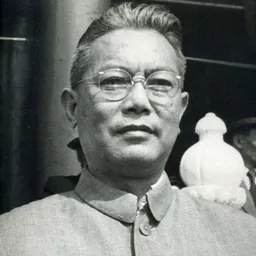
Yang Shangkun (3 August 1907 – 14 September 1998) was a Chinese Communist military and political leader, president of China from 1988 to 1993, and one of the Eight Elders that dominated the party after the death of Mao Zedong.
Born to a prosperous land-owning family, Yang studied politics at Shanghai University and Marxist philosophy and revolutionary tactics at Moscow Sun Yat-sen University he was one of the 28 Bolsheviks. He went on to hold high office under both Mao Zedong and later Deng Xiaoping; from 1945 to 1965 he was Director of the General Office and from 1945 to 1956 Secretary–General of the Central Military Commission (CMC). In these positions, Yang oversaw much of the day-to-day running of government and Party affairs, both political and military, amassing a great deal of bureaucratic power by controlling things like the flow of documents, the keeping of records, and the approval and allocation of funds. in Shuangjiang, Tongnan County, near the city of Chongqing in Sichuan, and studied at Chengdu Higher Normal School and its affiliated secondary school in 1920–25, and then returned to Chongqing. His older brother, Yang Yingong was one of the founding Executive Committee members of the Chinese Communist Party (CCP) in Sichuan, and influenced Yang Shangkun's ideological orientation. After joining the Communist Youth League in 1925, and the CCP in 1926, he enrolled in Shanghai University, where he studied politics. Later in 1927 Yang traveled to the Soviet Union and enrolled at the Moscow Sun Yat-sen University, where he studied Marxist theory and techniques of political organization and mobilization.
Second Sino–Japanese War and Chinese Civil War During the Second Sino–Japanese War Yang Shangkun was Deputy Secretary of the CCP North China Bureau and worked with Liu Shaoqi behind the Japanese lines. In January 1939, Yang became Secretary of the North China Bureau and worked with Zhu De and Peng Dehuai to cooperate with the military operations of the Eighth Route Army, including the Hundred Regiments Campaign. In 1941, Yang returned to Yan'an and worked as personal aide to Mao. In 1945, he became the Director of the General Office of the Party, as well as Secretary–General of the Central Military Commission, that was chaired by Mao himself. In these capacities, he was responsible for much of the day-to-day administration of the Party's military and political work, and carried out this duty with much success.
On the eve of the Cultural Revolution, Yang was identified as a supporter of Liu Shaoqi and Deng Xiaoping, and was purged as a counter-revolutionary in mid-December 1965. After being ejected from the Communist Party and removed from all positions, Yang was persecuted by Red Guards, who accused Yang of planting a covert listening device to spy on Mao, the same accusation shared by Deng Xiaoping.
Yang remained in prison until Mao died and Deng Xiaoping rose to power, in 1978. After Deng gained control of the military he recalled Yang, raised him to the position of general, and gave Yang the responsibility of reforming China's army, which Deng considered as larger than necessary and engaged in too many non-military activities. Deng raised Yang to the position of Vice Chairman of the Central Military Commission in order to give Yang the authority to complete these reforms (Deng was chairman). In 1982 Yang was also appointed as a full member of the Politburo.
Along with Xi Zhonguxn, Yang persuaded Deng that Guangdong should be a national demonstration zone for Reform and Opening Up.
Yang had a close friendship with Deng and shared many of Deng's long-term economic goals, but was far less enthusiastic about the agenda of political liberalization promoted by other senior leaders favored by Deng, including Hu Yaobang, Zhao Ziyang, Wan Li, and Hu Qili. Yang justified his support of economic reforms by referencing Vladimir Lenin and the New Economic Policy, and he emphasized that the Communist Party should still enjoy overall control of the economy, even in private businesses, through the system of Party committees in all enterprises. He also always defended Mao Zedong as a great and historic leader, despite his own suffering at the hands of radical Maoists.
In the early 1980s, Yang explicitly backed the efforts of a foreign China historian, Harrison Salisbury, to compile an account of the Long March by conducting extensive interviews with surviving Long March participants. The resulting book, Long March: The Untold Story, has been praised by China scholars as an excellent synthesis of first-hand oral sources. Within China, many Chinese veterans asked why it took a foreigner to produce such a book.
Presidency
In 1988, Yang was appointed president of China replacing Li Xiannian, making him the only president who was not a member of the Politburo Standing Committee. Under the conventions of the 1982 Constitution, the president's role was largely symbolic,
Yang died on 14 September 1998, aged 91. His official obituary described him as "a great proletarian revolutionary, a statesman, a military strategist, a staunch Marxist, an outstanding leader of the party, the state, and the people's army." In 2001, the ashes of Yang and his wife were interred at a cemetery named after him in Tongnan District, Chongqing.
Personal life In 1929, he married Li Bozhao, a woman who participated in the Long March alongside Yang. She had studied in the Soviet Union and even learned yablochko in Moscow. They had three sons.
Don’t just read it —
keep it.
Full-length biographies made to live with: read them, listen on the way to work, watch them tonight.
- E-book
- Audio
- Video
Instant download · yours to keep · every purchase keeps this site free
Important facts
People in Yang Shangkun's life
Named in this biography and alive at the same time



Related people
Same field, nearest in time





Contemporaries
People whose lives overlapped Yang Shangkun's



Frequently asked questions
Who was Yang Shangkun?
4th President of the People's Republic of China (1907–1998)
When was Yang Shangkun born?
Yang Shangkun was born on 5 July 1907 in Tongnan District.
When did Yang Shangkun die?
Yang Shangkun died on 14 September 1998 in Beijing.
What was Yang Shangkun's occupation?
Yang Shangkun was a politician and revolutionary.
What nationality was Yang Shangkun?
Yang Shangkun was Chinese.
Sources & further reading
Cite this page
APA: Biography.guide. (2026). Yang Shangkun. https://biography.guide/yang-shangkun/
MLA: "Yang Shangkun." Biography.guide, https://biography.guide/yang-shangkun/.
Chicago: "Yang Shangkun." Biography.guide. https://biography.guide/yang-shangkun/.
Data last updated: 2026-09-25 · Spot an error? Report a correction.
Page generated 2026-09-27 05:12 UTC