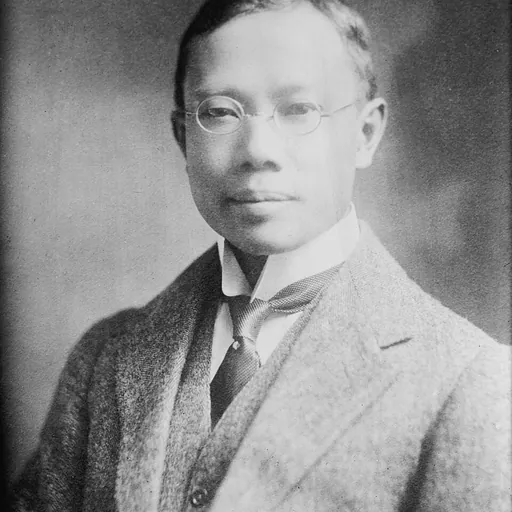
About Wu Lien-teh
Lived 1879 – 1960 (aged 80). Wu Lien-teh was a Malaysian physician and health officer, known for Manchurian plague.
Wu Lien-teh (; Goh Lean Tuck and Ng Leen Tuck in Hokkien and Cantonese transliteration respectively; 10 March 1879 – 21 January 1960) was a Malayan physician renowned for his work in public health, particularly the Manchurian plague of 1910–11. He is the inventor of the Wu mask, which is the forerunner of today's N95 respirator.
Wu was the first medical student of Chinese descent to study at the University of Cambridge. He was also the first Malayan nominated for the Nobel Prize in Physiology or Medicine, in 1935.
Life and education Wu was born in Penang, one of the three towns of the Straits Settlements (the others being Malacca and Singapore), currently as one of the states of Malaysia. The Straits Settlements formed part of the colonies of the United Kingdom. His father was a recent immigrant of Ethnic Hoisanese background from Taishan, China, and worked as a goldsmith. Wu's mother's was of ethnic Hakka heritage and was a second-generation Peranakan born in Malaya. Wu had four brothers and six sisters. His early education was at the Penang Free School, a Church of England school. after winning the Queen's Scholarship. He had a successful career at university, winning virtually all the available prizes and scholarships. His undergraduate clinical years were spent at St Mary's Hospital, London and he then continued his studies at the Liverpool School of Tropical Medicine (under Sir Ronald Ross), the Pasteur Institute, Halle University, and the Selangor Institute. in Peking, to travel to Harbin to investigate an unknown disease that killed 99.9% of its victims. This was the beginning of the large pneumonic plague epidemic of Manchuria and Mongolia, which ultimately claimed 60,000 lives.
Wu was able to conduct a postmortem (usually not accepted in China at the time) on a Japanese woman who had died of the plague. Having ascertained via the autopsy that the plague was spreading by air, Wu invented the face mask which became the precursor of the N95 respirator. Gérald Mesny, a prominent French doctor who had come to replace Wu, refused to wear the mask and died days later of the plague.
Wu chaired the International Plague Conference in Mukden (Shenyang) in April 1911, a historic event attended by scientists from the United States of America, the United Kingdom of Great Britain and Ireland, France, Germany, Italy, Austria-Hungary, the Netherlands, Russia, Mexico, and China. The conference took place over three weeks and featured demonstrations and experiments.
Wu later presented a plague research paper at the International Congress of Medicine, London in August 1911 which was published in The Lancet in the same month.
At the plague conference, epidemiologists Danylo Zabolotny and Anna Tchourilina announced that they had traced the initial cause of the outbreak to Tarbagan marmot hunters who had contracted the disease from the animals. A tarabagan became the conference mascot.
Later career
Group photo of Messrs. Jan van L., Dr. Wu Lien Teh and Professor De Langen, Tandjong Priok, Batavia, c. 1928 In 1912, Wu became the first director of the Manchurian Plague Service. He was a founder member and first president of the Chinese Medical Association (1916–1920).
Wu led the efforts to combat the 1920-21 cholera pandemic in the north-east of China.
The Wu Lien-teh Collection, which comprises 20,000 books, was given by Wu to the Nanyang University, which later became part of the National University of Singapore.
In 2015, the Wu Lien-Teh Institute opened at Harbin Medical University.
In 2024, Wu's great granddaughter, Associate Professor Shan Woo Liu, published a children's book about her great grandfather, Masked Hero: How Wu Lien-Teh Invented the Mask That Ended an Epidemic.
Dr. Wu Lien-teh is regarded as the first person to modernise China's medical services and medical education. In Harbin Medical University, bronze statues of him commemorate his contributions to public health, preventive medicine, and medical education.
Places named after Wu Lien-Teh A road named after Wu is found in Ipoh Garden South, a middle-class residential area in Ipoh, Malaysia. A residential area named Taman Wu Lien Teh is located near the Penang Free School in Malaysia. A school sporting house is named after Dr Wu at the Penang Free School, his alma mater. Jalan Doktor Wu Lien Teh in George Town, Penang, Malaysia There is a Dr Wu Lien-Teh Centre for Research on Communicable Diseases at the Universiti Tunku Abdul Rahman in Malaysia There is a Wu Lien-Teh Institute at the Harbin Medical University in China.
Commemoration during the COVID-19 pandemic Wu's work in the medical field of public health had contemporary relevance during the COVID-19 pandemic.
In May 2020, Dr. Yvonne Ho united the 22 known living medical and scientific descendants of Dr. Wu Lien-Teh via video conferencing which spanned four continents and 14 cities around the world. In July 2020, some of these medical and scientific descendants collaborated to publish an article to memorialize Dr. Wu's lifetime work in public health. This was published in Hong Kong's South China Morning Post. In August 2020, a second group of Wu's medical and scientific descendants collaborated on another publication in Malaysia's The Star. In September 2020, Wu's medical and scientific descendants published a third publication in Singapore's Lianhe Zaobao.
In March 2021, Wu was honoured with a Google Doodle, depicting Wu assembling surgical masks and distributing them to reduce the risk of disease transmission.
Commemoration beyond the COVID-19 pandemic In May 2026, The Lancet Voice podcast featured Dr Wu.
Don’t just read it —
keep it.
Full-length biographies made to live with: read them, listen on the way to work, watch them tonight.
- E-book
- Audio
- Video
Instant download · yours to keep · every purchase keeps this site free
Important facts
People in Wu Lien-teh's life
Named in this biography and alive at the same time



Related people
Same field, nearest in time



Contemporaries
People whose lives overlapped Wu Lien-teh's


Frequently asked questions
Who was Wu Lien-teh?
Malaysian physician (1879–1960)
When was Wu Lien-teh born?
Wu Lien-teh was born on 10 March 1879 in Penang Island.
When did Wu Lien-teh die?
Wu Lien-teh died on 21 January 1960 in Penang.
What was Wu Lien-teh's occupation?
Wu Lien-teh was a physician and health officer.
What was Wu Lien-teh known for?
Wu Lien-teh was known for Manchurian plague.
What nationality was Wu Lien-teh?
Wu Lien-teh was Malaysian.
Sources & further reading
Cite this page
APA: Biography.guide. (2026). Wu Lien-teh. https://biography.guide/wu-lien-teh/
MLA: "Wu Lien-teh." Biography.guide, https://biography.guide/wu-lien-teh/.
Chicago: "Wu Lien-teh." Biography.guide. https://biography.guide/wu-lien-teh/.
Data last updated: 2026-09-22 · Spot an error? Report a correction.
Portrait: Wikimedia Commons · author & licence
Page generated 2026-09-27 04:59 UTC