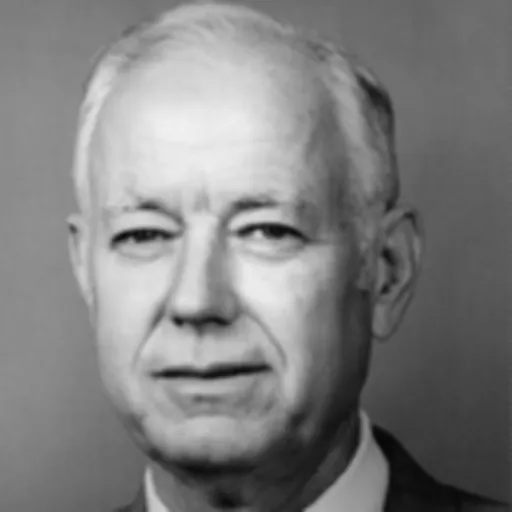
Woody Bledsoe
American mathematician and computer scientist
About Woody Bledsoe
Lived 1921 – 1995 (aged 73). Woody Bledsoe was an American mathematician, priest, computer scientist, engineer and artificial intelligence researcher.
Woodrow Wilson "Woody" Bledsoe (November 12, 1921 – October 4, 1995) was an American mathematician, computer scientist, and prominent educator. He is one of the founders of artificial intelligence (AI), making early contributions in pattern recognition, facial recognition, and automated theorem proving. He continued to make significant contributions to AI throughout his long career. One of his influences was Frank Rosenblatt.
Beginning in 1966, he worked at the department of mathematics and computer science of the University of Texas at Austin, holding the Peter O'Donnell Jr. Centennial Chair in Computing Science starting in 1987.
Bledsoe joined the Church of Jesus Christ of Latter-day Saints as an adult, and served in the church as a bishop, counselor to the stake presidency, and stake patriarch. He also served as a leader in the Boy Scouts of America. Bledsoe died on October 4, 1995, of amyotrophic lateral sclerosis, more commonly known as ALS or Lou Gehrig's disease.
Works The n-tuple method (1959) was an early method for learning a pattern recognition program. The basic method is illustrated by the problem of recognizing 36 alphanumerical characters (0-9, a-z).
Let the input be a 10x15 binary image. It is equivalent to a single string with 150 binary letters. Now, randomly partition the 150 binary pixels into 75 pairs. Each pair has 4 possibilities: 00, 01, 10, 11. Now we will define a 300x36 binary matrix as follows:
Let represent the 00-state of the first pair, and similarly for the others. We have 300 such states, each represented in a row. The 36 columns each correspond to one alphanumerical character. The entire binary matrix is arranged as follows: The pattern recognizer is defined by the binary matrix. It is trained by firstsetting all entries to zero, then it is presented with several binary images of each alphanumerical character. For each image, the corresponding entries in the matrix are set to one, and the other entries are unchanged. This is an example of machine learning.
After the training the recognizer, it can be used to recognize new images. First compute the new image's corresponding column vector, then take the dot-product with each column of the binary matrix. The column with the highest dot-product is outputted as the most likely character.
Don’t just read it —
keep it.
Full-length biographies made to live with: read them, listen on the way to work, watch them tonight.
- E-book
- Audio
- Video
Instant download · yours to keep · every purchase keeps this site free
Important facts
People in Woody Bledsoe's life
Named in this biography and alive at the same time




Related people
Same field, nearest in time

Contemporaries
People whose lives overlapped Woody Bledsoe's

Frequently asked questions
Who was Woody Bledsoe?
American mathematician and computer scientist (1921–1995)
When was Woody Bledsoe born?
Woody Bledsoe was born on 12 November 1921 in Maysville.
When did Woody Bledsoe die?
Woody Bledsoe died on 4 October 1995 in Texas.
What was Woody Bledsoe's occupation?
Woody Bledsoe was a mathematician, priest, computer scientist, engineer and artificial intelligence researcher.
What nationality was Woody Bledsoe?
Woody Bledsoe was American.
Sources & further reading
Cite this page
APA: Biography.guide. (2026). Woody Bledsoe. https://biography.guide/woody-bledsoe/
MLA: "Woody Bledsoe." Biography.guide, https://biography.guide/woody-bledsoe/.
Chicago: "Woody Bledsoe." Biography.guide. https://biography.guide/woody-bledsoe/.
Data last updated: 2026-09-22 · Spot an error? Report a correction.
Portrait: Wikimedia Commons · author & licence
Page generated 2026-09-27 05:02 UTC