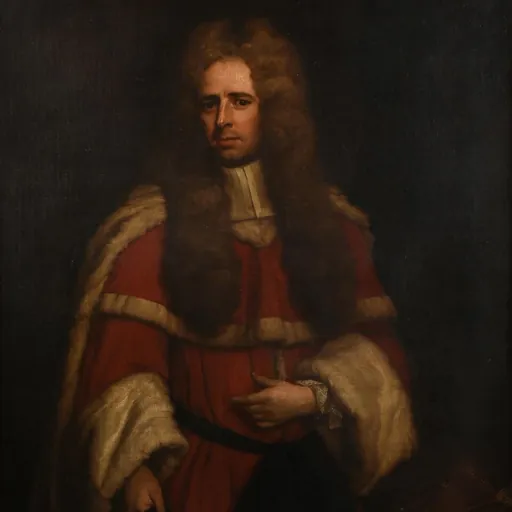
About William Whitshed
Lived 1679 – 1727 (aged 47–48). William Whitshed was a judge and politician.
William Whitshed (1679–1727) was an Irish politician and judge who held office as Solicitor-General and Lord Chief Justice of Ireland; just before his death he became Chief Justice of the Irish Common Pleas. He became the Member of Parliament for County Wicklow in 1703, and was appointed as Solicitor-General in 1709; he was Lord Chief Justice 1714–1727.
He is mainly remembered for the bitter hatred he inspired in Jonathan Swift, who among many other insults called him a "vile and profligate villain", and compared him to William Scroggs, the Lord Chief Justice of England in the 1670s, who was notorious for corruption. The principal cause for Swift's hatred of the judge was the trial of Edward Waters, Swift's publisher, for seditious libel, where Whitshed's conduct of the trial was widely condemned as improper, and Whitshed's unsuccessful efforts to have another publisher indicted for bringing out The Drapier Letters.
Background and early career
He was born in Dublin to a long-established family of Dublin merchants who also played a prominent part in politics; his father Thomas Whitshed (1645–1697) sat in the Irish House of Commons as member for Carysfort and was also a practising barrister. His mother was Mary Quin, daughter of Mark Quin, who became one of Dublin's richest citizens and was Lord Mayor of Dublin 1667–68, The younger James unsuccessfully claimed a share of the Quin fortune, but could not prove that his parents had been lawfully married.
In 1724, the Crown moved against Swift again, and again took an indirect route to their goal. John Harding, the printer of the Drapier Letters, was arrested and some efforts were made to formally identify and apprehend "Drapier" (although there was can have been little doubt in Government circles as to his real identity). Whitshed was pressed into service to persuade a grand jury to find that the Drapier Letters were seditious. This time the result was a complete failure: although Whitshed spared no efforts, interviewing the jurors individually, they refused to give a guilty verdict against Harding.
Swift, by now thoroughly enraged, attacked Whitshed in a series of verses, notably Verses Occasioned by Whitshed's motto on his Coach, with a venom that few judges have ever had to endure. Swift's friends joined the battle, and even painful personal details like the suicide of Whitshed's grandfather, and his grandmother's supposed adultery, were dragged up: "In church, your grandsire cut his throat... [your] grandame had gallants by the twenties, and bore your mother to a prentice". The Government, embarrassed by the whole affair and conscious that public opinion was on Swift's side, did little to protect the Chief Justice.
Last years Whitshed's hopes of becoming Lord Chancellor were never realised: his patron Archbishop King was steadily losing influence to Hugh Boulter, Archbishop of Armagh, who was not an admirer of Whitshed. Furthermore, the Swift affair had made him bitterly unpopular: it was admitted frankly in Government circles that it was impossible for a man so generally detested to be made Lord Chancellor.
In 1726, he asked to be transferred to the Court of Common Pleas, saying that the burden of his office was becoming too much for him as he aged. The following year it was decided to make him Chief Justice of the Irish Common Pleas, but he died suddenly, aged only 48, shortly afterwards. His early death was blamed by some of his friends on the toll taken on his constitution by the vicious personal attacks on him by Swift. Others blamed a lack of proper medical care, since no doctor attended him during his last illness, despite the seriousness of his condition. He was unmarried and had no children: his estate passed to his next surviving brother.
Assessment Ball notes that Whitshed as a young man was generally well-liked, although he became extremely unpopular in later life, even in Government circles. On the other hand, another legal historian, Bartholomew Duhigg, accused Whitshed of deciding cases on the basis of personal prejudice and malice, although he accepts that the judge did not take bribes and that his personal life was blameless.
Don’t just read it —
keep it.
Full-length biographies made to live with: read them, listen on the way to work, watch them tonight.
- E-book
- Audio
- Video
Instant download · yours to keep · every purchase keeps this site free
Important facts
People in William Whitshed's life
Named in this biography and alive at the same time

Related people
Same field, nearest in time



Contemporaries
People whose lives overlapped William Whitshed's


Frequently asked questions
Who was William Whitshed?
Irish politician
When was William Whitshed born?
William Whitshed was born in 1679.
When did William Whitshed die?
William Whitshed died in 1727.
What was William Whitshed's occupation?
William Whitshed was a judge and politician.
Sources & further reading
Cite this page
APA: Biography.guide. (2026). William Whitshed. https://biography.guide/william-whitshed/
MLA: "William Whitshed." Biography.guide, https://biography.guide/william-whitshed/.
Chicago: "William Whitshed." Biography.guide. https://biography.guide/william-whitshed/.
Data last updated: 2026-09-22 · Spot an error? Report a correction.
Portrait: Wikimedia Commons · author & licence
Page generated 2026-09-27 05:03 UTC