
About Hugh Boulter
Lived 1672 – 1742 (aged 70). Hugh Boulter was a British anglican priest and writer.
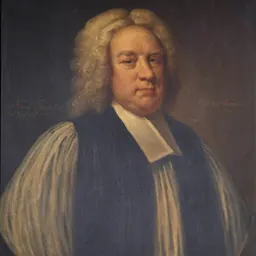
Career Hugh Boulter, mezzotint by John Brooks after Francis Bindon. After leaving the university in 1700 Boulter served as a chaplain to several prominent individuals, including Sir Charles Hedges, the Secretary of State for the North, and Thomas Tenison, the Archbishop of Canterbury, before being awarded his D.D. in 1708.
After spending seven years working as a rector, Boulter was appointed as the archdeacon of Surrey in 1715. In 1719 Boulter was announced as the successor to George Smalridge as both the Dean of Christ Church and as the Bishop of Bristol. Boulter was controversially offered the primacy of the Church of Ireland in 1724, William King, who as Archbishop of Dublin was the natural successor to the title, being passed over due to his opposition to the Toleration Act, although the official reason was his age. King showed his bitter disappointment at being passed over by refusing to stand in Boulter's presence. As Archbishop of Armagh Boulter was a keen supporter of the so-called English interest, and supported the policy of filling all top judicial, political, and ecclesiastical posts in Ireland with Englishmen in order to maintain English power in the country, a position that made him unpopular in Ireland. As Archbishop of Armagh, Boulter served as one of the Lord Justices eight times between 1726 and 1742.
He did not always get his own way on judicial appointments: the Dublin-born John Rogerson (1676-1741) was made Lord Chief Justice of Ireland in 1727, over strong objections from Boulter, who apart from the question of nationality, disliked him personally. His failure to veto the appointment has been explained by the fact that no English judge was willing to take the position (in addition Richardson was a very rich man, and no doubt supplied financial inducements).
His policy was to leave the Roman Catholics in Ireland subjected to penal legislation. By a statute enacted through Boulter's influence, Catholics were excluded from the legal profession and disqualified from holding offices connected with the administration of law. Under another act passed through Boulter's exertions, they were deprived of the right of voting at elections for members of parliament or magistrates—the sole constitutional right which they had been allowed to exercise. He supported the setting up of the charter school system, "to teach the children of the papists the English tongue, and the principles of the Christian religion", as long as they converted to Protestantism. In 1731 George II was petitioned for a charter to set up these schools, which was granted in 1733. Boulter contributed £400 towards the construction of a charter school for girls at Santry, Dublin.
He was responsible for forcing through a bill that revalued the price of gold in 1738, to the benefit of the poor.
Arms
Don’t just read it —
keep it.
Full-length biographies made to live with: read them, listen on the way to work, watch them tonight.
- E-book
- Audio
- Video
Instant download · yours to keep · every purchase keeps this site free
Important facts
People in Hugh Boulter's life
Named in this biography and alive at the same time




Related people
Same field, nearest in time


Contemporaries
People whose lives overlapped Hugh Boulter's



Frequently asked questions
Who was Hugh Boulter?
Anglican bishop (1672-1742)
When was Hugh Boulter born?
Hugh Boulter was born on 4 January 1672 in London.
When did Hugh Boulter die?
Hugh Boulter died on 27 September 1742 in London.
What was Hugh Boulter's occupation?
Hugh Boulter was an anglican priest and writer.
What nationality was Hugh Boulter?
Hugh Boulter was British.
Sources & further reading
Cite this page
APA: Biography.guide. (2026). Hugh Boulter. https://biography.guide/hugh-boulter/
MLA: "Hugh Boulter." Biography.guide, https://biography.guide/hugh-boulter/.
Chicago: "Hugh Boulter." Biography.guide. https://biography.guide/hugh-boulter/.
Data last updated: 2026-09-20 · Spot an error? Report a correction.
Page generated 2026-09-27 05:33 UTC