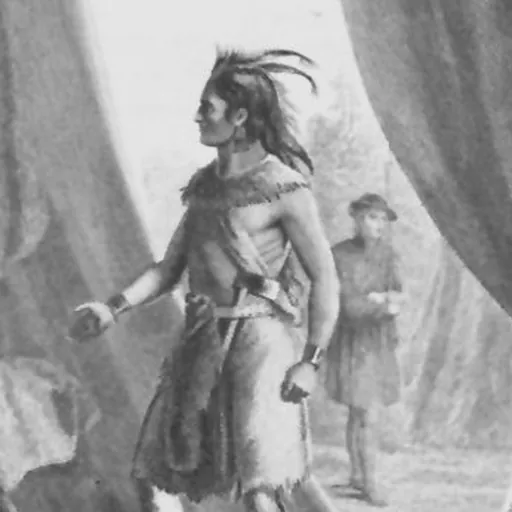
William Weatherford
Native American chief
About William Weatherford
Lived 1781 – 1824 (aged 42–43). William Weatherford was a traditional leader or chief.
William Weatherford, also known after his death as Red Eagle ( – March 24, 1824), was a Creek warrior of the Upper Creek towns who led many of the Red Sticks actions in the Creek War (1813–1814) against Lower Creek towns and against allied forces of the United States.
One of many mixed-race descendants of Southeast Indians who intermarried with European traders and later colonial settlers, William Weatherford was of mixed Creek, French, and Scots ancestry. He was raised as a Creek in the matrilineal nation and achieved his power in it, through his mother's prominent Wind Clan (as well as his father's trading connections). After the war, he rebuilt his wealth as a slaveholding planter in lower Monroe County, Alabama.
Early life and education William Weatherford was born in 1781 (Griffith Jr. analysis), near the Upper Creek towns of Cusseta. It is near the current Cusseta, Georgia, and was then a Koasati Indian town, near Hickory Ground (current Wetumpka, Alabama). His mother was Sehoy III, a "daughter of a Tabacha chieftain" and from "the most powerful and privileged of all the Creek clans," the Wind Clan ). His father, Charles Weatherford, was a red-haired Scots trader and friend of the chieftain, and had married Sehoy III after the death of her first husband, Tory Col. John Tate, in the summer of 1780. Charles Weatherford had a trading post near the Creek village, built a plantation, raised thoroughbred horses for racing, and contributed to his family as a trader.
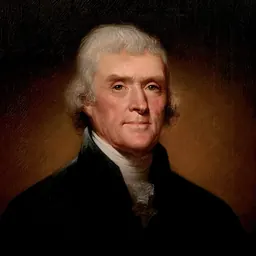
Benjamin Hawkins, first appointed as United States Indian agent in the Southeast and then as Superintendent of Indian Affairs in the territory south of the Ohio River, lived among the Creek and Choctaw, and knew them well. He commented in letters to President Thomas Jefferson that Creek women were matriarchs and had control of the children "when connected with a white man." Weatherford surrendered at Fort Jackson (formerly Fort Toulouse). Jackson spared Weatherford's life and used his influence and knowledge of Creek language to bring the other Upper Creek chiefs to a peace conference.
Weatherford negotiated a new peace through a new treaty with the US; although he had to accept a permanent reduction in Creek territory, he gained retention of most of their territory, including areas where they had homes. Weatherford subsequently moved to the southern part of Monroe County, Alabama, where he rebuilt his wealth as a planter. He died there in 1824. A decade later, the US forced removal of most of the Creek and other Indians from the Southeast to west of the Mississippi River in Indian Territory (now Kansas and Oklahoma).
Marriage and family
William Weatherford married Mary Moniac ( – 1804), who was also of mixed race. They had two children, Charles and Mary (Polly) Weatherford. After Mary's death, Weatherford married Sopethlina Kaney Thelotco Moniac ( – 1813). She died after the birth of their son, William Weatherford, Jr., born 25 December 1813. About 1817, Weatherford married Mary Stiggins (–1832), who was of Natchez and English heritage. They also had children, Alexander McGillivray Weatherford, Mary Levitia Weatherford, Major Weatherford, and John Weatherford.
Weatherford's nephew, David Moniac, son of his sister Elizabeth Weatherford, was the first Native American graduate of the United States Military Academy.
William Weatherford may have been a blood relative of the Shawnee Tecumseh and Tenskwatawa whose mother and father were of Creek and Shawnee lineages. Their relationship may have been the foundation of the strong alliance between Chief Red Eagle and Chief Tecumseh during the Indian Wars.
Don’t just read it —
keep it.
Full-length biographies made to live with: read them, listen on the way to work, watch them tonight.
- E-book
- Audio
- Video
Instant download · yours to keep · every purchase keeps this site free
Important facts
People in William Weatherford's life
Named in this biography and alive at the same time


Related people
Same field, nearest in time


Contemporaries
People whose lives overlapped William Weatherford's




Frequently asked questions
Who was William Weatherford?
Native American chief
When was William Weatherford born?
William Weatherford was born in 1781.
When did William Weatherford die?
William Weatherford died on 24 March 1824.
What was William Weatherford's occupation?
William Weatherford was a traditional leader or chief.
Sources & further reading
· Wikipedia: William Weatherford
· DBpedia: William Weatherford
Cite this page
APA: Biography.guide. (2026). William Weatherford. https://biography.guide/william-weatherford-traditional-leader-or-chief/
MLA: "William Weatherford." Biography.guide, https://biography.guide/william-weatherford-traditional-leader-or-chief/.
Chicago: "William Weatherford." Biography.guide. https://biography.guide/william-weatherford-traditional-leader-or-chief/.
Data last updated: 2026-09-20 · Spot an error? Report a correction.
Portrait: Wikimedia Commons · author & licence
Page generated 2026-09-27 04:58 UTC