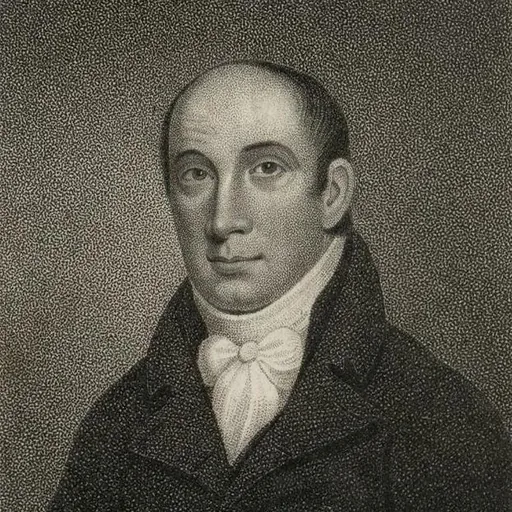
William Ward
English pioneer Baptist missionary, author, printer and translator
About William Ward
Lived 1769 – 1823 (aged 53). William Ward was a British translator, bible translator, missionary, writer and printer.
William Ward (20 October 1769 – 7 March 1823) was an English Baptist missionary, author, printer and translator.
Early life Ward was born at Derby on 20 October 1769, and was the son of John Ward, a carpenter and builder of that town, and grandson of Thomas Ward, a farmer at Stretton, near Burton upon Trent in Staffordshire. His father died while he was a child, and the care of his upbringing fell to his mother. He was placed with a schoolmaster named Congreve, near Derby, and afterwards with another named Breary.
On leaving school he was apprenticed to a Derby printer and bookseller John Drewry (1732-1794), with whom he continued two years after the expiration of his indentures, assisting him to edit the Derby Mercury. In 1793, Ward moved to London to study typesetting before relocating once again to Stafford, where he assisted Joshua Drewry, a nephew of his former master, to edit the Staffordshire Advertiser from its prospectus in late 1794 to the fall of 1795. At the end of 1795, Ward proceeded to Hull, where the Rawson printing firm employed him to focus solely upon improving their infant newspaper, the Hull Advertiser. Ward continued to edit the Hull Advertiser through the summer of 1797 before leaving for his own ministerial studies.
Ward was involved with local and national sociopolitical campaigns for the abolition of the slave trade, pacificism, and parliamentary reform. Contrary to most secondary sources on his life, Ward was not involved in the Thelwall riot in Derby on March 6, 1797.
Religion Ward early in life became a Baptist, and on 28 August 1796 he was baptised at Hull.
Death Ward died of cholera at Serampore on 7 March 1823, 'Account of the Writings, Religion, and Manners of the Hindoos,' Serampúr, 1811, 4 vols. 4to; 5th edit., abridged, Madras, 1863, 8vo. 'Farewell Letters in Britain and America on returning to Bengal in 1821,' London, 1821, 12mo; 2nd edit. 1821. 'Brief Memoir of Krishna-Pal, the first Hindoo, in Bengal, who broke the Chain of the Cast by embracing the Gospel;' 2nd edit., London, 1823, 12mo.
He was also the author of several hymns, sonnets and short poems which were printed as an appendix to a memoir of him by Samuel Stennett. A portrait, engraved by R. Baker from a painting by Overton, is prefixed to the same work.
Don’t just read it —
keep it.
Full-length biographies made to live with: read them, listen on the way to work, watch them tonight.
- E-book
- Audio
- Video
Instant download · yours to keep · every purchase keeps this site free
Important facts
People in William Ward's life
Named in this biography and alive at the same time
Related people
Same field, nearest in time



Contemporaries
People whose lives overlapped William Ward's




Frequently asked questions
Who was William Ward?
English pioneer Baptist missionary, author, printer and translator
When was William Ward born?
William Ward was born on 20 October 1769 in Derby.
When did William Ward die?
William Ward died on 7 March 1823 in Serampore.
What was William Ward's occupation?
William Ward was a translator, bible translator, missionary, writer and printer.
What nationality was William Ward?
William Ward was British.
Sources & further reading
· DBpedia: William Ward (missionary)
Cite this page
APA: Biography.guide. (2026). William Ward. https://biography.guide/william-ward/
MLA: "William Ward." Biography.guide, https://biography.guide/william-ward/.
Chicago: "William Ward." Biography.guide. https://biography.guide/william-ward/.
Data last updated: 2026-09-24 · Spot an error? Report a correction.
Portrait: Wikimedia Commons · author & licence
Page generated 2026-09-27 05:09 UTC