
William Vermillion Houston
American physicist
About William Vermillion Houston
Lived 1900 – 1968 (aged 68). William Vermillion Houston was an American physicist, science administrator, university teacher and university president.
William Vermillion Houston ( ; January 19, 1900 – August 22, 1968) was an American physicist who made contributions to spectroscopy, quantum mechanics, and solid-state physics as well as being a teacher and administrator. He became the second president of Rice University in 1946.
Education
Houston began his college education in 1916 at Ohio State University (OSU) where he earned his baccalaureate degree in physics. He served in the military during 1918 and 1919. After teaching physics at the University of Dubuque for one year, he entered graduate studies at the University of Chicago and studied under Albert A. Michelson, who had won the Nobel Prize in Physics in 1907, and Robert Millikan who would win the Nobel Prize in Physics in 1923 for his measurement of the charge on the electron and for his work on the photoelectric effect. It was at this time that Houston began his experimental work on the fine structure of hydrogen and was awarded an M.S. in 1922. In 1922, he returned to Ohio State, where he was an instructor in physics and studied spectroscopy under A. D. Cole. Houston was granted his Ph.D. in 1925, after which he went to the California Institute of Technology (Caltech) on a National Research Fellowship, largely because Millikan had left Chicago for Caltech in 1922. At Caltech Houston continued his work in spectroscopy and making improvements in Fabry–Pérot interferometry. At Caltech, he taught a spectroscopy course out of Atombau und Spektrallinien, which became the "bible" of atomic theory for the new generation of physicists who developed atomic and quantum physics. In 1927 and 1928, Houston was awarded a Guggenheim Fellowship, which he used to go to Germany to do postgraduate study with Arnold Sommerfeld at the Ludwig-Maximilians-Universität München and Werner Heisenberg at Leipzig University. Also studying with Sommerfeld concurrently with Houston were Carl Eckart, Edwin C. Kemble, and Rudolf Peierls. At that time, the winter semester of 1927, Sommerfeld, in his special lectures, treated the theory of electrons in metals for the first time. As a course of study, Sommerfeld suggested to Houston that he investigate the mean free path of electrons and its relationship to resistance in metals as a function of temperature. Sommerfeld showed Houston the proof of a paper soon be published on the subject of Fermi statistics applied to phenomena in metals. Houston's and Eckart's works on the subject were published in the papers following Sommerfeld's article. After spending the winter semester of 1927 with Sommerfeld, Houston went to spend the spring semester of 1928 with Heisenberg in Leipzig. There, he studied the spin-orbit interaction in two-electron spectra. Houston was able to show the transition from Russell-Saunders coupling to jj-coupling in two-electron systems and its influence on the Zeeman effect. It was at this time that Houston formed a professional and personal friendship with Felix Bloch, who did pioneer work on the motion of electrons in periodic structures.
Career
After his study and research in Germany, Houston returned to Caltech and served as an assistant professor (1927–1929), associate professor (1929–1931), and professor (1931–1946).
In 1953, Houston wrote a review of Sommerfeld's first volume of the six-volume Lectures on Theoretical Physics, based on Sommerfeld's six-semester course on theoretical physics.
Houston was productive until the day he died in Edinburgh, Scotland on August 22, 1968. He was survived by his wife, Mildred née White, whom he married in 1924.
Textbooks William V. Houston Principles of Mathematical Physics (McGraw-Hill, 1934 and 1948) William V. Houston Principles of Quantum Mechanics (McGraw-Hill, 1951) William V. Houston Principles of Quantum Mechanics, Non-relativistic Wave Mechanics with Illustrative Applications (Dover, 1959)
Professional Organizations American Physical Society and serving as president in 1962 American Philosophical Society
Honors 1943 – Elected to the National Academy of Sciences with service on the Council (1959–1962) Board member of the Carnegie Foundation Elected as Fellow of the American Academy of Arts and Sciences Navy Medal of Merit presented by the Secretary of the Navy for services during World War II Presidential appointment to the board of the National Science Foundation 1962 – Rice University Medal of Honor
Selected publications W. V. Houston, "Acceleration of Electrons in a Crystal Lattice", Phys. Rev. 57, 184 (1940) W. V. Houston, "Die Elektronenemission kalter Metalle", Zeits. f. Physik 47, 33–37 (1928) W. V. Houston, "The Physical Content of Quantum Mechanics," 5 (2), 49–55 (1937). Paper cited in Robert H. Romer "Editorial: Memorable papers from the American Journal of Physics, 1933–1990", "Am. J. Phys." 59 (3), 201–207, March 1991
Don’t just read it —
keep it.
Full-length biographies made to live with: read them, listen on the way to work, watch them tonight.
- E-book
- Audio
- Video
Instant download · yours to keep · every purchase keeps this site free
Important facts
People in William Vermillion Houston's life
Named in this biography and alive at the same time

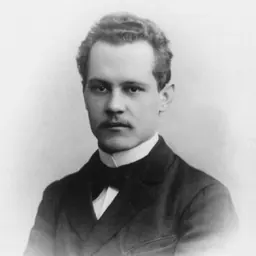
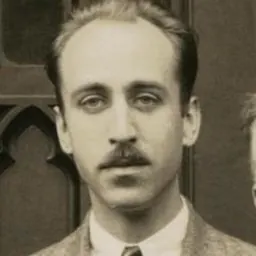
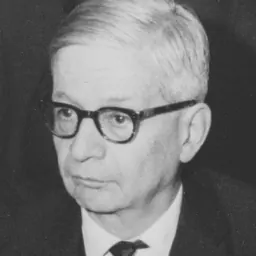
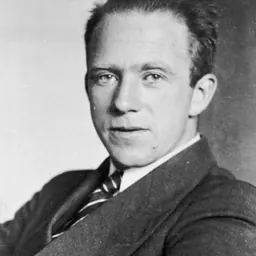
Related people
Same field, nearest in time

Contemporaries
People whose lives overlapped William Vermillion Houston's




Frequently asked questions
Who was William Vermillion Houston?
American physicist (1900–1968)
When was William Vermillion Houston born?
William Vermillion Houston was born on 19 January 1900 in Mount Gilead.
When did William Vermillion Houston die?
William Vermillion Houston died on 22 August 1968 in Edinburgh.
What was William Vermillion Houston's occupation?
William Vermillion Houston was a physicist, science administrator, university teacher and university president.
What nationality was William Vermillion Houston?
William Vermillion Houston was American.
Sources & further reading
· Wikipedia: William Vermillion Houston
Cite this page
APA: Biography.guide. (2026). William Vermillion Houston. https://biography.guide/william-vermillion-houston/
MLA: "William Vermillion Houston." Biography.guide, https://biography.guide/william-vermillion-houston/.
Chicago: "William Vermillion Houston." Biography.guide. https://biography.guide/william-vermillion-houston/.
Data last updated: 2026-09-20 · Spot an error? Report a correction.
Page generated 2026-09-27 05:29 UTC