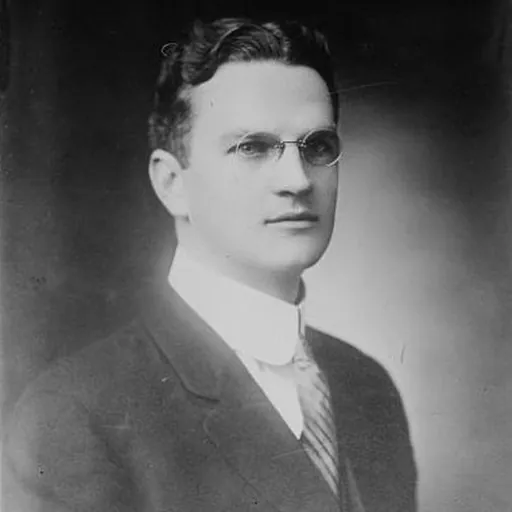
About William Trufant Foster
Lived 1879 – 1950 (aged 71). William Trufant Foster was an American economist and university teacher.
William Trufant Foster (January 18, 1879 – October 8, 1950) was an American educator and economist, whose theories were especially influential in the 1920s. He was the first president of Reed College.
Early life and education Foster was born in Boston, Massachusetts, on January 18, 1879. He attended Roxbury High School in Boston. He graduated from Harvard University with an A.B. in 1901 and an A.M. in 1904.
His conception of "the ideal college" set out in the concluding chapter of his dissertation, led to his appointment as the first president of Reed College. He served from 1911 to 1919. He rejected intercollegiate sports and Greek life in favor of an intense academic education. He fostered close intellectual collaboration between faculty and students. He treated undergraduates as if they were graduate students and created a system of small seminars, comprehensive examinations, undergraduate research, and senior theses.
He was director of the Pollak Foundation of Economic Research from 1920 to 1950, in Newton, Massachusetts, where he emphasized the need to protect consumer interests.
Economics He collaborated with his Harvard classmate Waddill Catchings in a series of economics books that were highly influential in the United States in the 1920s. His influential books, written with Catchings, were Money (1923), Profits (1925), Business Without a Buyer (1927), The Road to Plenty (1928), and Progress and Plenty (1930).
With Catchings, he was one of the leading pre-Keynesian economists, in the underconsumptionist tradition, advocating similar issues to Keynes such as the paradox of thrift and economic interventionism. The two are now rarely mentioned in contemporary economics texts, standing as they do in the shadow of Keynes's The General Theory.
Foster and Catchings rejected traditional laissez-faire economics and called for aggressive federal involvement to balance the economy lest destabilizing forces upset prosperity. The main problem was underconsumption, which could be overcome by strategic government spending in public works. The theory strongly influenced the anti-depression programs of Herbert Hoover, Franklin D. Roosevelt, and Federal Reserve Board Chairman Marriner Eccles.
Don’t just read it —
keep it.
Full-length biographies made to live with: read them, listen on the way to work, watch them tonight.
- E-book
- Audio
- Video
Instant download · yours to keep · every purchase keeps this site free
Important facts
People in William Trufant Foster's life
Named in this biography and alive at the same time

Related people
Same field, nearest in time


Contemporaries
People whose lives overlapped William Trufant Foster's


Frequently asked questions
Who was William Trufant Foster?
American economist
When was William Trufant Foster born?
William Trufant Foster was born on 18 January 1879.
When did William Trufant Foster die?
William Trufant Foster died on 8 October 1950.
What was William Trufant Foster's occupation?
William Trufant Foster was an economist and university teacher.
What nationality was William Trufant Foster?
William Trufant Foster was American.
Sources & further reading
· Wikipedia: William Trufant Foster
· DBpedia: William Trufant Foster
Cite this page
APA: Biography.guide. (2026). William Trufant Foster. https://biography.guide/william-trufant-foster/
MLA: "William Trufant Foster." Biography.guide, https://biography.guide/william-trufant-foster/.
Chicago: "William Trufant Foster." Biography.guide. https://biography.guide/william-trufant-foster/.
Data last updated: 2026-09-20 · Spot an error? Report a correction.
Page generated 2026-09-27 05:10 UTC